Agreed, but I suspect there is a lot of pent up demand from their "old" customer base. GTA 6 is out soon.I think it's generally accepted that Nvidia is an AI play at this stage.
You are using an out of date browser. It may not display this or other websites correctly.
You should upgrade or use an alternative browser.
You should upgrade or use an alternative browser.
Performance Update for Colm Fagan's ARF
- Thread starter Colm Fagan
- Start date
Colm Fagan
Registered User
- Messages
- 998
My mother retired in 1975, after more than 40 years as a teacher, on a defined benefit pension of half her salary. On her death 21 years later, in 1996, her pension was well more than double its starting amount. That’s because her employer, the state, recognised that its promise to her included providing some protection against inflation. And well it might: inflation in 1975, the year she retired, topped 20%.
I retired 35 years after her, at end 2010, on a pension that was entirely defined contribution, yet I have enjoyed even better inflation protection than my mother. Already, less than sixteen years into retirement and in a far more benign inflation environment, my pension is more than double its starting amount. (See “The Magic Porridge Pot" post above https://www.askaboutmoney.com/threa...r-colm-fagans-arf.234034/page-33#post-2014535 ). Also, I can reasonably expect that future increases will more than match inflation for however long I live.
That's because I recognised from the start that my need in retirement was for a real income, not one fixed in nominal terms whose real value would be eroded year by year by inflation, so I invested all in equities, which can be expected to keep their value in real terms in the long-term as well as delivering a good real income along the way.
The losers in all this are retired members of (most) private sector defined benefit schemes, whose assets are invested primarily or exclusively in fixed interest bonds, either directly or through annuities that the scheme trustees bought from life assurance companies. Their incomes in retirement are either fixed in nominal terms or have limited inflation protection. (There are occasional, honourable exceptions.)
In a previous post, I asked for answers on how the actuarial profession allowed itself to be bamboozled/ browbeaten into agreeing that bonds were the best matching assets for defined benefit pensions in the private sector. No-one rose to the challenge on LinkedIn (one person on AAM did), so I’ll make my own suggestions.
As a non-expert (I’m an actuary by profession, but from a life assurance rather than a pensions background; furthermore, I retired many years ago), I think it was due to a combination of pressure from regulators and accounting standard setters and intellectual browbeating by financial economists. My reading is that the latter group persuaded the profession that the Equity Risk Premium (ERP) is a fiction, that €100 in bonds is worth the same as €100 in equities. Yes , it is, but that’s an average for very different investors. Pension investors and their advisers should look to the long-term. It is reasonable for them to anticipate the ERP, which is very real, when estimating the pension that can be afforded by investing backing assets in equities, while recognising the short-term risks, of course.

I retired 35 years after her, at end 2010, on a pension that was entirely defined contribution, yet I have enjoyed even better inflation protection than my mother. Already, less than sixteen years into retirement and in a far more benign inflation environment, my pension is more than double its starting amount. (See “The Magic Porridge Pot" post above https://www.askaboutmoney.com/threa...r-colm-fagans-arf.234034/page-33#post-2014535 ). Also, I can reasonably expect that future increases will more than match inflation for however long I live.
That's because I recognised from the start that my need in retirement was for a real income, not one fixed in nominal terms whose real value would be eroded year by year by inflation, so I invested all in equities, which can be expected to keep their value in real terms in the long-term as well as delivering a good real income along the way.
The losers in all this are retired members of (most) private sector defined benefit schemes, whose assets are invested primarily or exclusively in fixed interest bonds, either directly or through annuities that the scheme trustees bought from life assurance companies. Their incomes in retirement are either fixed in nominal terms or have limited inflation protection. (There are occasional, honourable exceptions.)
In a previous post, I asked for answers on how the actuarial profession allowed itself to be bamboozled/ browbeaten into agreeing that bonds were the best matching assets for defined benefit pensions in the private sector. No-one rose to the challenge on LinkedIn (one person on AAM did), so I’ll make my own suggestions.
As a non-expert (I’m an actuary by profession, but from a life assurance rather than a pensions background; furthermore, I retired many years ago), I think it was due to a combination of pressure from regulators and accounting standard setters and intellectual browbeating by financial economists. My reading is that the latter group persuaded the profession that the Equity Risk Premium (ERP) is a fiction, that €100 in bonds is worth the same as €100 in equities. Yes , it is, but that’s an average for very different investors. Pension investors and their advisers should look to the long-term. It is reasonable for them to anticipate the ERP, which is very real, when estimating the pension that can be afforded by investing backing assets in equities, while recognising the short-term risks, of course.
Last edited:
Gentle reminder on how to link to posts correctly for ease of thread navigation.See “The Magic Porridge Pot”, #645 above
How to reply to or quote a post
To reply to a post, you just start typing in box below the post and then press Post Reply.
www.askaboutmoney.com
Colm Fagan
Registered User
- Messages
- 998
Nearretiree
New Member
- Messages
- 5
Colm
Some people might consider the fact that your pension fund has grown since your retirement a kind of failure in itself. What's a pension fund for but to finance consumption in retirement?
This is not unusual. It's the subject of an article in the Atlantic magazine.
It has a US focus but the theme is universal.
We have known for a quite a while now that retirees who have a predictible income in retirement tend to spend more that those who rely on a pension pot.
Perhaps your mother and those who planned her pension were on to something.
PS For some reason I cannot link to the article but it is in the October issue and is available free on line.
Some people might consider the fact that your pension fund has grown since your retirement a kind of failure in itself. What's a pension fund for but to finance consumption in retirement?
This is not unusual. It's the subject of an article in the Atlantic magazine.
It has a US focus but the theme is universal.
We have known for a quite a while now that retirees who have a predictible income in retirement tend to spend more that those who rely on a pension pot.
Perhaps your mother and those who planned her pension were on to something.
PS For some reason I cannot link to the article but it is in the October issue and is available free on line.
NotMyRealName
Registered User
- Messages
- 227
Here's the link, but you'll need to sign up to read more than the opening paragraph....at least in my case anyway.
Like it or not some people may also see it as a (possibly tax efficient) way of facilitating intergenerational wealth transfer.What's a pension fund for but to finance consumption in retirement?
Plus even if someone's pension continues to grow in retirement today doesn't mean that they necessarily should lead a more lavish lifestyle just because they can.
Some people might consider the fact that your pension fund has grown since your retirement a kind of failure in itself.
If we hit a recession and Colm's fund shrunk, would that turn the failure into success in these peoples' minds?
Nearretiree
New Member
- Messages
- 5
Retirement under consumption can have serious conquences.
The above referenced article has a link to an acedemic study of the Chilean retirement system. I cannot link to it but you can find it if you search for "Annuties and the effect on longevity".
The above referenced article has a link to an acedemic study of the Chilean retirement system. I cannot link to it but you can find it if you search for "Annuties and the effect on longevity".
Colm Fagan
Registered User
- Messages
- 998
I agree! The problem is that, under the Irish tax system, I'd be a fool to take more than 6% a year from my pension fund. Anything I take from the fund is taxed at 40% while it's 'only' taxed at 30% if it's still there when I die.Colm
Some people might consider the fact that your pension fund has grown since your retirement a kind of failure in itself. What's a pension fund for but to finance consumption in retirement?
In practice, I am working on a plan to get rid of practically everything by the time I cock my clogs.
I consider my pension and other assets in total (but ignoring the family home). I have a spreadsheet that assumes I live to age X (say 90). I project future investment returns to that date on cautious assumptions, and also future regular outgo, increasing with inflation, with the amount of the regular outgo obtained by reference to the target as below.
The target to leave €Y in total (between pension fund and other assets) at age X, which can be used to pay for me in a nursing home for the rest of my days. (If I'm dead by then, it can be added to my estate). I must also consider the other half.
That spreadsheet is updated every few months, having regard to actual expenditure and investment returns. I also work on smoothed asset values rather than market values, to avoid sudden changes in affordable expenditure. The smoothing formula is similar to, but not exactly the same as, the one shown in the pensions tab of my website colmfagan.ie. The latest version is at the entry dated 1/10/2026.
For the reasons given at the start, I take 6% a year from the pension fund, as required under Irish tax legislation. Anything in excess of that (and I nearly always take in excess of that!!) comes from the non-exempt assets.
Last edited:
Don't forget your friends here on Askaboutmoney...In practice, I am working on a plan to get rid of practically everything by the time I cock my clogs.

Why?I consider my pension and other assets in total (but ignoring the family home).
Key Post - Should your home be considered an investment diversification?
I question the idea that your home is an asset in an investment portfolio. Are your legs also an asset? Diversification means that if one asset falls maybe another will do well. Your home may rise in value but you still have to live in it. If you want to think of it as an asset then think of...
www.askaboutmoney.com
Colm Fagan
Registered User
- Messages
- 998
Quite a few reasons.Why?
a I have no intention of trading down.
b I don't fancy getting a life loan on it.
c I don't have a clue what it's worth, other than a very ballpark figure. It's not worth paying an estate agent to put an approximate value on it, especially in the light of a and b above.
d The family - children and grandchildren - have a "reasonable expectation" that the house will form part of our estate when we die.
Colm Fagan
Registered User
- Messages
- 998
I'm getting nervous about the stock market. That leaves me with a dilemma.
What does someone with an avowed strategy of investing 100% in equities do when they get nervous about the market? Do I ditch the strategy, taking a leaf from the advice book of a former boss who once opined that consistency is the last refuge of small minds? **
Not quite yet.
My first line of defence was to exchange some ‘growth’ shares for stodgier ‘income’ ones. Earlier this week, I sold my entire holding in Halma plc, a UK services company. It accounted for 4% of my pension and was on a racy multiple of 31 times adjusted historic earnings. I sold on Tuesday last, 13 October, at £35.36 a share. That compares with an average £29.65 when I bought the shares in May/June 2025. I did OK, but I missed a trick: the price hit £49 earlier this year. If only I’d sold then ….
On the face of it, Halma’s high multiple was well justified: earnings per share grew by an average of more than 12% a year for the last ten years and management expects strong growth to continue in future; however, what they call their ‘sustainable growth model’ depends heavily on acquisitions, and goodwill is a significant asset on the balance sheet. Those two features made me more nervous at this nervous time, so I decided to sell.
I invested the proceeds in two of my my old reliables, Standard Life and Legal & General, because I believe that they’ll still deliver, even if markets wobble. They're also my 'home' territory.
I had only recently reduced my holding in Standard Life, so it seemed perverse to reverse course so quickly, but I took comfort from the fact that I was buying back at a cheaper price (867p) than my most recent sale (923p in August).
The number of holdings in my pension portfolio is now down to eleven. That’s because I reinvested the proceeds from the AerCap sale (https://www.askaboutmoney.com/threa...r-colm-fagans-arf.234034/page-32#post-2013935) in Goodwin plc, which some would see as a most unlikely defensive stock, given my past disasters with this company (https://www.askaboutmoney.com/threads/performance-update-for-colm-fagans-arf.234034/post-1999656); however, I decided that Goodwin now has little downside: it has agreed to sell the major part of its business for a price that equates to almost the current price of the share, so current shareholders are left with the rest of the business for practically nothing (barring a complication of the company being liable to tax on the gain; I don’t know its impact).
A natural question is: why didn’t I reduce my exposure to Nvidia? The answer is that I’m still comfortable with my analysis of a few months ago (https://www.askaboutmoney.com/threa...r-colm-fagans-arf.234034/page-30#post-2011130), so I’m happy to hold on to what I have, although Nvidia is back down to number 2, because of the Standard Life purchase and recent weakness in Nvidia’s share price.
** Google tells me that "Consistency is the hobgoblin of little minds" is correct. My boss probably realised that 'hobgoblin' was too erudite a word for me!!
What does someone with an avowed strategy of investing 100% in equities do when they get nervous about the market? Do I ditch the strategy, taking a leaf from the advice book of a former boss who once opined that consistency is the last refuge of small minds? **
Not quite yet.
My first line of defence was to exchange some ‘growth’ shares for stodgier ‘income’ ones. Earlier this week, I sold my entire holding in Halma plc, a UK services company. It accounted for 4% of my pension and was on a racy multiple of 31 times adjusted historic earnings. I sold on Tuesday last, 13 October, at £35.36 a share. That compares with an average £29.65 when I bought the shares in May/June 2025. I did OK, but I missed a trick: the price hit £49 earlier this year. If only I’d sold then ….
On the face of it, Halma’s high multiple was well justified: earnings per share grew by an average of more than 12% a year for the last ten years and management expects strong growth to continue in future; however, what they call their ‘sustainable growth model’ depends heavily on acquisitions, and goodwill is a significant asset on the balance sheet. Those two features made me more nervous at this nervous time, so I decided to sell.
I invested the proceeds in two of my my old reliables, Standard Life and Legal & General, because I believe that they’ll still deliver, even if markets wobble. They're also my 'home' territory.
I had only recently reduced my holding in Standard Life, so it seemed perverse to reverse course so quickly, but I took comfort from the fact that I was buying back at a cheaper price (867p) than my most recent sale (923p in August).
The number of holdings in my pension portfolio is now down to eleven. That’s because I reinvested the proceeds from the AerCap sale (https://www.askaboutmoney.com/threa...r-colm-fagans-arf.234034/page-32#post-2013935) in Goodwin plc, which some would see as a most unlikely defensive stock, given my past disasters with this company (https://www.askaboutmoney.com/threads/performance-update-for-colm-fagans-arf.234034/post-1999656); however, I decided that Goodwin now has little downside: it has agreed to sell the major part of its business for a price that equates to almost the current price of the share, so current shareholders are left with the rest of the business for practically nothing (barring a complication of the company being liable to tax on the gain; I don’t know its impact).
A natural question is: why didn’t I reduce my exposure to Nvidia? The answer is that I’m still comfortable with my analysis of a few months ago (https://www.askaboutmoney.com/threa...r-colm-fagans-arf.234034/page-30#post-2011130), so I’m happy to hold on to what I have, although Nvidia is back down to number 2, because of the Standard Life purchase and recent weakness in Nvidia’s share price.
** Google tells me that "Consistency is the hobgoblin of little minds" is correct. My boss probably realised that 'hobgoblin' was too erudite a word for me!!
Last edited:
I sold on Tuesday last, 13 October, at £35.36 a share.
What about £/€ forex fluctuations in the meantime?but I took comfort from the fact that I was buying back at a cheaper price (867p) than my most recent sale (923p in August).
Bear in mind that Nvidia are at risk of other AI compute developers such as Google, Amazon, Microsoft, Meta, Huawei, various startups etc. coming up with the goods imminently and eating some of their lunch.A natural question is: why didn’t I reduce my exposure to Nvidia? The answer is that I’m still comfortable with my analysis of a few months ago, so I’m happy to hold on to what I have
Colm Fagan
Registered User
- Messages
- 998
Generally, they don't matter much. I tend to replace sales in a particular currency with purchases in the same currency. As I recall, that's what happened here.What about £/€ forex fluctuations in the meantime?
I stand by what I wrote on 3 September.Bear in mind that Nvidia are at risk of other AI compute developers such as Google, Amazon, Microsoft, Meta, Huawei, various startups etc. coming up with the goods imminently and eating some of their lunch.
Nvidia only gets 2% of it's revenue from software. They're supplying hardware to Google et al. They're not a threat. Maybe China will develop competing manufacturing capability (or "acquire" it from Taiwan), but the current US protectionist stance against China should protect Nvidia.Nvidia are at risk of other AI compute developers such as Google, Amazon, Microsoft, Meta, Huawei, various startups etc. coming up with the goods imminently and eating some of their lunch
Last edited:
GrumpyOldMan
Registered User
- Messages
- 18
Microsoft attempting their own AI silicon, not that they have a great track record outside of the software area.coming up with the goods imminently
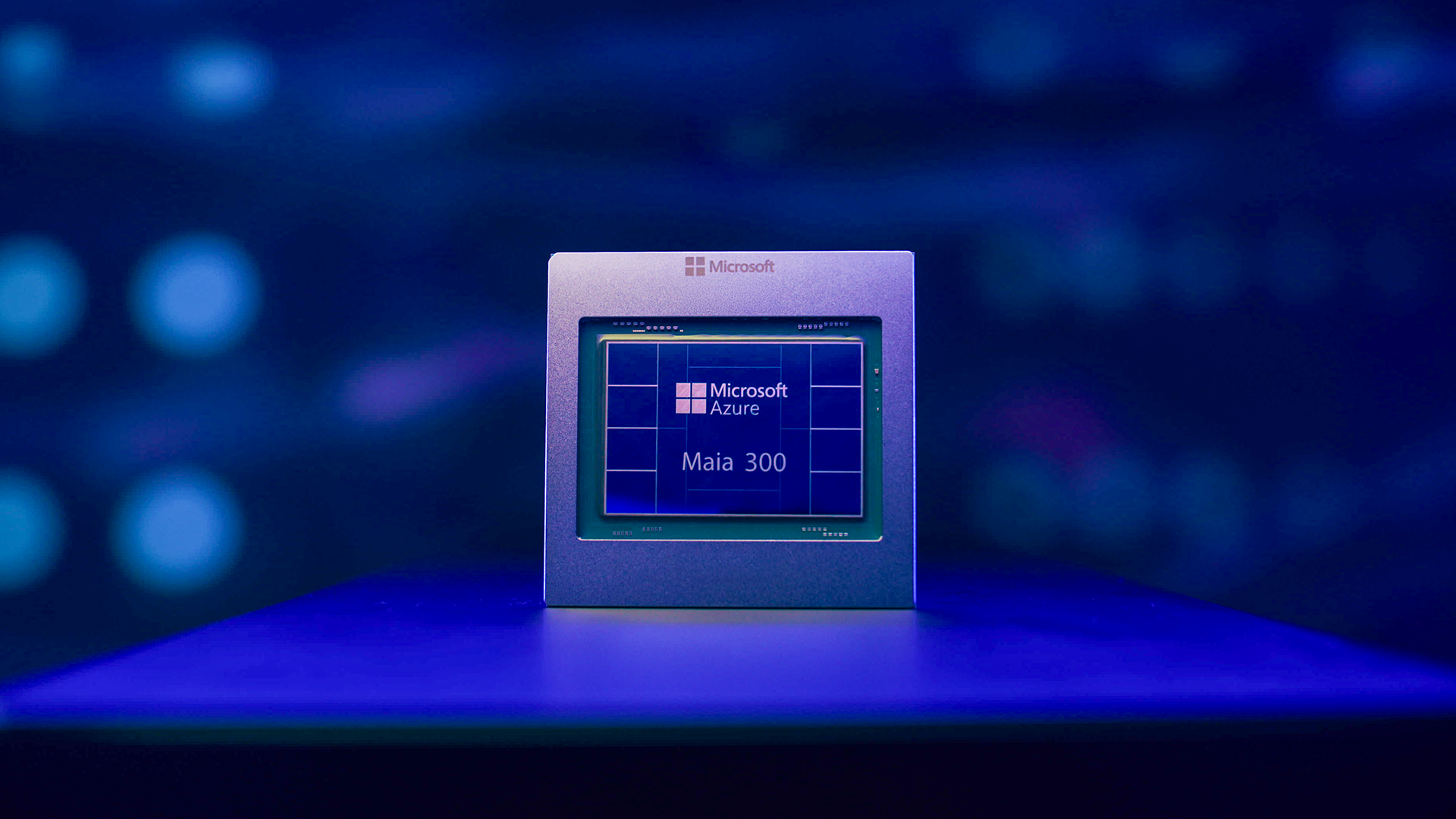
Before - Microsoft's latest custom chip: Maia 300
 news.microsoft.com
The companies that I mentioned are developing AI compute hardware/chips that will likely compete with Nvidia GPUs and related AI compute hardware.Nvidia only gets 2% of it's revenue from software
I hadn't heard that. I asked Gemini, and it seems to imply that Nvidia will still be used for training.The companies that I mentioned are developing AI compute hardware/chips that will likely compete with Nvidia GPUs and related AI compute hardware.
• Most hyperscalers deploy their custom silicon primarily for running existing models (inference) to protect profit margins, while Nvidia remains the default choice for heavy model training.
• Continued Reliance: Despite these massive in-house efforts, these four tech giants still purchase hundreds of thousands of Nvidia GPUs because general-purpose flexibility and training demand remain high.