Performance Update for Colm Fagan's ARF

@Duke of Marmalade In fairness to @dubliner8 , it's probably a case of apples and oranges. My ARF is gross of tax. I suspect that @dubliner8 's portfolio is net.
Readers may enjoy the attached piece, which I wrote in 2019, extolling the virtues of a concentrated portfolio. Two of the stocks mentioned in the piece, Phoenix (now called Standard Life) and Renishaw, are still among my largest holdings. At the time, I was happy with my short position in Tesla. Let's not go there!! Needless to say, I have avoided Tesla like the plague for the last few years, from both a short and a long perspective! There is an entire thread on AAM about the losses I incurred shorting Tesla.
 

Attachments

@Duke of Marmalade I'm only in my 40s and have barely begun my journey with investing so no, not yet. I do have my doubts but maybe that's the lack of foresight at this stage. I'm taking delivery of 3 Steps to Investment Success by Rory Gillen soon, I had seen a commenter mention this book in this thread. @Colm Fagan I haven't made enough gains in value terms yet to incur a taxable event, while my dividends would be net of withholding tax. Not sure I'm answering on that correctly with that. Not that it matters I guess since I don't have any data yet.
 
The Ladybird story of the magic porridge pot was a regular for our children when my wife and I used to read bedtime stories to them, many decades ago now. For those not familiar with the story, it told of a woman who cooked a pot of porridge, which had the magic property that, no matter how much porridge the woman took from the pot, lots more remained. (Our children, none of whom were porridge lovers, didn’t fancy that one little bit!).

My drawdown pension fund is like the magic porridge pot. For every €1,000 in the fund when I retired at end 2010, I added another €108 in subsequent years, the proceeds of maturing pension policies from life assurance companies (€79 in 2016, €29 in 2017), making a total of €1,108 invested in the fund.

In the fifteen and three-quarter years from end 2010 to 30 September 2026, I withdrew €1,457 in total. That’s equivalent to €60 (6%) in year 1, increasing by 5.6% a year. In practice, withdrawals were a percentage of fund value from time to time, so amounts withdrawn fluctuated from year to year, while following a generally upward path. There is also a technical point that, in the early years, I was allowed to transfer part of the fund to a separate account called an AMRF, which I was able to keep intact until a few years ago. That reduced the percentage withdrawal rate in the early years by around half of one percent a year.

In a repeat of the woman’s experience with the magic porridge pot, the value of the remaining fund at end September 2026 was €2,144, almost double the total amount invested, despite the withdrawals in the intervening years. The average investment return over the entire period was 11% a year.

Looking to the future, if the fund earns just 6% a year from now on, I’ll be able to continue withdrawing €128 a year every year for the rest of my days, leaving the capital intact.

The fund’s investment strategy is set out in my recent presentation to the Experienced Investor Forum (see #607 above). The strategy is so simple – invest as close as possible to 100% in equities - and is also so obvious for pension savers.

The more I think of it, the more I wonder how did the actuarial profession ever allow itself to be bamboozled into agreeing that bonds were the more appropriate backing assets for DB pensions, especially post-retirement, just at the time when retirees need some inflation protection?

Answers on a postcard, please

View image
 
Last edited:
"What was the biggest year-on-year reduction in your drawdown (ARF) pension and by how much did spending fall, after allowing for other savings/ income used to bridge the gap?"

That question from a reader on LinkedIn (paraphrased slightly) made me realise that there are lots of moving parts in my efforts to bring order to my own financial planning, against a background of volatile asset values.

Firstly, the short answer to the question is that my ARF pension fell by 16.2% between 2015 and 2016; however, I manage my finances by reference to total assets, including assets outside the pension fund (excluding our family home), so the 16.2% fall in the ARF pension, which was driven by a similar fall in the value of the ARF fund, had relatively little impact on how I manage my total finances. From here on, we will focus on total assets. (My non-pension assets are also almost entirely in equities).

At a high level, the starting point is the current smoothed value of assets, not their market value. The smoothing formula is shown in the entry dated 1/10/26 on the pensions tab of my website colmfagan.ie., while the results (just for my ARF) are shown on the spreadsheet accompanying that entry.

The two charts below show how the smoothing formula dealt with market gyrations during Covid (value fell 25% in Feb/ Mar 2020). The chart on the left shows that smoothed values (net of monthly withdrawals) barely moved; the one on the right shows smoothed returns falling from an annualised 8.54% in Jan 2020 to a low of (plus) 4.81% in Mar 2020, then rising again to 6.62% by Dec 2020.

The spreadsheet linked to the entry dated 1/10/26 shows smoothed values doing as it says on the tin, while tracking market values reasonably closely. (They crossed paths 18 times in 12.75 years).

Starting with the current month's smoothed value, I project future smoothed values on cautious assumptions, e.g., 5.5% pa return, composed of 2% risk-free, 4% ERP less 0.5% costs, and project future outgo on consistent inflation assumptions. The aim is to find the monthly “income” that will leave €X (which I decide) in the fund at the chosen end age, Omega.

As you can guess, there are lots of variations, e.g., allow for known future once-off costs, vary Omega or X, etc. I also reduce the projected short-term return if smoothed value exceeds market value currently. That’s the actuary in me coming through!

Sorry for the rushed description, but there is a lot to pack into the post. I’m happy to take questions and expand on the above in the comments.

PS: I attach the latest (1 October) update of the spreadsheet showing returns (actual and smoothed) on my ARF. The relevant tab is the first one. Ignore the second and particularly the third tab, which is work in progress on what the results would have been if the formula had been applied during the GFC.

View image
 

Attachments

The more I think of it, the more I wonder how did the actuarial profession ever allow itself to be bamboozled into agreeing that bonds were the more appropriate backing assets for DB pensions, especially post-retirement, just at the time when retirees need some inflation protection?
I often wonder the same when presented with a long period of time when bond yields were extremely low.

Using the US as an example, for the period from 2011 to 2022, the average 10 year bond yield was always sub 3% - and sub 2% for 4 of those years. This is most of the 16 year period that you're using for presenting past performance of your personal portfolio.

Then, during the years since 2022, bond yields have been rising sharply; meaning bond prices have been plummeting.

Basically, looking at the past 15 years, things have culminated in a bond crisis and one of the most significant bull equity markets in a generation.

In hindsight, bond allocations at ridiculously low yields at a time when equity markets were starting to recover after the financial crisis was a bad move - and we're right to question who thought it was a good idea at the time, even without that hindsight.

Does that mean that a bond allocation at a time when equities are at all time highs and bond yields are at multi decade highs will turn out to be a bad move - only time will tell.

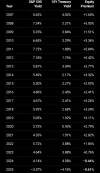
I've attached a screenshot of equity premium of the S&P 500 over the 10 year US Treasury. Of course, there is no scope for earnings growth when it comes to bonds but also near-zero risk for someone holding bonds to maturity.

The S&P 500 trailing P/E was 25.37× at June 30, 2026, which implies an earnings yield of 3.94%. The 10 year yield on US treasuries is 5.26% - so the equity premium is now negative 1.32% on a trailing P/E basis.

S&P 500 earnings expectations are high for the coming year so the forward P/E is 19.2, implying an earnings yield of 5.21%. This would be the more valid figure to use and gives an equity premium of negative 0.05% (negligible).

Surely there must come a point where a negative equity premium has rose to a level where bonds become interesting?

A negative equity premium implies that there is an expectation of high earnings growth over the coming years. Personally, I expect this to be the case. However, the case for 100% equities becomes less of a no-brainer as the negative equity premium increases.

If the S&P 500 forward P/E grew to 20 as the market rises further, and 10 year treasuries moved to a 5.5% yield, implying a 0.5% additional yield on bonds, is any allocation to bonds still a bad idea?

Yes, forward P/E is only based on earnings one year ahead and the markets currently expect multi year earnings growth, which is why the negative yield exists - but is it worth allocating 100% of a portfolio based on that assumption?
 

Attachments

  • Screenshot_20261005-054926.webp
    Screenshot_20261005-054926.webp
    53.1 KB · Views: 6
Last edited:
Thanks @ronaldo for the big picture’ perspective.
I’m looking at a bigger picture again.
The equity risk premium (ERP) has existed forever and is certain to continue to exist in future; otherwise, investors would have no incentive and would take no risks.
In the last 15.75 years my pension fund has earned an average 11% a year net of all costs. That’s without me showing any investment skill; the return was almost identical to what I would have got from a passive investment strategy. The comparable return if I had invested in bonds would probably have been around 4% a year (or less, considering the recent rise in bond yields and corresponding fall in values).
I agree that the last 15 years have been great for equities but even in ‘normal’ conditions I would have expected to earn between 3% and 6% more a year on average - with bumps along the way.
Obviously, the employer wants to get rid of the bumps and is prepared to pay for the privilege, but should trustees, who have a wider duty of care, accede to the employer’s wishes?
 
The equity risk premium (ERP) has existed forever and is certain to continue to exist in future; otherwise, investors would have no incentive and would take no risks.
The issue is that the equity risk premium of S&P 500 based on today's 10 year Treasury and the forward P/E of the S&P has completely vanished (slightly negative actually - but by a negligible amount).

I do agree with you, there is an expectation of higher returns from stocks and the current situation highlights that people are expecting significant earnings growth rates beyond the year ahead; which is what is being used for the current forward P/E.

The issue is, what if earnings don't continue to grow beyond 2027? What if China release chips that are in any way close to being comparable to Nvidia, forcing margin contraction at the world's biggest company. What if a Chinese, or even European, AI model that surpasses the Mag 7 models is released in the coming decade.

I don't see these risks as base case, but they do exist. Therefore, there must be a point where we consider an allocation to bonds.

I don't mean that we should have a standard, ongoing, percentage allocated to bonds. I just mean that things appear to be getting a little out of whack and, just like equities can overshoot on the way up, bonds can overshoot on the way down. This being the case, there is a point where a temporary allocation to bonds should he considered. Whether we're there yet will only be known in hindsight.
 
@ronaldo I don't think we're far apart; it's just that we're looking at different time horizons.
You could be right over the next five, ten years. My statement, which you quote at the start, is true for the duration over which money is being put aside for retirement, and then drawn down in retirement, a period that could span 70 years or longer.
Of course, there are times, which could extend for years, maybe even for a decade or more on the odd occasion, when equities don't outperform bonds. As I've said on many occasions, I'd be useless at guessing when that might happen. I just take my chances and trust the long-term outperformance of equities. That's why I'm still 100% in equities.
 
Last edited:
Obviously, the employer wants to get rid of the bumps and is prepared to pay for the privilege, but should trustees, who have a wider duty of care, accede to the employer’s wishes?
Just want to point out that there's a member-interest case for derisking too, not just for employers. A long investment horizon only helps if the scheme has the support to wait out a downturn. DB trustees regularly assess the level of employer support ('covenant') for any scheme. This isn't just their ability to support the scheme but also their willingness (and the extent to which trustees can require it to contribute if the willingness is lacking!). Even a relatively healthy employer can’t necessarily be relied on to fund a deficit, and in a crash the employer could get into trouble just as markets fall so they may not be able to anyway. Without that support, a (potentially temporary) shortfall can become a permanent loss for members, even if the employer continues trading - see Element Six, INM as historical examples of the limits of employer support (whatever the underlying causes of their deficits)
 
Hi @Shannb1. Thanks for your reply.

It reminded me of discussions I used to have with our pension advisers some years ago, when I was chair of a DB scheme. (It's worth recording that, despite my actuarial qualification, I claim no expertise in DB pensions, other than that of an informed layman: the last time I worked in pensions was in the early 80's, when the pensions world was very different.)

Recalling those discussions, I believe that aspects of the current regime are misguided, to say the least.

One is the focus on “deficits”. As I recall, a scheme is deemed to be “in deficit” if the current market value of assets is insufficient to buy immediate annuities for retired members and deferred annuities for active members - even if there is no intention whatsoever of closing the scheme or of buying annuities, immediate or deferred.

This approach denies the existence of an Equity Risk Premium (ERP), which experts agree is of the order of 4% a year. If the value of accrued liabilities allowed (even partially) for the ERP (but only to the extent that the scheme is invested in equities, of course), then “deficits” would be rare indeed. For example, suppose the average liability duration is 20 years (it’s probably at least that long, even for a closed scheme), then allowing for a 2½% ERP would cut the value of accrued liabilities by almost 40%.

At the time of those discussions, my financial economist friends persuaded me that it would be wrong to discount liabilities at a rate higher than the yield on sovereign bonds: €100 of assets is worth €100, you can’t conjure value out of thin air by investing in something different, which is what the financial economists say I’m doing by discounting liabilities at a higher rate if backing assets are invested in equities.

I now think that argument is flawed. Of course, €100 of assets is worth €100 whether it's in bonds or equities, but it’s a weighted average for investors with different objectives. For my DC pension, I would immediately convert €100 of bonds into equities. On the other hand, someone with an obligation to pay €100 in five years’ time would insist on bonds. They couldn’t risk putting the money in equities. The market finds the equilibrium between us.

My approach of valuing the liabilities at a higher rate results in a “surplus”, but the employer shouldn't be able to lay their hands on it. This is another area of misunderstanding. A “surplus” can only exist if beneficiaries are being adequately compensated for inflation.
 
Recent changes at the top of the leader board for my twelve-stock pension portfolio are microcosms of the wider market: increases in interest rates caused the value of my pseudo-bond shares to fall while shares associated with the AI boom rose in value.

Standard Life, the leader for the last ten years at least, has been toppled from the number one spot. At end 2025, it accounted for 27.4% of the fund. At end September 2026, its share of the fund was down to 17.8%. This was due entirely to share sales – the share price has been falling recently but rose strongly over the full nine months. The share price has fallen further since quarter end, so Standard Life’s share of the fund is now even lower.

Nvidia is the new number one. At end September, its share of the fund was 17.9%, up from 7.3% at end December 2025. Similarly, its share price has increased since end September so its share of the fund is now even higher.

Renishaw, the UK engineering company, is the new number three. It also has a presence in the AI space. At end September, it accounted for 9.9% of the fund, up from just 1.7% at end 2025, mainly on the back of share purchases but partly due to strong price performance (price up 65%).

The fund’s total return for the nine months was 8.9% made up of 18.4% gains by “winners”, offset by 9.5% losses by “losers”. The biggest contributor to the gains was Standard Life (plus 7.3%) followed by Nvidia (plus 3.2%), while the biggest contributor to the losses – by some distance – was Goodwin (minus 4.2%) followed by Ryanair (minus 2.3%). Fees and commissions (mainly platform fees but also including the costs of buying and selling shares) contributed minus 0.5%.

Regular readers of my pension fund updates will know why Goodwin occupies the dunce’s spot. This time last year, I hadn't even heard of the company's existence. If only it had stayed like that …..

View image
 
@Colm Fagan It's been a few years since I was a trustee myself, so I don't claim to be an expert either!

I agree the wind-up basis is conservative and that the ERP is real. I had a longer response to your points drafted but this isn't really a DB thread and most of my points just came back to variations of the same one I've made already: a wind up basis is used (alongside ongoing measures too) because employer support can sometimes evaporate at short notice. The scheme may then actually have to wind up & rely on its assets to settle members’ entitlements. It might not get a chance to stick the course and benefit from the ERP. If there were an alternative backstop (e.g. the state), or if members accepted that their benefits may vary, then the answer could be different.

I agree as well that the asymmetry isn't really fair: if members bear the downside risk, they should share in the upside of higher returns. But I think there could be unintended consequences of including an ERP in the valuation. The reported funding position would improve, but the assets and the promise would be unchanged. My concern would be that recognising the ERP could allow employers to contribute less before those returns have actually been earned, leaving members exposed if they don’t materialise.
 
The fund’s total return for the nine months was 8.9% made up of 18.4% gains by “winners”, offset by 9.5% losses by “losers”. The biggest contributor to the gains was Standard Life (plus 7.3%) followed by Nvidia (plus 3.2%), while the biggest contributor to the losses – by some distance – was Goodwin (minus 4.2%) followed by Ryanair (minus 2.3%).
I presume that when you say Standard Life (for example) contributed + 7.3% you mean 7.3% of the whole portfolio.

I was surprised at the wide disparity of these figures. It is prima facie evidence that you get enough divergence out of a dozen shares as you do out of 500. Of course it is only a single observation and it is hard to avoid the thought that it could easily have been 18.4% losses and 9.5% gains in the same overall market performance.

Do you follow a diversification strategy?
 
Thanks @Duke of Marmalade
As I wrote in my presentation to the experienced investors forum (see #607 above) I seek some diversification, but there’s no science involved. For example, I’m no fan of oil companies but I added BP to my portfolio last year (I think- I’m away from base and can’t check the details). That helped when Trump and Co decided to bomb Iran.
On your broader point, I’ve been surprised at how closely my highly concentrated portfolio (now down to just 11 shares) has tracked a passive international equity portfolio over the long-term (though not in individual years - see the graph on slide 7 of the presentation to the experienced investors forum). This despite the fact that I limit myself to UK and US shares, with the odd exception (Ryanair, Novo). The theorists (are you one?) might argue that it just proves that the market is good at getting relative share prices correct, so it doesn’t really matter where you put your money. I’m agnostic.
PS: I’ve just realised that I haven’t replied to your first question. Yes, it’s 7.3% of the total portfolio. I divided the portfolio into ‘winners’ and ‘losers’. The ‘winners’ delivered total gains of 18.4% of the total portfolio. The ‘losers’ contributed -9.5% of the total portfolio, so the net gain was 8.9% of the total portfolio. Standard Life (Phoenix as was) contributed 7.3% of the 18.4% through a combination of unrealised gains, realised gains (measured since end 2025) and dividends (including dividends yet to be paid but declared before end September- Standard Life went xd shortly before quarter end)
 
Last edited:
Do any of your investments have heavy exposure to AI stocks? It seems like most investment funds are being carried by AI valuations and this may indicate a bubble in the making.
 
@redstar I’ve been asking myself the same question.
@ClubMan , you’re partly right but I see it more that Nvidia is supplying the picks and shovels to the AI ‘prospectors’ which insulates it to some extent, I think. I also understand that it lends some of its massive cash pile to the prospectors to enable them to buy its picks and shovels. I don’t have a major problem with that - provided they eventually repay the loans!
 
Back
Top