Ive written a piece about The IPO trap here https://open.substack.com/pub/marcwestlake/p/the-ipo-trap?r=6xvrb4&utm_medium=ios
You are using an out of date browser. It may not display this or other websites correctly.
You should upgrade or use an alternative browser.
You should upgrade or use an alternative browser.
Performance Update for Colm Fagan's ARF
- Thread starter Colm Fagan
- Start date
The US saw massive inflows of $1.5Trillion into passive ETFs in 2025.
In theory since the inflows are channelled into the market in proportion to current market cap one might have expected that they would not of themselves affect the market cap proportions. But apparently "academic research" says differently. A lot of those inflows are from declining active funds. That process must have limits and it begs the question of what will be the effect when passive cashflow stabilises or even goes into reverse.
I think to tease out this issue, requires a new thread, separate from the specifics of the performance of this ARF.
Duke of Marmalade
Registered User
- Messages
- 5,655
From @Marc's post 501 their impact will only be about 1% of the index.This will be tested soon when three new mega-caps enter the index. From the FT:
Duke of Marmalade
Registered User
- Messages
- 5,655
I see Godwin is up about 20% in a matter of months. Missed the boat again, damn
Colm Fagan
Registered User
- Messages
- 990
Ha ha! You forgot the prelude, Duke. It fell 50% shortly after I bought it. As @Marc likes to point out, it then has to rise 100% to recover the loss.I see Godwin is up about 20% in a matter of months. Missed the boat again, damn
I'm a long way from the 100% rise with Goodwin!
Colm Fagan
Registered User
- Messages
- 990
It's been a crazy few months for my pension.
At end January, I was ar mhuin na muice. The fund's return in the ten months since April 2025 was more than 20%. But I feared it wouldn’t last. I was sorely tempted to break my self-imposed rule of always having close to 100% in equities - but resisted the temptation. The fund's cash level at end January was just 0.8%.
My fears proved well-founded. The fund fell by 4.4% in February and by more than twice that, 9.7%, in March. The most galling aspect was that 4.3% of March's 9.7% decline was attributable to Goodwin, which I had touted on this forum as my great white hope only a few weeks previously. Goodwin's share price at end March was less than half what it was just one month previously. How embarrassing!
Then, just as quickly, values recovered: up 10.3% in April, up another 5.8% in May. And the biggest monthly riser? You guessed it: Goodwin, up over 30% in May. As my party-trick friends like to remind me, though, the price must rise 100% to recover from a 50% fall; however, I take some consolation from having added more Goodwin at a bargain basement price.
The return in the four months was marginally positive, not bad considering the Goodwin debacle, but I would have much preferred a smoother ride.
Talk of a smoother ride could get me started on my proposal, which government rejected, to use smoothed rather than market values for pensions when circumstances permit - as they do for auto-enrolment.
At end January, I was ar mhuin na muice. The fund's return in the ten months since April 2025 was more than 20%. But I feared it wouldn’t last. I was sorely tempted to break my self-imposed rule of always having close to 100% in equities - but resisted the temptation. The fund's cash level at end January was just 0.8%.
My fears proved well-founded. The fund fell by 4.4% in February and by more than twice that, 9.7%, in March. The most galling aspect was that 4.3% of March's 9.7% decline was attributable to Goodwin, which I had touted on this forum as my great white hope only a few weeks previously. Goodwin's share price at end March was less than half what it was just one month previously. How embarrassing!
Then, just as quickly, values recovered: up 10.3% in April, up another 5.8% in May. And the biggest monthly riser? You guessed it: Goodwin, up over 30% in May. As my party-trick friends like to remind me, though, the price must rise 100% to recover from a 50% fall; however, I take some consolation from having added more Goodwin at a bargain basement price.
The return in the four months was marginally positive, not bad considering the Goodwin debacle, but I would have much preferred a smoother ride.
Talk of a smoother ride could get me started on my proposal, which government rejected, to use smoothed rather than market values for pensions when circumstances permit - as they do for auto-enrolment.
Colm Fagan
Registered User
- Messages
- 990
I have askaboutmoney to thank for my latest slice of investment good fortune.
Just over two weeks ago, on Sunday 17 May, I decided to make my own assessment, for the benefit of AAM readers, of whether shares are overvalued at present. The assessment was prompted by two FT articles expressing opposing views on the subject (see post #492 above).
In the post, I looked at Nvidia and concluded that it was reasonably priced, on assumptions that I deemed conservative.
The following Wednesday (20 May), Nvidia posted earnings for its latest quarter. The rate of growth was well in excess of that underlying my assessment – but the price fell.
I decided to put my money where my mouth was. I added significantly to my pension’s holding in Nvidia, increasing its share of the fund by almost 4%, to over 12%. The purchase was funded by selling down some of my Standard Life shares and by reducing the cash portion of the fund to almost zero.
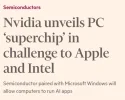
As of today (1 June), Standard Life's share price is down 5.4% from what I sold at while https://www.linkedin.com/company/nvidia/ (NVIDIA)’s is up 5.1% on what I bought the extra shares at, primarily on the back of today’s news that it has unveiled a “PC superchip in challenge to Apple and Intel” (see heading below).
The total portfolio is now worth 0. 4% more than it would be worth if I had done nothing.
Thank you, askaboutmoney!
Just over two weeks ago, on Sunday 17 May, I decided to make my own assessment, for the benefit of AAM readers, of whether shares are overvalued at present. The assessment was prompted by two FT articles expressing opposing views on the subject (see post #492 above).
In the post, I looked at Nvidia and concluded that it was reasonably priced, on assumptions that I deemed conservative.
The following Wednesday (20 May), Nvidia posted earnings for its latest quarter. The rate of growth was well in excess of that underlying my assessment – but the price fell.
I decided to put my money where my mouth was. I added significantly to my pension’s holding in Nvidia, increasing its share of the fund by almost 4%, to over 12%. The purchase was funded by selling down some of my Standard Life shares and by reducing the cash portion of the fund to almost zero.
As of today (1 June), Standard Life's share price is down 5.4% from what I sold at while https://www.linkedin.com/company/nvidia/ (NVIDIA)’s is up 5.1% on what I bought the extra shares at, primarily on the back of today’s news that it has unveiled a “PC superchip in challenge to Apple and Intel” (see heading below).
The total portfolio is now worth 0. 4% more than it would be worth if I had done nothing.
Thank you, askaboutmoney!
Attachments

Brendan Burgess
Founder
- Messages
- 58,406
Colm - it's too short a timeframe to make such a call.
Come back to us in a year and then in 5 years.
Come back to us in a year and then in 5 years.
Colm Fagan
Registered User
- Messages
- 990
Agreed, Brendan! Yet it was a nice short-term outcome - far better than the opposite, as has happened to me on occasion, e.g., with Goodwin.Colm - it's too short a timeframe to make such a call.
Come back to us in a year and then in 5 years.
As you know, I'll definitely come back to you a year and five years from now - if I'm still around!
NotMyRealName
Registered User
- Messages
- 216
So, does this follow..?
If you're re-balancing a portfolio and one of your holdings is in the bargain basement and you believe the analysis of its fundamentals are sound....then shouldn't you sell some of your other holdings with lesser growth prospects (as determined by analysis)and buy the dip.
Thank you, askaboutmoney
You're VERY welcome Colm......although you'd, of course , have done a lot better selling Standard Life and buying Goodwin. That would have given you a "smoothed " Goodwin price point, wouldn't it?
Intuitively I'd be inclined to reverse the trade now , and swap Nvidia for Standard life and "bank" the arbitrage . More smoothing?
I know nothing about stock trading but the psychology of what next is fascinating. I'm very interested in behavioural economics and psychology. FOMO, risk aversion, et al.
As a counterpoint the MSCI all world is up around 8% or so , on the set and forget.
Agreed, especially considering all the earlier posts equating UK life assurance shares to bonds based on their dividends.Intuitively I'd be inclined to reverse the trade now , and swap Nvidia for Standard life and "bank" the arbitrage .
Colm Fagan
Registered User
- Messages
- 990
I don't agree.Intuitively I'd be inclined to reverse the trade now , and swap Nvidia for Standard life and "bank" the arbitrage . More smoothing?
I know nothing about stock trading but the psychology of what next is fascinating. I'm very interested in behavioural economics and psychology. FOMO, risk aversion, et al.
As AAM readers know, I don't trade. I try to focus on the long-term. The switch was made on the basis of a long-term assessment, justified by the following:
A few days later (20 May), Nvidia reported earnings per share for the latest quarter. They were 36% higher than the previous quarter (up from $1.76 to $2.39). On the basis of the updated back-of-an-envelope calculation, I decided that Nvidia offered better long-term prospects than Standard Life.I decided to take an old actuary’s look at NVIDIA, a darling of stock market bulls. It accounts for close to 10% of my pension portfolio.
Its earnings in the quarter to 26 January last were $1.76 a share, having grown by an average 19% a quarter from the corresponding quarter in 2025.
I decided that it was reasonable to assume average earnings growth of 10% a quarter for the next eight quarters, and for the share to be valued then at twenty times annualised earnings (eighty times quarterly earnings) and that it would be appropriate to discount that at 15% a year to get a reasonable current value for the share.
The calculation is as follows (roll the drums!!!):
1.76 * (1.10)^8 * 4*20/(1.15^2) = $228.
NVIDIA’s closing price on Friday last (15 May) was $225.32. The conclusion therefore, on my back-of-a-fag packet model, is that the share is reasonably priced at present. In fact, I think my assumptions may err on the cautious side, so I’m comfortable continuing to hold the share at its current price.
Another important consideration is that, after the sale, Standard Life still represents more than 20% of my pension portfolio. I'm a bit nervous with it that high.
Last edited:
Colm Fagan
Registered User
- Messages
- 990
Firstly, in reply to the many who’ve asked, the answer is no, I didn’t buy SpaceX, and no, I have no intention of buying it, and no, I have no intention of shorting it either. Once bitten, twice shy. Elon Musk is living proof of the truth of Keynes’ adage that markets can remain irrational for longer than you can remain solvent. I have the financial scars to prove it.
Now to my current concerns. In studying the performance of my pension fund in advance of a half-year update, I made the depressing discovery that I would be better off now if I had sat on my backside since year-end and done nothing. The pension fund is worth less than if I had left everything untouched, other than making the small sale required to cover the excess of pension payments and expenses over dividend receipts year to date. In other words, all my activity since year-end was for nought.
I knew that one of my decisions was a turkey. As recounted in previous posts, I lost more than half my investment in a company called Goodwin plc within a short time of venturing a significant portion of the fund in it in January/ February last. By end March, the cumulative loss on that single investment was 4.9% of the fund’s total value at end 2025.
We all make mistakes. We learn and move on. Goodwin was a disaster, but it’s not the end of the world.
One of the aims of this year’s switches was to reduce my exposure to Standard Life and Legal & General. Together, these two insurers accounted for over 35% of my pension fund at end 2025. Even for me, that was high.
The return on these two shares from end 2025 to Friday last, 19 June, based on their end-2025 weightings, was a whopping 14.7% (10.4% capital gains, 4.3% dividends). That set a high bar for any switches made with the aim of reducing my exposure to them.
After doing the sums, I am happy to report that, ignoring the Goodwin debacle – a very important qualifier - the fund is now worth slightly more than it would be worth if I had done nothing and held on to all my Standard Life and L&G shares. I’ve also made progress with my aim of reducing my exposure to these two insurers, although there’s still a long way to go. Nvidia is now the fund’s second largest holding, up from fifth largest at year-end, but it’s still a long way behind Standard Life.
As a closing thought, it’s ironic that shares in Standard Life have contributed so strongly to my pension fund’s performance, given that a key part of Standard Life’s business strategy is to invest the assets backing liabilities for pensions in payment and deferred pensions under defined benefit pension schemes in fixed interest bonds. My prescription for my own pension, which has been in drawdown now for over 15 years, is to invest entirely in equities, with no exposure whatsoever to bonds. This is the same investment strategy as the one I prescribed – without success, unfortunately – for Ireland’s auto enrolment pension scheme.
Now to my current concerns. In studying the performance of my pension fund in advance of a half-year update, I made the depressing discovery that I would be better off now if I had sat on my backside since year-end and done nothing. The pension fund is worth less than if I had left everything untouched, other than making the small sale required to cover the excess of pension payments and expenses over dividend receipts year to date. In other words, all my activity since year-end was for nought.
I knew that one of my decisions was a turkey. As recounted in previous posts, I lost more than half my investment in a company called Goodwin plc within a short time of venturing a significant portion of the fund in it in January/ February last. By end March, the cumulative loss on that single investment was 4.9% of the fund’s total value at end 2025.
We all make mistakes. We learn and move on. Goodwin was a disaster, but it’s not the end of the world.
One of the aims of this year’s switches was to reduce my exposure to Standard Life and Legal & General. Together, these two insurers accounted for over 35% of my pension fund at end 2025. Even for me, that was high.
The return on these two shares from end 2025 to Friday last, 19 June, based on their end-2025 weightings, was a whopping 14.7% (10.4% capital gains, 4.3% dividends). That set a high bar for any switches made with the aim of reducing my exposure to them.
After doing the sums, I am happy to report that, ignoring the Goodwin debacle – a very important qualifier - the fund is now worth slightly more than it would be worth if I had done nothing and held on to all my Standard Life and L&G shares. I’ve also made progress with my aim of reducing my exposure to these two insurers, although there’s still a long way to go. Nvidia is now the fund’s second largest holding, up from fifth largest at year-end, but it’s still a long way behind Standard Life.
As a closing thought, it’s ironic that shares in Standard Life have contributed so strongly to my pension fund’s performance, given that a key part of Standard Life’s business strategy is to invest the assets backing liabilities for pensions in payment and deferred pensions under defined benefit pension schemes in fixed interest bonds. My prescription for my own pension, which has been in drawdown now for over 15 years, is to invest entirely in equities, with no exposure whatsoever to bonds. This is the same investment strategy as the one I prescribed – without success, unfortunately – for Ireland’s auto enrolment pension scheme.
Last edited:
That's the great thing about ignoring losses, you never lose.After doing the sums, I am happy to report that, ignoring the Goodwin debacle – a very important qualifier - the fund is now worth slightly more than it would be worth if I had done nothing and held on to all my Standard Life and L&G shares.

Isn't that usually the case for everyone?The pension fund is worth less that if I had left everything untouched
Going back to the very first post that started this epic thread, I really don't understand why you didn't just go passive. But I guess that you enjoy the work involved in actively managing your own pension investments?Isn't that usually the case for everyone?
My stock selection wasn't great, to put it mildly. I would have done far better by investing in a passive world equity fund.
Colm Fagan
Registered User
- Messages
- 990
We've had this discussion many times. If I'd gone passive, I would never have had the courage to invest entirely in equities. I would have invested at least 30% in bonds or in a managed fund with a significant bond element. I thought about putting a portion of the fund in bonds, but decided it would be stupid to condemn myself to a guaranteed low return for a portion of the fund. Standard Life and L&G can be considered as bond proxies. They have high dividend yields, probably twice what I would get from bonds. I think those dividends are safe. I could be proved wrong, of course. They also have the potential to deliver long-term capital growth. Bonds don't. The end result is an average return on the entire fund of more than 10% a year since I started drawing from my pension account more than 15 years ago. The fund is now worth around twice what I invested at the start, despite my taking nearly 6% (of current value) every year. I hope to give more precise figures after 30 June.I really don't understand why you didn't just go passive.
I hope that the above is an adequate explanation for why I didn't just go passive.
Actually, there's very little work involved. As recorded previously, there were no transactions whatsoever in 2023. No purchases, no sales. The 6% 'income' came entirely from dividends and from running down the cash in the fund.But I guess that you enjoy the work involved in actively managing your own pension investments?
I have done a fair amount of switching this year, but it was largely a waste of effort, as noted above. I would have been better off opting for a repeat of 2023. And the answer to your question is that I enjoy managing my own pension investments, but I keep making work for myself, quite unnecessarily.
Last edited:
Colm Fagan
Registered User
- Messages
- 990
I learned last week that a man I know - a quiet, unassuming chap – is now worth €21 million from an initial investment of €80,000 fifteen years ago, mainly by taking long and short positions in biotech companies. That’s equivalent to a return of 45% a year, probably more than that, because the 45% calculation assumes he reinvested all his trading profits. I’m sure he treated himself the odd time! He deserved it!
I can well believe the figures; he’s not the type of person who boasts about his exploits - not like some others who write on AAM, I hear you say!
In truth, the return on my portfolio since I started drawdown over a decade and a half ago is no better than average. What distinguishes it is the decision, taken at the start and adhered to throughout, to invest entirely in a highly-concentrated portfolio consisting entirely of ordinary shares, to steer clear of bonds, to hold as little as possible in cash, and to keep expenses low. Despite poor stock selection at times, that simple strategy has ensured an average return over the entire period of more than 10% a year. Within the next week or two, I hope to have more precise figures for returns over the 15½ years since starting drawdown.
Recent switching activity shows the poor quality of some of my decisions. In the last two months, I’ve sold a portion of my Standard Life holding at an average of £8.07 a share. The current share price (at close of business on Friday last, 26 June) is £8.40. I replaced it with Nvidia, bought at an average of $210.88 a share; the current share price is $192.53, so I lost on both the buying and selling parts of the switch. However, the poor quality of that switching decision (in the short-term, at least) is dwarfed by the bigger-picture consequence of having more than 25% of my entire pension in Standard Life. Its share price has increased by 14.4% since end 2025; dividends have contributed a further 3.8%, so the total return on that share since end 2025 to Friday last was 18.4%. The fact that I’ve missed out on some of that gain by selling a portion of my holding is secondary to being overweight in it in the first place.
I can well believe the figures; he’s not the type of person who boasts about his exploits - not like some others who write on AAM, I hear you say!
In truth, the return on my portfolio since I started drawdown over a decade and a half ago is no better than average. What distinguishes it is the decision, taken at the start and adhered to throughout, to invest entirely in a highly-concentrated portfolio consisting entirely of ordinary shares, to steer clear of bonds, to hold as little as possible in cash, and to keep expenses low. Despite poor stock selection at times, that simple strategy has ensured an average return over the entire period of more than 10% a year. Within the next week or two, I hope to have more precise figures for returns over the 15½ years since starting drawdown.
Recent switching activity shows the poor quality of some of my decisions. In the last two months, I’ve sold a portion of my Standard Life holding at an average of £8.07 a share. The current share price (at close of business on Friday last, 26 June) is £8.40. I replaced it with Nvidia, bought at an average of $210.88 a share; the current share price is $192.53, so I lost on both the buying and selling parts of the switch. However, the poor quality of that switching decision (in the short-term, at least) is dwarfed by the bigger-picture consequence of having more than 25% of my entire pension in Standard Life. Its share price has increased by 14.4% since end 2025; dividends have contributed a further 3.8%, so the total return on that share since end 2025 to Friday last was 18.4%. The fact that I’ve missed out on some of that gain by selling a portion of my holding is secondary to being overweight in it in the first place.
Last edited:
Duke of Marmalade
Registered User
- Messages
- 5,655
After tax!!is now worth €21 million from an initial investment of €80,000 fifteen years ago, mainly by taking long and short positions in biotech companies. That’s equivalent to a return of 45% a year