Performance Update for Colm Fagan's ARF

@Duke of Marmalade You're right! I'd forgotten that! Makes his achievement even better. OK, maybe there's a contingent CGT liability for unclosed positions that hasn't been allowed for, but that's nit-picking!

Someone on this forum (I won't say who!!) said that, if this guy can do all this on his own, why can't the big investment houses deliver similar returns for their clients?

The obvious answer occurred to me later. If you have that sort of skill, the last thing you'll do is invite others to join in the fun, especially when you consider all the hassle, regulatory and otherwise, that that involves. You'll have it all for yourself!!
 
I learned las week that a man I know - a quiet, unassuming chap – is now worth €21 million from an initial investment of €80,000 fifteen years ago, mainly by taking long and short positions in biotech companies. That’s equivalent to a return of 45% a year, probably more than that, because the 45% calculation assumes he reinvested all his trading profits. I’m sure he treated himself the odd time! He deserved it!

I can well believe the figures
I'd be a bit more skeptical and less credulous myself in the absence of hard evidence. Extraordinary claims require extraordinary proof all all that.
 
Hi @ClubMan
I can understand your scepticism. I would be equally sceptical if I didn't know the guy. He really is very unassuming. He doesn't shout about his achievements from the rooftops. Far from it.
In short, I believe that the figures are correct, but I can understand why you might not believe them. I probably wouldn't believe them either if I were in your shoes.
 
My pension fund returned a solid 4.7% (net of expenses) in the first six months of 2026. For every €1,000 in the fund at the start of the year, pension withdrawals were €28.70 and expenses were €3.30. Expenses consist mainly of fees by the platform provider, but also include stamp duty on share purchases and dealing commission on purchases and sales. Dividends of €21.00 and capital gains of €28.20 brought the fund’s value at end June to €1,017.20. (See Note at end on how the 4.7% return was calculated).

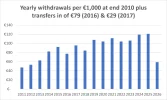
For pension investors, it's the long-term, not the short-term, that matters. In the 15½ years since I started drawing from the fund in December 2010, for every €1,000 in the fund at the start, another €107.60 was added in 2016/2017 (consolidation of insurance company pension contracts), total withdrawals in the 186 months were €1,427.40, equating to 0.5% of the starting fund in month 1 (monthly equivalent of 6% a year), increasing by 5.3% a year, and the remaining fund at 30 June last was worth €2.090. In practice, withdrawals were calculated as a percentage of market value from time to time and so fluctuated considerably from year to year. The chart below shows year by year withdrawals. It also shows that withdrawals in the first six months of 2026 exceeded total withdrawals in all of 2011.

The average money-weighted return (net of expenses) for the entire 15½-year period was 10.9% a year; the average time-weighted return (also net of expenses) was a slightly lower 10.7% a year. Yearly market returns ranged from a low of minus 15.3% in 2018 to a high of plus 45.3% in 2019; however, the worst short-term fall in market values was in February/ March 2020 (during Covid), when values fell by 25.5%. They recovered later in the year, to such an extent that that there was an overall small positive return of 1.8% in full-year 2020.

In follow-up posts, I plan to give a breakdown of the main contributors to the above returns.

Note on how the 4.7% return was calculated:
The formula is i (rate of return) = 2*I/(A+B-I), where “A” is fund at start, “B” is fund at end, and “I” is total return, i.e., capital plus dividends (net of expenses).
I = 21.0+28.2-3.3 = 45.9; therefore i = 2*45.9/(1000+1017.2-45.9) =4.7%

1782914870798.webp
 

Attachments

  • Withdrawals 2011 to 2026.webp
    Withdrawals 2011 to 2026.webp
    31.8 KB · Views: 26
Last edited:
.... Expanding on the main contributors to the above performance:

As readers know, the strategy is to invest in a highly concentrated portfolio of ordinary shares (currently just 13 shares), and to hold as little as possible in cash (currently just 0.9%). The aim is to buy and hold for the long-term - some shares have been in the portfolio since well before I ‘retired’ at end 2010 – and to keep costs as low as possible.

The return in the six months to 30 June (before expenses) of €49.20 for every €1,000 in the fund at end 2025 consists of plus €99.10 from “winners” and minus €49.90 from “losers”.

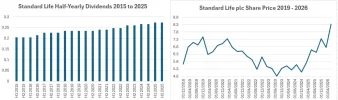
The top “winner” was Standard Life, which contributed €48.20, or almost half the total €99.10 gain from “winners” in the period. The company, formerly known as Phoenix Group Holdings, has been a major positive contributor to my pension fund's performance over many years, even though I would have been prepared to accept slightly lower returns, perceiving it as a bond proxy because of its secure (in my opinion, of course) dividend.

As can be seen from the chart below, Standard Life's price has raced ahead in recent months. The downside of that is that every pound of prospective dividend income is now more expensive than possibly any time in the last decade, which explains why I sold some of my shares in the company in the first half of 2026. According to the graph, a correction looks overdue. This time could be different, though. I'm happy to subscribe to that possibility, which explains why I’m still heavily overweight in Standard Life, even after the sales. Nevertheless, the plan is to keep reducing my exposure, provided I can find good alternative homes for the proceeds.

The top “loser” in the period was Goodwin plc. My travails with Goodwin have been well documented in recent posts. It contributed €26.40, or more than half the total losses of €49.90 from “losers” in the six months; however, there is a redemptive story behind the bad news. At end March, the Goodwin losses equated to €49.00 for every €1,000 in the fund at end 2025, but it bounced back strongly in the second quarter. I added to my holding when the price was on the floor, and Goodwin turned into a strong “winner” in Q2, contributing profits of €22.60 in the period for every €1,000 in the fund at end 2025.
1782915175305.webp
 

Attachments

  • Standard Life Divs and Share Price.webp
    Standard Life Divs and Share Price.webp
    34.4 KB · Views: 14
Last edited:
Now that I’m fully retired, I get few invites to business-related seminars; however, I got one a few days ago that I’m pleased to accept.

The seminar, on Wednesday next, is on challenges facing DC retirees. As someone who ‘retired’ over 15 years ago on an entirely DC pension, it’s a subject on which I have strong views.

Firstly, far too much emphasis is placed on retirement date itself. Obviously, it’s important in terms of lifestyle changes. In financial terms, though, it's just a staging post on the retirement journey, the point at which you stop adding to your retirement account and start withdrawing from it instead.

My own case is a good example. At retirement, I just transferred the equities in my pension fund to a post-retirement fund and made a similar in-specie transfer of the equities earmarked for “tax-free cash” to a non-exempt investment account. The equity holdings were exactly the same before and after retirement.

Unfortunately, retirement typically requires cashing a pre-retirement contract and using the proceeds to buy a separate post-retirement contract. This causes retirement date to be seen as a cliff-edge.

The Irish government’s auto-enrolment scheme, “My Future Fund”, perpetuates the cliff-edge concept. It pays a lump sum at retirement, which the retiree then has to hawk around the market to secure a pension. In other words, just when the retiree has the greatest need for a comfort blanket of assured good value (which, in fairness, My Future Fund delivers in spades), the rug is pulled from under them.

Another issue on which I have strong views is the emphasis on “de-risking” in the approach to, and in, retirement. This is typified by MFF’s default investment strategy, which starts de-risking at age 51.

There is near-universal agreement that equities are the best asset class for long-term savers. The Equity Risk Premium is of the order of 5% pa, so the expected return on equities is over double that on bonds. Given this differential, it’s madness to consign retirees to annuities, where 100% is invested in bonds. It’s even crazier to condemn them to “de-risking” in the years immediately preceding retirement, when funds have their highest earning power.

Short-term volatility of returns is a drawback with equities, but the insurance industry learned years ago to tame that volatility through with-profits arrangements. Yes, with-profits ran into difficulties, but those difficulties can be overcome if there are robust controls to prevent people from ‘playing the system’. My award-winning entry for the 2022 Institute and Faculty of Actuaries’ Redington Prize showed how equity volatility can be tamed for auto-enrolment, enabling members to enjoy stable, deposit-like returns more than double what they could get from ‘safe’ investments, before AND after retirement, with funds invested 100% in equities. It should not be beyond the wit of actuaries to devise similar approaches for other retirement arrangements.
 
Last edited:
A PS to the above post is that the two issues - (a) retirement as a cliff-edge and (b) de-risking - feed off one another and exacerbate the problems outlined above.
Often, the aim is to be almost 100% in cash by retirement date. Then, on reaching retirement and cashing the pre-retirement contract, it's difficult psychologically to crank up the risk again in a post-retirement contract. The tendency is to remain in low-risk, low-return investments.
I faced no such problems transitioning from pre-retirement to post-retirement. There was no de-risking followed by re-risking. As mentioned in the post, I just held onto the same equities all the way through. The bulk (c75%) was transferred to an Approved Retirement Fund (ARF), the remainder to a non-exempt investment account. Other retirees do not have that flexibility. They should have.
 
Thanks Colm, what investment account do you use for your investments outside the ARF? Something like Degiro? Do you do your own tax return?
 
I was only thinking of the issue of the retirement cliff edge the other day and wondering if I'm probably in a fortunate minority in having most of my pension in a PRSA from which I can periodically carve off a smaller policy, take the 25% TFLS of that amount and vest the rest to provide a regular income, rather than retirement and drawdown of pension benefits being an all or nothing, one time only event/choice? Or will this be an option for more and more people as those who have had access to PRSAs (since 2002?) hit early or normal retirement age?
 
I can periodically carve off a smaller policy
I am in an occupational employee pension scheme. I have been advised that on early retirement I can strategically opt to transfer this pension into, for example, 4no separate PRSAs. Then as I require funds I can convert the first of the PRSAs to an ARF, take the TFLS and draw down the ARF as required.

This allows the other three to compound tax free and as PRSI (4.2%) is levied up to age 66 I also minimize that outlay.
 
Thanks Colm, what investment account do you use for your investments outside the ARF? Something like Degiro? Do you do your own tax return?
Remember that it was over 15 years ago when I 'retired'. The company that I was with then has changed ownership at least twice in the meantime! De Giro didn't even exist (not in Ireland anyway) at the time. Also, at that time, my tax situation was quite complicated, with part-time consulting work, directorships, etc. I had a tax adviser then. It's much simpler now.
 
I was only thinking of the issue of the retirement cliff edge the other day and wondering if I'm probably in a fortunate minority in having most of my pension in a PRSA
You're right. Initially, I had forgotten about PRSA's (which I don't think were an option for me at retirement, because I had a DC company pension) but then it occurred to me that PRSA's could deliver the type of outcome I'm advocating, which caused me to add "typically" in the sentence:
Unfortunately, retirement typically requires cashing a pre-retirement contract and using the proceeds to buy a separate post-retirement contract.
Incidentally, no-one has asked the question I was expecting: at retirement, how did I decide which shares to allocate to the "ARF" bucket and which to allocate to the "non-exempt account" bucket?
I can remember thinking about it at the time, and deciding to allocate the shares with low dividend yields (so-called "growth" shares) to the non-exempt account, and the high-dividend shares to the ARF account, because of the more favourable tax treatment of unrealised capital gains in a non-pension account. I can't remember, though, if I followed through on that intention.
 
The question I'm more interested in was: what provider facilitated pre-retirement direct investment and inspecie transfer to a taxable account?
Remember that we're talking about ancient history.
As I recall, I set up an occupational pension scheme for the company in 1996. It cost me a fair few bob. There was a Trust Deed and Rules, I had to have a pensioneer (or is it pensioner?) trustee, etc. I think I got Mercer. The pensioneer trustee was a guy who did that sort of thing (as well as acting as an insurance broker). As I say, not cheap, but I had the long-term in mind, so I was prepared to pay the up-front cost. I appointed an asset manager on an execution only basis. Obviously, I made all investment decisions from the start. I still make them.
Then, when it came to "retirement" at end 2010 (forced on me, I think, by an imminent change in the rules on tax-free cash), it was reasonably straightforward. I stuck with the same asset manager, and just told them to move the scheme's assets in three directions, to an ARF, to an AMRF (which I required at the time) and to a personal non-exempt investment account (the 'tax-free cash'). A few years ago, (2020?) it was possible to roll the AMRF in with the ARF, something to do with the contributory OAP having increased sufficiently by then, I think.
 
I would appreciate help on something from the AAM community.
I've been asked to attend an upcoming meeting of a group of investment professionals (all has-beens like myself :)) to answer questions on my pension fund's long-term investment performance.
I have lots of figures (naturally!) on my fund's performance, but I have virtually nothing on comparable figures for commercially available unit-linked funds.
In the past, contributors to AAM - I'm thinking particularly of @GSheehy in post #86 on this thread - have been very kind in providing comparable figures for various equity and mixed funds.
Does anyone have figures for long-term returns for the period to 30 June 2026 (ideally, going back to the start of 2011, but not necessarily that long) for international equity funds and mixed funds (i.e., including bonds).
The reason I need both with and without bonds is that I can foresee disagreement over what's the correct benchmark for my fund's performance. From the start, the fund has been invested almost entirely in equities. This would indicate that the 'correct' comparison is with international equity funds; however, the intention at the start was to have a bond element, to provide some stability (I am retired, after all!!), but I couldn't stomach the low yields on bonds, so decided to invest the "bond" money in high-yielding equities instead, Standard Life (formerly known as Phoenix Group Holdings) being the most obvious example.
Any help, either in providing the figures, or telling me where I could find them, would be very much appreciated.
 
but I have virtually nothing on comparable figures for commercially available unit-linked funds.

Best I could find https://funds.nationalpensionhelpline.ie/funds, not sure of the quality of the data or source.

The Irish Times used to provide fund prices, with data supplied by Long Boat Analytics or Moneymate, but they seem to have stopped that. You could verify performance figures of certain funds from the providers website direclty.
 
Back
Top