Performance Update for Colm Fagan's ARF

@ Clubman - S&P 500 Total Return Index would be a fairer comparison? The price index excludes dividends which contribute a lot to long term performance...
According to Gemini AI:
An investment of $100 in the S&P 500 at the beginning of 1996 with all dividends reinvested would have grown to over $1,800 by early 2026, representing a cumulative total return exceeding 1,700%.
 
And for comparison, a $100 investment in BRK.B at the start of 1996 would be worth about $2,190 today. A much less dramatic difference than suggested by the price-only S&P chart.
 
That’s a ridiculous comment.
I’m not claiming to have outperformed the market.
I have done better than the average fund in drawdown because I’ve avoided bonds like the plague and I’ve kept costs low.
I’ve replaced bonds with high dividend paying shares. That decision has paid off but it could come unstuck in a bear market. I think I have built enough resilience into the portfolio to deal with that eventuality. I could be wrong.
In any event, it matters less at this stage.
I respectfully disagree. Your strategy could have caused ruin. The fact that it has performed adequately for you is not because of your strategy, but in spite of it.
 
Your strategy could have caused ruin.
That’s a bit hyperbolic - the chances of all 13/14 stocks diminishing to nothing are minuscule. Also bear in mind that Colm is a lifelong financial services professional who had risen to the top of his chosen field, which specialised in accurately measuring risk. He probably learned a thing or two along the way that the average Joe Soap investor wouldn’t have learnt.
 
On reflection I agree and I withdraw my unfair criticism.
Apologies, Colm.
Fair play! :)

Also, my comments aren't intended to disparage @Colm Fagan's approach but more to point out that his approach may not be for everybody, which, I'm sure, is something that he's also pointed out along the way. In many or most cases a cheap diversified equity index tracker is arguably more appropriate.
 
BTW, my point here was just that one shouldn't judge absolute or comparative performance of equity investments over a short timeframe:

What about using past performance as a guide to future performance?

In many or most cases a cheap diversified equity index tracker is arguably more appropriate.

I'd argue a lot of passive investors do not understand the structural characteristics (problems) associated with their strategy. Passive flows are now a significant part of the market. Being passive means you are price agnostic to each component of your index. You rely on price discovery which is provided by active investors (Colm), whose ability to do so is being diminished, whilst the passive investor rewards/punishes size, exacerbating over/under-valuations in the market. A reinforcing feedback loop i.e. a giant momentum play!

Now what is going to happen to prices when net passive flows change direction and there isn't the price agnostic investors to support prices?

I don't think Colm is getting a fair shake of the stick. The gap between the appropriateness of the investment strategies is closer than is portrayed by this conversation, yet this low-cost index tracker solution is being presented as a slam dunk without regard to market and population dynamics, individual investment objectives, personality type etc.
 
You rely on price discovery which is provided by active investors (Colm), whose ability to do so is being diminished, whilst the passive investor rewards/punishes size, exacerbating over/under-valuations in the market. A reinforcing feedback loop i.e. a giant momentum play!
Investigating the point at which passive investing is likely to become inappropriate due it's proportion of the investment universe is on my mental to do list alongside checking of pooled bond funds can provide the same "safety" as directly holding bonds.

I do wonder what would happen in a world where all investing above small cap is done passively, and a mega-corp was to have an issue that would normally affect share price. Would passive investing keep the Tesla share price stable of their full self driving was found to be deliberately killing pedestrians? Or is there some demographic point where a large number of new retirees liquidating their investments over a short period would depress share prices?
 
I do wonder what would happen in a world where all investing above small cap is done passively
I don’t think this is a likely outcome, but I can see a day where passive investment becomes so large that it starts to be outperformed by certain active investment strategies. At which point price discovery begins to reassert itself. And of course, given the nature of group psychology, probably quite violently.
 
Are equities overvalued at present?
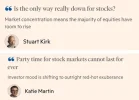
The investor’s bible, the FT, doesn’t seem to know its own mind. The two headings below from this weekend’s paper show one of its columnists thinking that “the majority of equities have room to rise”, while another concludes that “party time for stock markets cannot last for ever”.
What do I think?
I decided to take an old actuary’s look at NVIDIA, a darling of stock market bulls. It accounts for close to 10% of my pension portfolio.
Its earnings in the quarter to 26 January last were $1.76 a share, having grown by an average 19% a quarter from the corresponding quarter in 2025.
I decided that it was reasonable to assume average earnings growth of 10% a quarter for the next eight quarters, and for the share to be valued then at twenty times annualised earnings (eighty times quarterly earnings) and that it would be appropriate to discount that at 15% a year to get a reasonable current value for the share.
The calculation is as follows (roll the drums!!!):
1.76 * (1.10)^8 * 4*20/(1.15^2) = $228.
NVIDIA’s closing price on Friday last (15 May) was $225.32. The conclusion therefore, on my back-of-a-fag packet model, is that the share is reasonably priced at present. In fact, I think my assumptions may err on the cautious side, so I’m comfortable continuing to hold the share at its current price.
I’m also comfortable with the current prices of my other large holdings. UK life insurers, which account for over a third of my portfolio, rose in price last week, despite UK bond prices falling, which some experts think should be bad news for insurers. Their prices rose mainly because private equity players think they’re undervalued. I agree!
Therefore, on balance, I’m still in the optimists’ camp. I could be wrong, of course. If I am, it wouldn’t be the first time, and definitely not the last!
This week should tell us more: Nvidia’s earnings for the quarter to end April will be released on Wednesday next, 20 May.
 

Attachments

  • FT unsure on market direction.webp
    FT unsure on market direction.webp
    14.9 KB · Views: 38
Last edited:
I should have added that I never worked in an investment department in my entire life. All my experience, as an executive and as a consultant, has been on the boring liabilities side of the balance sheet. I don't know how investment analysts see the world. Therefore, my analysis could be completely flawed. If it is, I would appreciate being told.
 
The above post helps to explain why I prefer holding shares in real businesses to investing in collective funds. A similar calculation would be impossible for a unit-linked fund.
Critics can reasonably say that I pulled the figures out of the air, so what use are they? I disagree. The model may be flawed but it provides a framework to be compared with what happens in the real world.
 
I don't understand your point

1996 to date returns:
  • BRK.B: c. 1,900%
  • S&P 500 TR: c. 1,700%
By placing the two charts side by side showing S&P 500 at +894% and Berkshire Hathaway at +1,923% — you gave readers the impression, intentional or otherwise, that Berkshire had massively outperformed the S&P over the period. My point was simply that this isn’t the case.
 
It is still overstated because they aren't the same time period. You can calculate the returns in Google Sheets with the =googlefinance function.

For the 30 year period from 10/05/1996 to 13/05/2026:
- Berkshire Hathaway +1,923%
- S&P 500 TR index +1,867%

As an annualised return = BRK.B 10.54% per year, S&P500 10.44% per year, which again is much less dramatic.
 
Last edited:
I do wonder what would happen in a world where all investing above small cap is done passively
Warning Gemini said:
Academic research has increasingly found that passive flows disproportionately raise the stock prices of the economy's largest firms. This helps explain why the market has become so incredibly top-heavy.
The US saw massive inflows of $1.5Trillion into passive ETFs in 2025.
In theory since the inflows are channelled into the market in proportion to current market cap one might have expected that they would not of themselves affect the market cap proportions. But apparently "academic research" says differently. A lot of those inflows are from declining active funds. That process must have limits and it begs the question of what will be the effect when passive cashflow stabilises or even goes into reverse.
 
A quick update on post #492 above. My back-of-a-fag-packet valuation of Nvidia on Sunday last assumed (inter alia) earnings growth of 10% a quarter for 8 quarters, starting from diluted earnings per share of $1.76 in the quarter to end January 2026. Per last night's results, diluted earnings for the quarter to end April 2026 were $2.39 a share, so actual earnings growth in the quarter was 36%.
 
Last edited:
Gemini said: Academic research has increasingly found that passive flows disproportionately raise the stock prices of the economy's largest firms. This helps explain why the market has become so incredibly top-heavy
This will be tested soon when three new mega-caps enter the index. From the FT:

‘Fast entry’ SpaceX, OpenAI and Anthropic IPOs to ignite Wall Street trading frenzy

"The new rules, implemented this month by Nasdaq, mean billions of dollars of passive money will automatically flow to the three companies shortly after they go public, driving their share prices higher but forcing investors to sell other stocks."
 
Last edited:
Back
Top