Performance Update for Colm Fagan's ARF

Interesting post as always Colm and thanks for sharing your experience.

In this instance I’d say equities generally falling is the reason Goodwin has fallen in price, as alluded to above.

personally I think technical analysis can be helpful with timing a trade when markets are relatively benign but a better strategy when committing a large amount of cash to buying is to simply use pound cost average. This way you’re more likely to reduce regret risk, you might be better or worse off but you’ll reduce the risk that the timing of the trade was off.

I’d hazard a guess that the fall in value of your share since you bought could be simply explained by the beta of Goodwin plc.

I’m sure there is some buffet quote about allocating gains from the impatient to the patient too that might be relevant in this instance.
 
Hi @ClubMan , @Sarenco and @Cameo
I take your point to some extent. I wouldn't have posted except for the earlier email exchange with my friend about the technical analysis advice to wait for a price fall. That advice proved prescient, which of course could be purely coincidental.
It is worth noting though that I would have expected Goodwin's share price to be relatively unaffected by the Iran war, given its defence interests. Against that, one can also ask why the life assurers in my portfolio also fell sharply. It's difficult to see how they're affected negatively by it.
@NotMyRealName. Yes, I'd love to fill my boots with Goodwin (and with a few others that have fallen much further than I think was justified) but remember that I aim always to be as close to 100% invested as possible. Given that my ARF is in drawdown, that means that I would have to sell something else at a depressed price in order to fund the purchase.
 
Last edited:
Against that, one can also ask why the life assurers in my portfolio also fell sharply. It's difficult to see how they're affected negatively by it.
Most, if not all, life insurers are heavily invested in bonds, using the income to help fund payouts. Bonds have taken an absolute hammering, particularly last Friday, so that will affect the life insurers book value.

In a normal market, stocks would fall and bonds would rise and life insurers would see a lesser fall than the overall market as the value of their bonds rise.

However, we're not in a normal market right now and bonds seem to have, at least in the very recent past, lost their negative correlation to stocks. It's a "sell everything" market.
 
Bonds have taken an absolute hammering, particularly last Friday, so that will affect the life insurers book value.
It's normal that a large proportion of.bonds closely match liabilities so the impact of falling bond prices would be largely offset.

However, they can have a lot of other.stuff that.might be more negatively impacted, infrastructure, private debt, etc

They are generally a leveraged play on equity markets as they earn income on customer funds, which are largely invested in equities( unless they hedge this risk), which means falling equity values negatively impacts them

Higher inflation expectations usually negatively impact them, too.
 
Last edited:
I know we're not allowed to talk about individual stocks on AAM, but in this thread Goodwin is in the spotlight......Down a hair-raising 38% this morning. I believe they were not awarded contracts in Estonia and Sellafield.
 
Last edited by a moderator:
Ouch! :eek:

1000023316.webp


Edit: post crossed with @Brendan Burgess's post...
 
Last edited by a moderator:
Before @NotMyRealName 's comment, I was going to reply to @Cameo that I don't have a problem with what he wrote (although my understanding is that Standard Life (ex Phoenix) has less exposure than other life assurers to unit-linked business so would be less affected by falls in share prices.)
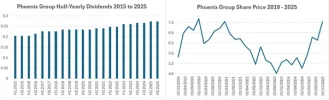
What I was finding difficult to understand was the scale of the fall in share price. At one time this morning, the price was down 17% from end February, just over three weeks ago. It started recovering mid-morning, and is now down 'only' 12.5% since last month-end. That still seems a bit crazy to me, in view of my posting of a few weeks ago, showing the history of dividends v price (see below).
 

Attachments

  • Phoenix Divs and Share Price.webp
    Phoenix Divs and Share Price.webp
    15.7 KB · Views: 36
And it only got worse as the day went on. Down 46.29% on the day.
Colm, I feel your pain. Hopefully that's temporary. It's part of the reason that I don't hold individual shares. Admittedly, when I did, my choices weren't too good. In fact my choices were terrible.....Eircom, Deutsche Telecom, Bula Resources, Elan ( a precipitous drop after deaths linked with tysabri ). A real rogues gallery.
ETFs for me and my pension in passive funds, all in equities. Still, down 4%± in the last couple of weeks. Best of Luck Colm, I'm keeping my fingers crossed for a timely rebound. Your posts are interesting and your openness and honesty admirable.
A rally got it back to -33.19% on the day.
 
Last edited:
So, does this follow..?
If you're re-balancing a portfolio and one of your holdings is in the bargain basement and you believe the analysis of its fundamentals are sound....then shouldn't you sell some of your other holdings with lesser growth prospects (as determined by analysis)and buy the dip.
 
Colm, I feel your pain. Hopefully that's temporary. It's part of the reason that I don't hold individual shares.
I appreciate your concern. Genuinely!
Actually, today is a good example of why I DO hold individual shares rather than funds.
If you look at the fall in the share price in the right-hand graph of #429 above, you get very depressed, but if you look the graph on the left, you wonder why all the excitement. I tend to look at the graph on the left. Maybe that's just because I'm an optimist by nature!! Actually, I saw the sharp fall in Standard Life's (Phoenix's) share price in recent days as a buying opportunity. I've topped up my holding in another (much smaller) account.
Goodwin is a different story. I just have to accept that I made a bad call. Move on. Helps keep one humble!!
I wonder is it linked to their results announcement on the 16th?
I don't think so. Yes, the price fell immediately after the announcement, because analysts were concerned about IFRS earnings, but cash generation rather than IFRS earnings is what matters for Standard Life (and L&G, another company in which I have shares). Later in the day, that realisation started to dawn and the share price recovered. At least that's my reading of the situation. Then, of course, Iran blew up again (literally and metaphorically).
But there is a link to the increase in yields in UK government bonds. I was reading on another website that UK bond yields hit almost 5% today. That's something.
So, does this follow..?
If you're re-balancing a portfolio and one of your holdings is in the bargain basement and you believe the analysis of its fundamentals are sound....then shouldn't you sell some of your other holdings with lesser growth prospects (as determined by analysis)and buy the dip.
Yes, I did a bit of that. I sold some BP last week at £5.72 (which I had bought in January 2025 at £4.25), but that was mainly to fund normal withdrawals than to rebalance the portfolio.
I've set my face against trying to beat the market by jumping in and out. The reasoning is that, if there is money to be made that way (and I'm not too sure there is), there are lots of people out there far more skilled at it than I would be. They'd also have much lower transaction costs.
 
It's heartbreaking to see a newly entered position drop so drastically; and I've got my own samples of the same.

Without getting into individual share speculation, if I owned a share where the family had 53-54% controlling interest, the main thing I'd be keeping an eye on is what they do. They'll unlikely ever go below 51% and loss control - but will they reduce it a little, increase it a little after the recent drops or hold steady?

There aren't many companies where the founding family owns a controlling interest but it's interesting to watch their actions after massive swings in share price as it can give an idea as to whether they think the market moves are overdone.
 
Thanks @ronaldo
I agree with every word you said - including about not getting into share speculation.
This is a problem with small to mid-cap companies where one or a small number of connected shareholders own more than 50%.
I have one other company in that category. I've had it for donkeys' years, and I think I now know its idiosyncrasies (thank God for spellcheck!!!). I have shied away from investing in other such companies in recent years, preferring large cap ones where there wasn't that risk.
Maybe I should have stayed on the straight and narrow!!
There is some consolation in that the Goodwin share price recovered quite a bit yesterday and a bit more so far today - but I'm not holding my breath for ever getting a positive return.
 
Last edited:
March 2026 was a mensis horribilis for my pension. The return was minus 9.7%, thanks to Trump's war – and Goodwin plc.

I was surprised to discover, though, that it didn’t get into the rogues’ gallery of poor returns since I started recording monthly returns in January 2014. The worst was March 2020 (minus 15.7%: Covid) followed by June 2016 (minus 12.7%: Brexit); then February 2020 (minus 11.7%: also Covid) and September 2022 (minus 11.3%: I don’t remember – who can tell me?).

Thankfully, the fund recovered after all previous setbacks. At end December 2025, the average return (money-weighted) since starting drawdown at end 2010 was 10.9%pa. The corresponding time-weighted return was 10.8%pa.

By end March 2026, the average money-weighted return had fallen to 10.2% but the average time-weighted return had fallen far more, to 9.7%. At first, I thought that I had made an arithmetical mistake, but I hadn’t. Who among my readers can explain the much larger fall in the time-weighted return? A virtual box of chocolates to the winner.

Obviously, the money-weighted return is what matters to me.

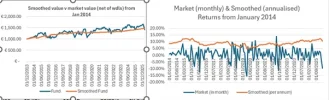
For planning purposes, I use smoothed values, not market values. The smoothing formula has remained unchanged from the start. The graph on the left below shows smoothed and market values since 2014 (net of regular withdrawals); the graph on the right shows monthly smoothed returns (annualised) and monthly market returns (actual). Keen-eyed readers will see from the graph on the left that market value (MV) fell below smoothed value (SV) in March 2026 after the longest run of MV exceeding SV since the start (28 months). Let's hope it won't take another 28 months for it to get back above SV.
 

Attachments

  • Market & Smoothed Fund Values and Returns.webp
    Market & Smoothed Fund Values and Returns.webp
    23.6 KB · Views: 45
For planning purposes, I use smoothed values, not market values.
What do you mean by this? Do you assume that the the smoothed value is the actual value of your fund and make investment and spending decisions based on this?
 
In short, yes - but I don’t assume anything. The market value is the market value. If SV>MV then I know that the smoothed return will probably be below the assumed l-t return for the next while. This influences my spending decisions. It’s probably more helpful to look at the progress of smoothed returns on the r-h graph.
 
Last edited:
By end March 2026, the average money-weighted return had fallen to 10.2% but the average time-weighted return had fallen far more, to 9.7%.
I presume by time weighted you mean you have chained the monthly returns together, effectively assuming you never made any withdrawals. I think that implies that time weighted always gives more weight to the latest figure than money weighted would.
 
Back
Top