Performance Update for Colm Fagan's ARF

@Duke of Marmalade. Full marks! Go to the top of the class! That's exactly how I did it, chained returns together (yearly rather than monthly, because I don't have monthly returns for pre-2014).
It's obvious when you look at the numbers.
On the chained returns approach, €1,000 at end 2010 had grown to €4,635 by end 2025. It then fell €540 to €4,095 in the first three months of 2026.
The actual fund (allowing for withdrawals) grew from €1.000 at end 2010 to €2,054 at end 2025, so it 'only' fell €239 (plus withdrawals) in the first three months of 2026; the rest of the return had been consumed in the intervening 15 years.
What a pity that you're anonymous! Otherwise, I'd have been delighted to present you with the virtual box of chocolates. Maybe I should change it to an Easter Egg instead - they're going cheap in Dunne's today!
 
Hi Duke.
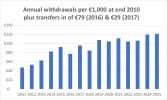
It's not that straightforward. There's the complication that the figure net of withdrawals allows for top-up contributions (transfers from other smaller ARF's) in 2016 and 2017, which I've treated as negative withdrawals. The average annual (gross) withdrawal rate over the entire period was more than you've calculated.
The table below (which I think I posted on another forum) may help.
 

Attachments

  • History of withdrawals.webp
    History of withdrawals.webp
    30.8 KB · Views: 49
Last edited:
If market values have fallen in a month, is it more or less likely that they'll rise the following month?

The question was prompted by the observation that, after falling sharply last month, my pension fund has bounced back even more sharply this month - so far, at least!

Logic says that it shouldn't matter how values reached their current levels. “History is bunk.”

To test whether this was true for my pension fund, I looked at market value changes in the 147 months from January 2014 (when I started recording monthly returns) to March 2026.

Market values (ignoring withdrawals) rose in 90 (61.2%) of those months and fell in 57 (38.8%) of them. If history is bunk, the expected number of months in which values rose for two months in a row (out of 146) is 146 multiplied by 0.612 squared, equals 54.7. The actual number was 53, which is very close to the expected number if changes followed a random walk.

The expected number of months in which values fell for two months in a row is 146 multiplied by 0.388 squared, equals 22.0, which once again is close to the actual number (20).

By subtraction, the number of months in which a fall is expected to be followed by a rise, or vice versa, is 69.3. The whizz kids among you (that’s practically everyone, of course) will know that this is the same as 146 multiplied by 0.612 multiplied by 0.388 multiplied by 2. The actual number of months in which that happened was 73, a bit further away from the expected number for a random walk, but the difference is not significant in statistical terms.

The above analysis is simplistic. For instance, it doesn’t matter if the rise (or fall) in a month is 1% or 10% and the analysis doesn’t extend beyond two months; however, it supports the conclusion that changes in market values follow a random walk, which agrees with the theory of efficient markets; however, a future post will show that it’s not that simple: market values do have a tendency to mean revert.

PS: The spreadsheet showing monthly returns can be found on the pensions tab of my website colmfagan.ie, under the entry dated 1 April 2026.
 
Last edited:
A financial adviser has accused me of being a gambler, not an investor. Why? Because my pension is invested in a highly concentrated portfolio of shares in real businesses - currently, just 13 companies. He says that I should be in pooled funds, to obtain the diversity that financial theorists say is the only free lunch available to investors.
But financial theorists don’t understand how real people think.
If my pension were invested in pooled funds, the price movements, with prices often changing for unfathomable reasons, would terrify me. To limit the risk, I would probably invest a significant portion in bonds or in an annuity, despite knowing that the expected return on such assets is much lower than on equities.
That is not the path I chose. I invest in businesses that I think will deliver good returns in the long-term, which I define as the next five, ten years, or even longer. I’m not overly concerned about short-term price movements, particularly those unrelated to company announcements. It’s the long-run that matters.
A good example is Renishaw a UK engineering company that I first bought in 1996 at just over £4 a share and have held continuously since then (not always in my pension). In the intervening thirty years, the share price has increased twelvefold, to over £51 today, implying an average return (capital only) of close to 9% a year. To this can be added an average dividend yield of over 2% a year. Result: average return over the last thirty years of around 11% a year. Of course, I may not have earned that precise return, because I increased and reduced my holding at various times along the way, sometimes with good results, sometimes not so good.
There have been other long-term successes. Apple and Phoenix (now called Standard Life) are two that come to mind. There have also been quite a few disasters, the most recent being Goodwin plc, which is currently trading at less than half what I paid only a few short months ago. Overall, though, successes have outnumbered failures, as evidenced by the average (money-weighted) return of more than 10.5% a year in the fifteen and a third years to 30 April last. That's net of all costs, including platform charges.
Arguably, the biggest contributor to the good long-term return wasn’t the shares chosen for the portfolio; it was the very fact of deciding to ignore the siren voices and to invest entirely in shares, and to eschew bonds.
.
 
the biggest contributor to the good long-term return wasn’t the shares chosen for the portfolio; it was the very fact of deciding to ignore the siren voices and to invest entirely in shares, and to eschew bonds.

This is a good point.

It's important to be in the market and for most people, a pooled investment is the best way to do it.

It would probably be better to have a concentrated portfolio than to be in deposits or bonds. Of course there is a risk that a few bad ones could wipe out your returns.

I am guessing that most of the returns one gets come from the market and not specific shares.
 
The evidence suggests that most market returns arise from a relatively small number of super-performers.

Obviously the more concentrated the portfolio, the higher the probability you will miss out on these super-performers.

 
It's important to be in the market and for most people, a pooled investment is the best way to do it.
Brendan, I agree in theory but one of the points I was trying to make is that I personally would find the price fluctuations of unit-linked funds unnerving. If my pension were invested in unit-linked funds, I would quite likely opt for a cautious approach (and consequently lower long-term returns) for at least a portion of my fund.
I'm far more at ease investing in individual businesses where I am inclined to take price fluctuations with a pinch of salt (except if the move is due to a company announcement). I'm far more prepared to be fully invested in equities in that case.
I agree that most returns come from the market than from individual stocks.
Others may be quite happy to invest in unit-linked funds. If they are, good luck to them.
 
Last edited:
Why does the price of shares fluctuating inside a fund cause worries, yet the fluctuations in the prices of shares held directly causes less worry?
For some companies, a fall in the share price is an opportunity to buy a great asset at a discount - a special offer! For example, see post #236 above. Here's a link to the post (I hope!): https://www.askaboutmoney.com/threa...r-colm-fagans-arf.234034/page-12#post-1976985
In other cases, a fall in share price may or may not be bad news.
If the price of a unit-linked fund falls, you don't have a clue as to what caused the fall. It could be one or many companies that fell in price.
 
Last edited:
I really don't understand the logic (or is it sentiment/emotion?) of being uncomfortable with volatility in one case (collective/unit linked funds) but not in another (less diversified direct equity holdings which are arguably "riskier"). Or what the relevance is of the earlier comments about bonds. It doesn't make sense to me at all.
 
I think there's an element of survivorship bias here.

You agree Colm that ".. most returns come from the market than from individual stocks." You had a good sized pension fund invested in equities for the entirety of a now 17+ year bull market. You had some bad eggs in your concentrated portfolio of individually held shares but you got very lucky with others and the rest well maybe they too rose with the rising tide.

If you had been less lucky and we had another recession or two during your retirement to date it might be a different story altogether and you'd be declaring: "I should have just put it all in an index fund"!

Anyway I'm really enjoying your updates Colm and learning from all the contributions to this thread.
 
I really don't understand the logic (or is it sentiment/emotion?) of being uncomfortable with volatility in one case (collective/unit linked funds) but not in another (less diversified direct equity holdings which are arguably "riskier").
In the example I gave (Standard Life, which was previously called Phoenix Group holdings), the asset is essentially the same (a fairly predictable series of half-yearly payments stretching far into the future), yet Mr Market insists on constantly changing the price of that asset. If he reduces the price at any time, that's great news, I can add to my holding. Vice versa if he increases the price by too much.
It's very different if the price falls because the asset's real value has fallen. We don't know for a unit-linked fund.
What's wrong with that logic?
 
If you had been less lucky and we had another recession or two during your retirement to date it might be a different story altogether and you'd be declaring: "I should have just put it all in an index fund"!
Apologies for not making myself sufficiently clear.
I'm not saying that I've done better than if I had put my money in an index (equity) fund. In fact, various posters have suggested that I would have objectively done better if I had invested in an index fund. I believe them.
What I am saying is that I would never have had the courage to put all my pension in an index fund. I would have been terrified of the price fluctuations. I would have put a good portion of it - probably at least 30% - in a "safer" home, probably a gilt fund or an annuity.
I was only prepared to take the chance of investing entirely in equities because I (sort of) knew the companies in which the money was invested and I was confident that, while there might be the odd disappointment, the overall return would be more than acceptable.
Of course, if there had been another recession or two, then I would have had a worse experience with some of my holdings (Renishaw being in that category) but the experience of others (e.g., Phoenix) would probably have been much the same as it has been. It's also worth adding that Renishaw suffered badly in the Great Financial Crisis of 2007/08 and during COVID in 2020/2021. Dividends were cut or stopped completely during those setbacks, but it recovered. Both those events are reflected in the 11% average quoted above.
 
What's wrong with that logic?
What's wrong with just buying into a fund, or better still, a diversified market index tracker, and sitting tight? Less stress, less work. It's certainly worked for me. I'd hate your job of managing the portfolio. But you seem to enjoy it so more power to you.

In any case, your reply still doesn't really explain to me why volatility in a collective fund should be more stressful than volatility in a directly held basket of shares.
 
In any case, your reply still doesn't really explain to me why volatility in a collective fund should be more stressful than volatility in a directly held basket of shares.
Either I'm very poor at explaining myself, or ....
I'll have one more go. If I don't succeed this time, I'll just have to give up.
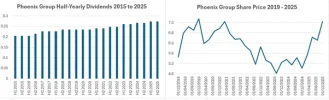
Below are two graphs. The one on the left shows the history of Phoenix Group (now Standard Life) dividends. The one on the right shows the price history for the same share.
The graph on the left shows dividends never falling and rising almost every year for the entire period. The graph on the right shows the share price fluctuating by more than 50% over the same period.
I base my investment decisions on the graph on the left.
If I were to hold the shares through a unit-linked fund, I would only see the graph on the right. The one on the left would be completely obscured from view.
Capito?
I'd hate your job of managing the portfolio.
As I've written many times, there is minimal effort in managing my portfolio. If you trawl back through my posts, you'll see that there were absolutely no sale or purchase transactions in 2023. Zilch, zero, diddly squat. All monthly income payments (12 of them, totalling 6% of the fund) derived from the small amount of cash in the fund at the start and from dividend receipts during the year. The cash proportion of the fund fell from 2.6% at the start of the year to 0.6% at the end.
 

Attachments

  • Phoenix Divs and Share Price.webp
    Phoenix Divs and Share Price.webp
    15.7 KB · Views: 44
Last edited:
I see where Colm is coming from, because he understands his portfolio, he's unconcerned about the volatility. He wouldn't have the same compulsion towards any other portfolio (global index or otherwise). That's fair enough I think.

@ClubMan I also don't have the time (or brains) to do similar to Colm, and so opt for a global passive index. As I hope to be around long enough to stay invested for another 40-50 years, the other attraction for me is that the index acts as a relay race, with the baton passed between companies over time. That helps me sleep more easily at night.

@Colm Fagan I couldn't do what you do, but I enjoy the updates, keep them coming.
 
Thanks, @nest egg . It's also worth adding some clarification. @ClubMan can reasonably say that it's fine and dandy to see a history of dividend increases, but how do I know that dividends won't fall off a cliff next year or the year after? The answer is that I worked at the financial coalface of the life assurance industry for more than 50 years, so I have a good understanding of the industry's financial dynamics. I don't think it likely that dividends will fall off a cliff, even in a worst case eventuality. I could be wrong, of course ....
 
Last edited:
Back
Top