RTB no teeth ?

CorkHome2022

Registered User
Messages
226
I am neither a landlord or a tenant but I find this one interesting.
From yesterdays Irish Times.

My understanding is RTB is there to protect both sides from abusing the rental process .
From reading the article it looks like a bogus eviction yet the RTB only give under 1400 in compensation to the evicted tenants.
So is it a viable financial gamble for a landlord to go down this route go move on existing tenants and get new ones in for better rent ?
When you consider what the tenants here would have to pay to secure new accommodation and what they would have spent on the private investigator the just under 1400 would no way cover their expenses .
If RTB is setting this as a benchmark for breaching agreements then tenants out their are on dodgy ground .

As I said above I have no skin in the rental market but this is an interesting ruling .

 
Last edited:
Absolutely. Most landlords would be delighted to pay €1,400 to get rid of a tenant.

The circumstances are a bid odd. Usually in cases where the landlord gives a bogus reason for ending the tenancy, the landlord relets the property at a much higher rent. But in this case, they don't appear to have relet the property at all to either the daughter or anyone else.
 
I agree, I thought the compensation granted to the tenant in this case seemed very low compared to other cases that have appeared in the news lately, for example the 80 year old whose husband passed away so she didn’t move in as originally planned (in her case from memory she had to pay around €20k in compensation).

It seems there is no consistency with the RTB, so I still wouldn’t take my chances as a landlord.
 
it looks like a bogus eviction
How so? The tenants left pretty soon after they received the NoT. Maybe the owners daughter was renting somewhere else and had to give notice to her landlord, maybe she was relocating from a different county or country, maybe she was separating, getting divorced. The PI said he watched for two months, maybe the daughter moved in later on. Maybe the owners or the daughter wanted to carry out some work eg painting and decorating before moving in, maybe they were waiting on tradespeople who are very busy especially coming up to Christmas time. The majority of property owners do work on properties before they move in, some older properties or ex-rentals can take months. So many possibilities why the daughter didn’t move in immediately. Jumping to a ‘bogus eviction’ is not the reality here and it’s just another swipe at demonising landlords.

Was there anything in the tribunal hearing to say the daughter never moved in? Was there a ruling that the NoT was invalid? How was the agreement breached? Where does it say new tenants were in the property?

Dodgy landlords are held to account by the RTB but it’s very disturbing to read that disgruntled former tenants hired a private investigator to carry out surveillance on their ex-landlord in the hopes of getting a cash payout. No wonder landlords are running for the exit door.
 
Dodgy landlords are held to account by the RTB but it’s very disturbing to read that disgruntled former tenants hired a private investigator to carry out surveillance on their ex-landlord in the hopes of getting a cash payout. No wonder landlords are running for the exit door.
Based on an FB group I lurk on, this seems to be an increasing problem. If you get on the wrong side of the tenant at all, in revenge problems suddenly turn up and they are off to the sympathetic RTB Tribunal for compensation. This will get worse with the 6 year/permanent tenancies.
It seems there is no consistency with the RTB, so I still wouldn’t take my chances as a landlord.
The Tribunal is taken from panels so a different mix of adjudicators everytime. That would give rise to inconsistency. The same could happen with judges of course. It is pot luck which judge you pull. They must follow the law from previous cases though so there is far less scope to lurch one way and then the other. That doesn't seem to be the rule with the Tribunal.
 
The LL might also have been worried about getting the property vacant for their need so proceed early with the notice.
 
it's a very strange case.

Why did the landlord not attend the hearing?

If there is an innocent explanation e.g. "I gave 6 months' notice because I knew I would need it in 6 months, but the tenant moved out early so the property was vacant until my daughter moved in..." , they would presumably not have been fined.
 
The tenants in this case asked for an acknowledgment, not money. Mr Murray told the Tribunal that if he had to choose between the two he'd take the acknowledgment. I haven't seen a tenant do that in any published report. The Tribunal put a price on it anyway: €837.90.

Which makes the thread title a disappointing one, given how much RTB output has been documented on this forum over the past year. The RTB has teeth. The evidence is about who they get used on.

From reading the article it looks like a bogus eviction yet the RTB only give under 1400 in compensation to the evicted tenants.
The Irish Times misread the order. The case is TR0001645 (Murray & Judge v Ryan & Bleahen, Anglesea Mews, Dublin 4). The tenants produced receipts for van hire and cleaning of €337.90. The Tribunal added €500. €337.90 + €500 = €837.90, and that is the whole order. There is no separate €500 on top.

And the Tribunal said why it was low. It listed the losses it would normally compensate: a Part 4 tenancy of unlimited duration gone, a longer commute for one tenant, rent over €400 a month higher. Then:
"These factors would normally be reflected in an award of substantial damages. However, the Applicant Tenants very fairly noted that they were not seeking substantial damages..."​
​
So €837.90 isn't the RTB's price for a false ground. It's what two unusually forgiving tenants asked for. The landlords' absence from the hearing cost them nothing. The tenants' restraint cost them thousands.


Absolutely. Most landlords would be delighted to pay €1,400 to get rid of a tenant.

True if every tenant is Mr Murray.

TR0001023 was the same ground, a family member, with a re-let at 50% more: €15,000. The ceiling is €20,000 (s.115(3)). A landlord using 1645 as a price list is betting on the tenant, not the RTB.

On re-letting, there's no finding either way, and the Tribunal didn't need one, because the test is objective:
"the occupation by the person concerned does not take place within a reasonable time after the service of the notice of termination" - s.56(1)(c)(ii) RTA 2004​
​
...the 80 year old whose husband passed away so she didn't move in as originally planned (in her case from memory she had to pay around €20k in compensation).
Your memory is right: TR0001469, €19,522.50, and it's the same subparagraph. s.56(1)(c)(ii) has two limbs: the person doesn't move in within a reasonable time, or the landlord fails to make the offer back.
  • 1645 failed the first limb. No evidence the daughter ever lived there. Landlords absent. €837.90.
  • 1469 failed the second. The Tribunal accepted her intention was genuine. Her husband died in May 2025, she short-let the flat rather than leave it empty, and she never offered it back. The tenant's loss was counted from the day her husband died. €19,522.50.
And the two Tribunals treated the claim in opposite ways. In 1645 the award stayed below the losses the Tribunal itself identified, because the tenants asked for less. In 1469 the tenant claimed €10,584 for the rent difference and was awarded €17,022.50 under that heading.
 
My understanding is RTB is there to protect both sides from abusing the rental process .
That might be your view, that is not the experience I've concluded from reading RTB cases. Your thread title is misleading, the RTB has oodles of teeth. They also have money.
From reading the article it looks like a bogus eviction
You cannot rely on any reporting of RTB cases in the newspapers, it's lazy journalism with click bait headlines and messy facts. In this case the actual Determination Order itself is messy as to facts. The RTB even relied on hearsay evidence.
So is it a viable financial gamble for a landlord to go down this route go move on existing tenants and get new ones in for better rent ?
Clearly the newspaper headlines are working. All us landlords are all out to evict our tenants every day to get higher rents.
When you consider what the tenants here would have to pay to secure new accommodation and what they would have spent on the private investigator the just under 1400 would no way cover their expenses .
Yep the poor tenants. Who hired a PI and are innocent victims.
If RTB is setting this as a benchmark for breaching agreements then tenants out their are on dodgy ground .
Oh lord.
 
it's a very strange case.

Why did the landlord not attend the hearing?

If there is an innocent explanation e.g. "I gave 6 months' notice because I knew I would need it in 6 months, but the tenant moved out early so the property was vacant until my daughter moved in..." , they would presumably not have been fined.

Actual case


- We have nearly zero info on the landlords opinion on what transpired
- The tenants and the landlord's agents, or the landlord, seem to have had an issue over a terrier dog
- Seems the dog was allowed under the lease, but it somehow became an issue over a second dog the second tenant Aisling brought into the flat

Timelines

1511/24 - Tenancy commences
3/9/25 - Notice of Termination (reason was daughter moving in)
Tenant notifies they are leaving
15/9/25 - Tenant leaves
25/11/25 - RTB case taken
4/2/26 - notice period
13/3/26 Medication case heard (no idea what happened at this)
20/3/26 appeal of the medication by tenants
7/7/26 -- Tribunal

Evidence by tenant Sean

That the CAO offers had come out the week the notice was served, no evidence the notice was related to this (in any case the termination would have been February of the following year.

Something about change of management company and dogs

Hearsay evidence about what the other tenant had said (who was not at the tribunal). The gist was the agent told the other tenants about the daughter and the flat being close to UCD

Sean then googled the landlords and daughter, found out she'd done the Leaving cert 10 years ago and was working ........ that she had a job in Dublin that started in September (in my opinion that's probably why the notice was served) . Sean went into a lot of personal stuff about the landlord and daugter (prominent people, linked in, horses)

Much confusion about conversation with the management company, daughter .... anyway Sean decides the best course of action is to hire a PI (as you do .....)

Sean says his partner Aisling noticed an ad for a room, on the 9th Oct, and this photo was of their spare room, no physical evidence of this supplied ....

Mad stuff about lights on on two days and a car parked their on one occasion

Evidence by tenant Aisling

She said on the 3rd Sept, which happens to be same day as the Notice of T - that she found another apartment, she emailed agent on 5th Sept that they would be leaving on 15th Sept.

New place had a garden (I suppose important for the dog)

Stuff about the dog, a family solicitor and a second dog (this is better than Judge Judy, except Judy wouldn't wouldn't have lasted this long)

PI Magnium (James Boyle)

He has a friend in the same complex. ......... so James checked out the place 30 times while visiting the friend (I think that's the gist) over 2 whole months - he did confirm the dwelling was unoccupied, apart from lights on on 2 occasions and a car parked once. Cleanng buckets and dust brought into evidence - which - surprise, proved the dwelling was unoccupied.

Anyway it is good Irish taxpayers can feel certain the RTB is doing good work, the tenant's wanted compensation as they were upset and hurt. But they did not want substantial compensation which is why the low award was made.

1793190867118.webp
 
Last edited:
Based on an FB group I lurk on, this seems to be an increasing problem. If you get on the wrong side of the tenant at all, in revenge problems suddenly turn up and they are off to the sympathetic RTB Tribunal for compensation. This will get worse with the 6 year/permanent tenancies.
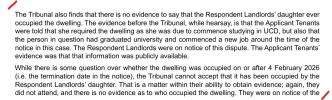
This bit @stormy might add to his list of cases because it's unreal that now hearsay evidence is fine for the RTB

1793191120560.webp
 
Hearsay evidence is fine in this case.
The landlord could have attended to challenge it.
Half right, and the half that's wrong is the half that matters.

The Tribunal isn't bound by the rules of evidence, and the hearing notice tells every party it will proceed and decide without them (s.104(4)(e)-(f)). The finding that decided the case, that the daughter didn't move in, didn't rest on hearsay at all. The investigator gave direct evidence of what he saw; the landlords gave none. On that, you're right.

But look at what else the Tribunal did with the hearsay. It made a finding of "ulterior motivation", and said it "must" make it. Nothing in s.56 asked for that finding, and nothing in the decision turned on it. s.56(1)(c)(ii) asks one question: did the person named in the notice move in within a reasonable time? It never asks why the landlord served the notice. Motive is not an ingredient of the claim, not a defence to it, and this Tribunal didn't treat it as a factor in the damages. A landlord with the purest intentions whose daughter changes her mind is caught by it; a landlord with the worst intentions whose daughter moves in anyway is not. The Act asks about occupation, nothing else.

That isn't an oversight in the drafting. The Act asks about a landlord's motive, and it says exactly where. A tenant who disputes a sale or family-occupation notice while still in the dwelling puts the landlord's intention at the centre of the case: the statutory declaration under s.35, the burden-shift in Stulpinaite v RTB, the genuine-intention test in Kelly v RTB [2024] IEHC 730, and whether the family member really "requires" the dwelling under Duniyva v RTB [2017] IEHC 578. And s.56 itself tells you that motive belongs there, not here:
"this section is without prejudice to the tenant's right to put in issue, in a dispute in relation to the validity of the notice of termination referred to the Board under Part 6, the bona fides of the intention of the landlord" - s.56(6)(b) RTA 2004​

Once the tenant has left on foot of the notice, the Act switches track. s.56(1)(c)(ii) stops asking why and asks only what happened next. Motive before you go, facts after. This Tribunal asked the first question in a case that only called for the second.

So the finding of bad faith was surplus to the decision. It changed nothing about the outcome, not the breach and not the €837.90. What it did do was put a finding of dishonesty against two named people on a public register, on what an agent and a management company were reported to have said, without the people concerned being there and without the Tribunal mentioning Ms Judge's own evidence that the agent had told her the dog issue was "unrelated to the termination". A tribunal that goes beyond the question the statute puts to it, in order to find against an absent party on hearsay, isn't applying the Act. It's editorialising, and the editorial now sits on a public record with their names on it.

That's the practice worth objecting to. Not that hearsay was admitted, but that it was used to decide something the Tribunal had no need to decide.

It also cuts the other way. In TR0001584 a landlord's hearsay about how a notice was hand-delivered was dismissed as "an assertion of practice rather than proof of delivery" because the person who delivered it wasn't called.


The rule is the same in both cases: hearsay gets the weight the Tribunal chooses to give it. In 1584 it was worth nothing. In 1645 it was worth a finding of bad faith the statute never asked for.


https://rtb.ie/disputes/dispute-outcomes-and-orders/adjudication-and-tribunal-orders/?_search=TR0001645
https://rtb.ie/disputes/dispute-outcomes-and-orders/adjudication-and-tribunal-orders/?_search=TR0001584
 
I am now completely confused.

Was it hearsay at all?

What was the actual hearsay as distinct from the reported comments?

This is not hearsay:

"The evidence before the Tribunal, while hearsay, is that the Applicant Tenants were told that she required the dwelling as she was due to commence studying in UCD, but also that the person in question had graduated university and commenced a new job around the time of the notice in this case. "

The tenant gave evidence that the agent told her that she wanted the house for her daughter.

That is direct evidence, not hearsay.
 
Last edited:
The tenant gave evidence that the agent told her that she wanted the house for her daughter.

That is direct evidence, not hearsay.

Direct evidence that the agent said it; hearsay the moment it’s used to prove anything about the daughter. But I take the point. The agent spoke for the landlords, his remark is near enough an admission, and I wouldn’t quarrel with a tribunal relying on it.

However, that isn’t the hearsay that did the damage. “Hearsay” is the Tribunal’s own word, and it put two things under it. The agent’s phone call is one. The other is what Google, LinkedIn and Facebook said about the daughter, relayed by Mr Murray. He said he’d taken screenshots; the report doesn’t record them being on file, only that “their evidence was that that information was publicly available”. So the motive finding (which is my gripe) rests on a tenant’s account of what he read online about a person who wasn’t there, with no record the Tribunal saw the pages.

And the agent’s remark grew in the telling. The evidence was that the daughter needed the flat “due to its proximity to UCD”. The tenants never said she was a student, though Mr Murray did note the notice came the week after CAO offers. In the Tribunal’s reasons for its findings, that morphed into the tenants being “told that she required the dwelling as she was due to commence studying in UCD”. That’s the sentence you pasted. Nobody said that. The agent said the flat was close to UCD. The Tribunal took the hint, wrote it down as the daughter being about to study at UCD, then used LinkedIn to show she wasn’t a student. It disproved its own paraphrase, not the agent’s words. For all the Tribunal knew, she wanted to live near UCD because her new job was nearby. The report doesn’t say where the job was, and nobody asked.

None of this touches the finding that she never moved in. That rests on the investigator and the landlords’ absence, and it produced the €837.90. Fine, I've no problem with that.

My objection is to the other finding, the one about motive. s.56 of the Act doesn’t ask the question, so the Tribunal had no business answering it. It answered it anyway, against two people who weren’t there, on evidence the report never records it seeing, and then rewrote that evidence so the answer would fit.

 
The tenant gave evidence that the agent told her that she wanted the house for her daughter.

That is direct evidence, not hearsay.
That is not direct evidence. It is hearsay because the tenant is recounting something the agent is alleged to have said. The tenant can not know if what the agent said is true. The tribunal should not rely on this as evidence. They knew it was hearsay and decided to rely on it anyway. It’s quite extraordinary. It was bonkers anyway, because the tenant knew the daughter had done their leaving cert so long ago it was unlikely they were going to college, the tenant said they googled the following:

- that the daughter had begun a job in Dublin
- the year daughter did leaving cert

Also
- the notice did not mention college as a reason
 
I thought hearsay was something different. But I am not a lawyer
John kicked the dog
Mary saw John kicking the dog.
Mary told Peter that she saw John kicking the dog.

If Peter gives this evidence in court, it's hearsay. It's reported indirect speech.

Mary can't be cross examined.

But in the RTB case the agent or landlord spoke to the tenant.

The tenant should be allowed to report that as evidence. The landlord could have challenged it had they shown up.

but the key issue here is that the landlord did not show up, so they have no grounds for complaint. And the RTB should not be criticised for making a decision on the unchallenged evidence in front of them.

Brendan
 
Back
Top