formerly good companies that are now dying, and are drying the marrow from the policyholders bones to the advantage of shareholders. I
Hi. That's why I added the PS to my post above, which you may have missed:
Maybe it's a bit unfair to say that policyholders are the patsies. The fact that such businesses are cash cows is partly the regulator's fault. The regulator forces companies to hold back lots of capital in case everything goes pear-shaped (new longevity XXXXXXXXXXXXXXXXXXXX mean that people will live forever, causing annuity costs to increase, AAA bonds default, etc.). Year by year, as it transpires that the world hasn't collapsed, the cash that's been held back for such contingencies can be released - on a very gradual basis.
PPS: don't know what happened there! I think the system thought I was saying something nasty when I was referring to aspirin, etc!!!!
You've may have heard of the term "new business strain" in the life assurance business. That's the extra capital that regulators force insurers to set aside when writing new business, for various reasons, including the risk of things going wrong. That additional capital need arises even if the business is expected to be very profitable. The opposite happens when businesses are in rundown.
Now to move to what I intended to write when I sat down this morning.
@PandPs put a lot of effort into their post. Thanks. They deserve a more comprehensive reply. I may not be able to cover everything now (domestic pressures!) but I'll make a start anyway.
Whenever Phoenix pays out a dividend of, say, €2/share, their share price mechanically falls by €2 (if it didn’t, someone would swoop in and arbitrage the hell of this market deficiency).
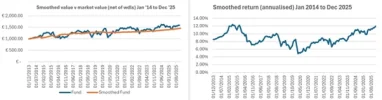
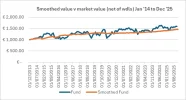
You're right. Every half-year, the share price falls (more or less by the amount of the dividend) on the day it goes ex-dividend (xd) reflecting the fact that value is transferred from the share price to shareholders' pockets. Those half-yearly price falls are fully reflected in the quoted prices and in the graphs attached to my previous post.
You're also right about the dividend being received gross.
If Phoenix decided to change its corporate strategy tomorrow and to no longer pay dividends, there should be no reason for you to change your investment strategy. Instead of getting €X/month of dividends from Phoenix, you’d just sell €X worth of Phoenix shares. Your income would remain strictly identical. The overall performance of your fund would remain strictly identical. The taxes you pay would remain strictly identical. This would literally make no difference whatsoever to you.
In theory, you're right here too. I'd say that there are quite a few members of the Phoenix Board and management team who'd like not to have the millstone of a high dividend around their necks, but they're stuck with it. They know that a change in strategy could potentially cause the share price to plummet. Shareholders are comfortable with the strategy that's there now. The devil you know is better than the devil you don’t know, etc.
If they make a big acquisition (e.g., taking on Standard Life a few years ago - which caused me to lose a job by the way, but that's another story!), their only realistic option was a rights issue, accompanied by a promise to keep the dividend at its former level.
Whenever Phoenix pays out a dividend when its share price is at the bottom, you’re in effect selling at the bottom (but with dividends, you can’t even control that. So even if you don’t need the cash at that particular point in time, you’re forced to take it and take the hit).
I'm not sure I get this part of your post. Dividends are within the company's control; the share price is not. It's determined by others. The Board is committed to paying a dividend of x every half-year. If something terrible happens to the business, i.e., in the real world, then they can reduce it, but they take all sorts of steps (hedging, etc.) to minimise the risk of having to cut the dividend. The price is a different story. They have no control over that so they're not going to cut the dividend just because the share price has fallen.
Looking at the share price graph you shared, it looks like Phoenix is the opposite of a safe, stable, bond-like investment. It’s all over the place.
Yes, that's one of the points I was trying to make. That's why I'm not too concerned about the price. I (or my estate) will have to worry about it sometime, of course.
As to what causes the share price to gyrate so wildly, I may have to come back on that, but I'll mention a few factors.
Firstly, everyone agrees on what the next dividend is going to be, probably the next few dividends.
Even if dividends were cast-iron guaranteed though, the share price would still gyrate as the discount rate investors used to value future dividends changed. Consider it as a very long-dated bond.
But dividends are going to rise or fall in the long-term. History shows them rising gradually. Even I don't expect them to keep rising, but others may be that optimistic. There's also a possibility that they'll fall. That's the natural course of events if Phoenix doesn't acquire new business. Therefore, some of the price changes reflect changing views on how dividends will progress in future (and whether they'll overpay for new business).
A final consideration is the price at which the share will eventually be sold. If it's a bond, you're guaranteed the nominal value at maturity. There's no such guarantee with Phoenix. I (or my estate) will be completely at the mercy of the market when the share is eventually sold. The price then could be 741, as it is currently, or it could be down to 480, what it was this time last year. That's a much greater imponderable than the dividend. It doesn't worry me too much, provided the dividend is secure, which it was this time last year as well. It does worry others. For example, based on what he's written on this forum many times about his loss aversion, I doubt if
@Duke of Marmalade would invest in it. He'd prefer to keep his money in the bank.