Performance Update for Colm Fagan's ARF

I managed to download the S&P 500 performance for H1 2025 (attached).
I am not very happy with the preliminary results as they suggest a quite tight distribution of portfolio returns. I will try and get full year figures
It could be an abnormal period since its around the time of the Trump tariff shock and recovery. Whereas a longer period would show more representative growth.
 
Last edited:
It would show how Colm's portfolio compared against all the possible options; i don't think their average returns would necessarily be the same as the index at all.
I haven’t been following in detail your interactions with @Duke of Marmalade but I’m not sure I see the relevance.
A fund invested entirely in the S&P590 would not have had a great 2025 because of the dollar’s weakness. No amount of selecting among its constituents alters that fundamental truth.
 
Bessembinder effect discussed previously here too:
 
The long-term performance of my self-managed pension in payment (ARF) poses tough questions on the value added by professional asset managers.

According to figures supplied by Rubicon Investment Consulting (Fiona Daly) - https://lnkd.in/dkQzTYJk - the top-performing multi-asset fund in Ireland in the 15 years to 31 December 2025 was Zurich’s Performance Fund, with an average return of 9.5% per annum. It was followed by Cantor Fitzgerald’s Multi-Asset 70 (9.2%) and IQEQ-DAM’s Select Managed (8.5%). Irish Life’s Pension Managed Fund returned an average 7.4% over the same period.

I started my ARF as a strapping 61-year-old at end 2010. Its average return over the same 15 years was 10.8% a year after all charges, including those by the platform provider at over 0.6% a year except for 2024 and 2024, when I negotiated them down to 0.4%. All such charges are excluded from professional managers’ results.

One could argue that my return didn’t allow for a notional fee to myself for managing the fund. Any such fee – notional or actual – would have been a reward for sloth: there were no transactions in 2023, just four in 2022, five in 2024. I did a bit more in 2025 - 8 purchases, 5 sales involving 8 companies - but still not enough to avoid getting sacked for laziness if I had been employed by a professional asset manager.

I don’t claim any special investment expertise. I never worked in an investment department; my only formal investment training was obtained when studying for the actuarial examinations over 50 years ago. The returns resulted from following a few simple rules, which I’ve outlined in various LinkedIn posts and on askaboutmoney.

If my experience with auto-enrolment is repeated, I’m unlikely to be invited to high-powered investment conferences to discuss my approach: my auto-enrolment proposal delivers higher pensions than My Future Fund at half the cost and much lower volatility, yet the IAPF (Irish Association of Pension Funds) declined my every request to discuss it at one of their conferences.
 
The long-term performance of my self-managed pension in payment (ARF) poses tough questions on the value added by professional asset managers.
Does it though? How many people are going to go as hands on with their pension investments as you have? A tiny minority I would imagine. Those that don't (including myself) pay for the convenience of not having to get our hands dirty. In my case I pay 0.35% AMC* to Royal London Ireland to deal with my main PRSA which is in their BlackRock Developed World Equity Index Fund passive tracker. Admittedly that's probably lower than would generally be available to RLI customers.

* Ignoring any discretionary ValueShare bonus.
 
IAPF would be perfectly entitled to turn someone away from their door that doesn't know the difference between a multi/mixed asset fund and an equity fund and who feels it's fair game to draw any sort of credible comparison between the two.
 
Colm, while a supporter of much of what you say, your message here is unclear and you should look to refine it. If you want to say you have done better than the professional managers then you should compare against the 100% equity funds not the multi-asset funds. If you’re trying to say 100% equity is better than the multi-asset construct then that is different albeit your timing is coincident with a long-term bull market and you should include this in any commentary if this is your angle.
 
IAPF would be perfectly entitled to turn someone away from their door that doesn't know the difference between a multi/mixed asset fund and an equity fund and who feels it's fair game to draw any sort of credible comparison between the two.
You may be right but the IAPF is a bit of a closed shop IMO, a vested interest group subject to a lot of group think and trying to pepertuate jobs for the boys. So even if one made arguably more technically correct comparisons, i doubt they would be that interested in alternative views of the world

Lots of investment consultancy types are still smarting with how badly their liability driven investment approaches did in the aftermath of the uk mini budget a few years back
 
Last edited:
comparison. I also don't see how they chose which multi-asset funds to include in their survey.
I think it's largely historical. Up to around 2008 or so a peer benchmark approach was used, also known as the managed pension fund survey

This was switched away from but generally i think rubicon uses multi asset funds with a high equity content but also include some bonds and other asset classes assuming broadly the same asset allocation as the old blanced managed pension fund.

The move away from the peer group approach probably put some distance between the terrible performance of these funds in the aftermath of the 2006 to 2008 financial crisis
 
Last edited:
For example, a significant proportion of my holdings are in sterling and it was necessary to convert sterling dividends to Euros in order to take a (taxable) income from the fund. They took a cut every time I converted sterling (or dollars) to Euros. That cost isn't included in the fees.
Why not cash the dividends in pounds sterling and lodge to UK based bank account, then transfer to yourself via Wise? I think you may even be able to lodge into Wise, but you could use Revolut/Monzo (my children found those last two to be the easiest way for UK bank accounts.) I used Wise to transfer Euros pounds and it was simple and cheap.
 
It's a pity they don't have figures for equity funds to make a more valid comparison. I
If you want to say you have done better than the professional managers then you should compare against the 100% equity funds not the multi-asset funds.
Similar comments on LinkedIn have caused me to question the appropriateness of the chosen benchmark funds. A friend in Zurich made a similar point, saying that Zurich's International Equities Fund was a more appropriate benchmark than its Performance Fund. Zurich's International Equities Fund averaged 11.2% pa over the period, very close to my 10.8% after deducting the platform charge.

Thinking about it, though, I still feel that the funds chosen were appropriate benchmarks. My aim from the start was to simulate a "balanced fund" but I eschewed the bonds part of the "balance" on the grounds that it would mean sacrificing too much long-term return, opting instead for high-yielding "safe" equities (my definition of "safe", of course!!) as my substitute "bonds"; however, I'm happy to hear dissenting views.


Like

Reply
 
Does it though? How many people are going to go as hands on with their pension investments as you have? A tiny minority I would imagine. Those that don't (including myself) pay for the convenience of not having to get our hands dirty. In my case I pay 0.35% AMC* to Royal London Ireland to deal with my main PRSA which is in their BlackRock Developed World Equity Index Fund passive tracker. Admittedly that's probably lower than would generally be available to RLI customers.
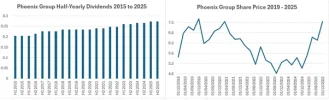
I admit at the start that I like owning shares in "real" businesses rather than funds. That's personal and I don't expect others to feel the same; however, owning shares in real companies gives peace of mind that's impossible with a unit-linked fund. Take for example my experience with Phoenix Group quoted above (#236 - the graphs that accompanied that post are included below). The knowledge that I'm assured of a nice steady dividend income means that I don't give a hoot about share price movements.

On your point about being "hands on", there's very little overhead involved. As mentioned in the post, there were no transactions whatsoever in 2023 and just 4 in 2022. If I were in unit-linked funds, I'd have to sell units every month.
I suspect that your ARF is not your main income source in retirement. Mine is. I don't have any DB pension. There's no way I'd invest in something like the Blackrock fund you mention. I'd think it too risky. I want a combination of "safe" bond-like investments and more risky "equity-like" investments; however, my "safe" investments (such as Phoenix) are called "high-yield equities" (less so now in Phoenix's case after its recent price rise).
 

Attachments

  • Phoenix Divs and Share Price.webp
    Phoenix Divs and Share Price.webp
    15.7 KB · Views: 58
Similar comments on LinkedIn have caused me to question the appropriateness of the chosen benchmark funds. A friend in Zurich made a similar point, saying that Zurich's International Equities Fund was a more appropriate benchmark than its Performance Fund.
I was trying to address this is earlier posts, a more appropriate approach to benchmark your performance would be to compare against all the possible funds you could have chosen, e.g., you could have selected lots of sat 12 stock equally weighted portfolios back in 2010 out of the say a universe consisting of 230p individual shares ( number of constituents of the msci world index). Therefore you should compare the performance of your particular fund against how all possible similar funds performed

You could calculate the returns of all such portfolios and see where yours ranked against these.

For what it's worth, i worked as a fund manager and in investment consultancy, and based on my experience, this would be the most appropriate way to benchmark your performance.

Since you are not considering bonds and other asset classes at all, i dont think comparisons with mulit asset funds are appropriate
 
IAPF would be perfectly entitled to turn someone away from their door that doesn't know the difference between a multi/mixed asset fund and an equity fund and who feels it's fair game to draw any sort of credible comparison between the two.
Firstly, you misunderstood my reference to IAPF. My reference to IAPF was in relation to it hosting a discussion on my auto-enrolment proposal, not my investment strategy.

Secondly, I hope my other replies have made it clear that I take a more nuanced approach to investments than simply classifying them as "equities", "bonds", etc. I view my shares in Phoenix Group Holdings (say) completely differently than those in Nvidia. Yes, they're both called "equities" but they're as different as chalk and cheese. Phoenix I see as a form of high-yield bond (less so now, as mentioned above) while Nvidia is more like what is normally viewed as an "equity".
 
Since you are not considering bonds and other asset classes at all, i dont think comparisons with mulit asset funds are appropriate
It's impossible at this point to recreate my thought processes from 15 years ago, but my intention at that time (I think) was to invest in a combination of bonds and equities (OK, maybe with some property in the form of shares in a property company, which I actually do have).
I probably had a naïve view that I'd switch between bonds and equities depending on my view of the market (anticipate a downturn and move into bonds, etc.); however, I realised quickly that it was foolish to think I could outguess the market so that plan went out the window. Also, I decided to ditch the "bonds" part of the strategy when I saw how much extra return could be got from dividends in shares that are described as "equities" but which in reality are more like irredeemable bonds. So, the decision to invest 100% in equities was accidental rather than intentional.
 
@Colm Fagan

I would be very curious to know the risk characteristics of your portfolio over the last 15 years in terms of annualised standard deviation and maximum drawdown.

In other words, did you manage to achieve something close to the return of the broader equity market but with lower volatility?
 
On your point about being "hands on", there's very little overhead involved. As mentioned in the post, there were no transactions whatsoever in 2023 and just 4 in 2022. If I were in unit-linked funds, I'd have to sell units every month.
Yes, but surely you're having to keep tabs on everything in order to know if/when you might need to effect changes? And that must take time and effort? Whereas I rarely think about my PRSA invested in the BlackRock passive index tracker.
I suspect that your ARF is not your main income source in retirement.
Actually my vested PRSAs (smaller policies chipped off my main pension) have been my main income in recent years through the pro-rata TFLSs and ongoing income. This is since I drifted into de facto early (late 50s) retirement having quit my last, long term, job due to burnout and disillusionment. I do have a smaller passive income stream too and I have significant non pension means that give me a good buffer if necessary.
 
I would be very curious to know the risk characteristics of your portfolio over the last 15 years in terms of annualised standard deviation and maximum drawdown.

In other words, did you manage to achieve something close to the return of the broader equity market but with lower volatility?
I don't have a quick answer to your questions. I look at risk, etc., differently to how a fund manager, analyst, whatever might look at it. My earlier post on the different ways of viewing my Phoenix investment (price or income stream) gives a clue as to how I look at them; however, I hope to be able to give you some information that will help answer your questions.
The spreadsheet below shows yearly cash flows and yearly returns since 2010. The maximum return was +45.3% in 2019 while the minimum was -15.3% in 2018.
I'll get back to you separately with monthly returns and cash flows since 2014, plus more on how I look at risk.
 

Attachments

Back
Top