Performance Update for Colm Fagan's ARF

I’ve just done the exact opposite of what the “experts” advise: I’ve REDUCED my diversification: my pension account now has just 15 shares, down from 16 at year-end.

I’m with Warren Buffett who once quipped, “If you have a harem of 40 women, you’ll never get to know any of them very well.” (The comparison would prompt my wife of fifty-something years to say, “Dream on, old man”).

A concentrated portfolio has served me well: in the 15 years since I started drawing down my pension, withdrawals have exceeded the initial investment, yet the residual fund is now worth more than double its starting amount.

The latest exit (Town Centre Securities) was chronicled in post #297 above. I also sold what was left of my Apple holding - less out of conviction than from a desire for consistency, following my recent musings (see post #294 above), a decision that now looks less than inspired, given recent movements in Apple's share price. I should have heeded the words of my one-time boss, Seamus Creedon, from decades ago: “Consistency is the last refuge of small minds”.

I have added one new share to the portfolio, to replace the two I’ve sold. My wife will be relieved to learn that new woman in my harem is well over a hundred years old! I’m keeping her under wraps for now.

 

Attachments

  • harem.webp
    harem.webp
    87.6 KB · Views: 48
May have missed it Colm, but what withdrawal rate have you used over the years and do you adjust it as a percentage of fund, yearly growth or just increase with inflationary needs?
 
Last edited:
May have mixed it Colm, but what withdrawal rate have you used over the years and do you adjust it as a percentage of fund, yearly growth or just increase with inflationary needs?
6%?
Withdrawals are 6% a year, funded mainly by dividends.
I haven't looked at the numbers for that year, but dividends probably covered about 4% of the income I took from the fund, leaving another 2% to find by way of asset sales.
 
A concentrated portfolio has served me well: in the 15 years
Could it be you just got lucky Colm?

A more concentrated portfolio is always more likely to to have more volatile returns and maybe you just got lucky and your portfolio is in the right side of the bell curve, one could argue you were equally as likely to be on the left side of the bell curve?

As an aside almost 50% of my pension assets are invested in one stock and one commodity (actually until recently enough I was nearly 50% in one US listed company), so I am one to talk.
 
May have missed it Colm, but what withdrawal rate have you used over the years and do you adjust it as a percentage of fund, yearly growth or just increase with inflationary needs?
@ClubMan's answer is almost correct. There was the complication of an AMRF at the start, which I could leave untouched until a few years ago, so the initial percentage was a bit less than 6%. Also, there was a once-off transfer in (in 2016, I think) from a small insurance company ARF, which was counted as a positive cash flow (i.e., a negative withdrawal). Detailed month by month withdrawals (and returns) from January 2014 are shown in the entry dated 1/2/2026 on the pensions tab of my website.
Could it be you just got lucky Colm?
Could be. I'll take 15 years of being lucky.
 
Last edited:
Could it be you just got lucky Colm?
It has been pointed out that, if I had invested in a passive world equity fund, I would have done at least as well (even allowing for the platform provider’s charges), so I wasn’t lucky; I just got an average return for my investment strategy. I don’t know. Someone on this forum will be able to confirm, I’m sure.
I would still prefer my approach, as I know exactly where my money was invested; I was confident that the companies in which I’d invested would deliver good returns in the long-term (the vast majority of them anyway).
The main point, though, is that it’s lunacy NOT to invest in equities post-retirement. The equity risk premium is very real, if volatile. The average pensioner has a life expectancy of 20 years or more from retirement. That gives more than enough time for the ERP to do its job, despite the volatility handicap.
 
The main point, though, is that it’s lunacy NOT to invest in equities post-retirement.
For a lot of retirees i agree with this, especially if you have other sources of income (ideally some guaranteed) but i think for some who have less assets the strategy mught be too risky in that they might not recover from a prolonged downturn in equities if they still havento draw down an income when equity values are depressed

My own plan it to do something pretty similar to what you did, plan to have core holding of 15 to 25 stocks, most paying a bit more in dividends than the market average
 
I think we can all agree that retirees should always have a proportion of their portfolios invested in equities post-retirement.

The question is how much?

For most folks I would suggest that anywhere between 30% and 70% is reasonable.

Having your retirement savings invested 100% in equities potentially jeopardises a comfortable retirement if it turns out that you retire in the teeth of a serious market crash.
 
The main point, though, is that it’s lunacy NOT to invest in equities post-retirement.
And this lunatic regrets not heeding you a long time ago :(
But, and this is especially true in the context of AE, the utility calculus is hugely dependent of individual circumstances.
For some people, at the margin they are really only investing on behalf of their estate. They personally would not see their living standards in this mortal coil ever being compromised by a market downturn. Not saying they couldn't care about their beneficiaries but their utility function is likely to be much flatter, close to risk neutral and furthermore the duration is much longer now encompassing two generations.
But at the other extreme, and here is where AE becomes relevant, losses take on a much greater significance. For these people there could well be a utility weighted negative ERP. Also their horizons would be much shorter. A 25% fall over the next 12 months would necessitate a complet reassessment towards holding on to whatever you can.
 
Last edited:
most paying a bit more in dividends than the market average
If you have income (e.g. OACP plus other income streams) that use up your tax credits and SRCOP then selling shares rather than taking dividend income would be more tax efficient (CGT versus top rate income tax plus USC)?
 
if it turns out that you retire in the teeth of a serious market crash.
This thinking would have been more applicable when people had to retire all of their funds in one go and buy an annuity. That's probably not the case for many people these days with more flexibility in terms of staggered/phased retirement of pensions and rolling over to an ARF or vested PRSA.
 
Not really.

If you retired at the start of 2000 with a €1m all-equity portfolio and drew down €40k a year, you would have gone bust years ago.

If you had 30% of the initial portfolio in government bonds, you would still be happily drawing down €40k a year today.
 
If you retired at the start of 2000 with a €1m all-equity portfolio and drew down €40k a year, you would have gone bust years ago.
If you retired in 2018 with 183k in an all equity ARF and drew down 4% per year you would now have an ARF pot of 315k and your yearly drawdowns would have increased from 7.3k per year to over 12k per year.
 
Not really.

If you retired at the start of 2000 with a €1m all-equity portfolio and drew down €40k a year, you would have gone bust years ago.

If you had 30% of the initial portfolio in government bonds, you would still be happily drawing down €40k a year today.
Presumably someone who retired then with that portfolio took a TFLS of say 200k, and then either had 1 million or 800k left all in equities after they took it. Would them have seen the market fall and lived off their lump sum for 5 years and/or adjusted their drawdown. Just like anyone would do now and no one would ever just blindly keep taking their planned needs in the face of a serious market adjustment?

If they lived off the lump sum for the 5 years and started taken withdrawals of 4% in 2005 they would still be worth about 3million now according to back of an envelope stuff
 
Last edited:
For a lot of retirees i agree with this, especially if you have other sources of income (ideally some guaranteed) but i think for some who have less assets the strategy mught be too risky in that they might not recover from a prolonged downturn in equities if they still havento draw down an income when equity values are depressed
I can see where you're coming from, and I would probably agree with you IF I were invested in funds rather than directly in equities. But being invested in real businesses, I take a very different view.
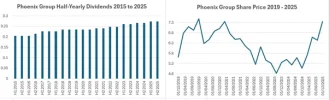
To illustrate why, let's assume it's 31/12/2018 and I'm wondering where to invest €100. I can put it in a government bond that will give me (say) €3 a year for the next (say) 10 years and my €100 back at the end. OR, I can put it in Phoenix Group shares that will give me a dividend of €8 a year (assuming last year's dividend is maintained), almost three times what I'd get from the bond (probably more than three times, because I suspect that bond yields were less than 3% at the time). I then look at the chart below (see #254 above), which shows the Phoenix dividend following a nice upward (at least not downward) trajectory for God knows how long, and I decide that it's a no-brainer: I wouldn't touch a government bond with a 40-foot bargepole.
Of course, the Phoenix dividend could fall. I recognise that, which is why I hold other shares. I can do a similar calculation for those shares (although it won't be as straightforward as for Phoenix) and I come to the same conclusion. Ergo, I don't put a cent in bonds.
 

Attachments

  • Phoenix Divs and Share Price.webp
    Phoenix Divs and Share Price.webp
    15.7 KB · Views: 33
Last edited:
If you retired at the start of 2000 with a €1m all-equity portfolio and drew down €40k a year, you would have gone bust years ago.
It amazes me that the infamous "retired on 1/1/ 2000" scenario is still being trotted out, more than 25 years later.

Firstly, I hope you'll agree that it's reasonable to assume that, if you retired on 1/1/2000 with an all-equity portfolio, you were in equities all the way through. Which means that you'll have enjoyed 152% appreciation since 1/1/1995 (based on FTSE figures in GBP; Euro figures were unlikely to be much different); 104% appreciation since 1/1/1996, 75% appreciation since 1/1/'97, 41% appreciation since '98, and 24% appreciation in the last 12 months. If you or your adviser think that those massive short-term gains are permanent and bankable, you need to have your head examined. This is one reason why I use smoothed returns for planning purposes. I would advise others to do the same. (As an aside, my fund is currently well above smoothed value).
Secondly, I know of no-one who makes constant cash withdrawals from an ARF; it’s always a percentage. Mathematically, the same percentage can be taken forever without exhausting the fund. (Of course, the residual fund could keep getting smaller!).
Thirdly, in relation to "sequence of return risk", which is often trotted out to deter people from investing entirely in equities, I agree that you're in trouble if you keep making constant cash withdrawals in the early years, while markets are falling. The good news is that the early years of retirement are when you're most likely to be able to take on part-time work to help bridge any gap between affordable withdrawals and required income.
 
Last edited:
Back
Top