It is definitive but for argument sake, lets use the unit rates that @FANTANA and many others use to overestimate the payback.completely wrong is a bit definitive.
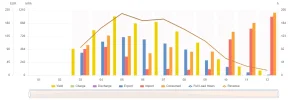
For 6 months of the year (April - September) , the system should produce an average of 650 kWh per month or 21.5kWh per day. They will now add 12.5kWh to that from an overnight charged battery.
That's 34kWh of usable electricity during daytime hours. For reference, we are also an all electric household for domestic use and heat pump. For those 6 months we average 13 unit per day with 8 units on the daytime hours. Unless I'm not mistaken, every single unit from the battery will go straight back to the FIT.
Even in the tail months of Feb, Mar, Oct, and Nov, our own daytime usage creeps up to 15 units on average as the HP does more work. The solar should still be generating 12.5 units along with the batteries 12.5 so still an excess of 10 units going to FIT.
I don't believe fantana has a heatpump so if their domestic use is more typical like the CRU's 4200 then pretty much all of the battery use for 9 months of the year is going to FIT as well as some in winter months. The savings is closer to €450-500
The point of all of this is to show that the vast majority overestimate their savings. Fantana has a great setup but the value has come from the massively reducing cost of batteries, the DIY install, comparing the wrong unit rates and by choosing to ignore the upfront costs when installing solar to allow the battery to be added.
In my approach it is still possible to land on the same plan when assessing the impact. This would typically happen when usage is high like yours (EV&HP) and either solar only or battery only is implemented.If i had a 16kwh battery and i diverted day usage to night it should save me circa 1.72 a day or 630 a year. Take 15% off (which i think is high) for days in the summer when i cant fully utilise the battery in a day (but would also charge less) its still around 535, you'd pay the battery back in 3 years.
To finish with a quote I've seen on AAM and I think it was from @Micks'r , "the cheapest unit is the one you don't use".
There are so many people who are very inefficient with their energy use before they install solar. This arbitrarily inflates the payback because it gets included in the calculation but that saving can be made independently. Similarly with switching provider every year. That is a 'free' saving that shouldn't be assigned to solar.
I'm a fan of solar/battery but I laugh when I see people claiming payback of less than 5-6 years.