How much are Solar Panels worth

Thanks for your reply. This is the argument I am trying to figure out. Your previous electricity costs were 1K per year and you spend 10K and you expect a payback of that in less than 5 years. This just does not add up for me. Do you actually get money from the electricity provider?

For this to work:

1. They would have to be getting 1k in FIT payments every year , on top of the 2 points below..
2. They generate enough solar throughout the year (including FIT to offset during winter), so their bills are zero.
3. The amount of solar they generate covers the standing charges as well, in FIT payments

So agree, it does feel a bit far fetched..
 
So agree, it does feel a bit far fetched..

It may sound like far-fetched but....

Pinergy FiT rate is 25c.

9.9kWp South will generate roughly 9,900 kWh in Ireland. Let's say you exported the lot at 25c = €2,475. Now, some of that is taxable. So let's assume €800 credit, so €1675 is taxable at 52% is €804, add back in the €800 tax-exempt export and you've got €1604. 6.25 years to pay back 10k, assuming nothing changes with FiT rates, etc.

And I haven't even started with potential earnings from charging a battery at 6c overnight and selling some at a post-tax 12.5c. Nor the potential household savings in lower running costs as a result of that battery.

Or with that amount of generation, putting the bill solely in the name of standard rate tax-payer may be more beneficial than having 2x €400 allowances.

Going by his signature, I'm guessing @Micks'r knows exactly what he's doing.;)
 
It may sound like far-fetched but....
Pinergy's day rates are 42c.

You've created a saving of €2k by selectively ignoring the penalty of going to 42c for existing usage.

I think @Micks'r is optimistic with a 5 year payback, more likely to land at 6.5-7 which is still great value
 
I think @Micks'r is optimistic with a 5 year payback, more likely to land at 6.5-7 which is still great value
You might be right, there are a lot of variables in play, only time will tell and I will post the actual performance in time.
 
You've created a saving of €2k by selectively ignoring the penalty of going to 42c for existing usage.
Fair, I was only demonstrating how it might not be far fetched. But the again, maybe the battery covers non-EV period usage.
 
Just shy of 242 kWhr
On your 9.9kWh panels for the first 10 days of March.

Wow, that is excellent. I have 185 kWh for the same 10 days with 9.45 kWh of panels. (193 kWh scaled up so 25% more)

I wonder are you in a sunnier part of the country or is your orientation better. I have 15 panels facing SE and 6 facing SW
 
Fair, I was only demonstrating how it might not be far fetched. But the again, maybe the battery covers non-EV period usage.
I have no doubt solar is good value in the long run, getting solar installed myself in June, just ppl's claims of paying 5 years or under, is really exaggerating it.. Its as if they know the future.....
The demonstration of how it is not far fetched, is not real life, so doesnt really illustrate anything..

Also, as batteries / inverters typically have 5 or 10 yrs warranty, when the 10 years are up you may need to replace one or the other, inverter / battery / panels will fall in performance over time, which will eat into the ROI.. Of course on the positive side with the cost energy going up, that will help ROI

As I have seen on the Facebook page for Solar, ppl having issues with the system, some teething, some not. But you again typically have 5 yr warranty with installer, after that you will have to pay to get someone to look at it.

I have no doubt this system will need maintenance of some form the older it gets...

Do panels need to be cleaned, people say they are self cleaning, but again Im sure after 5yrs (or less even, depends where you are) their will be a build up dirt that would need to be cleaned, and other costs that I am not aware of yet.

Im trying to go in with my eyes open, and not the absolute best outcome, as this is usually not real life, some will be luckier than others...
 
Last edited:
Im trying to go in with my eyes open, and not the absolute best outcome, as this is usually not real life, some will be luckier than others...

Yeah, I think you're worrying a bit too much about potential downsides though. In reality, 6-7 years is probably the average payback period. All based on current energy prices for sure, but they will generally track upwards with inflation and rarely reverse to any great extent.
 
Yeah, I think you're worrying a bit too much about potential downsides though.
I dont think its being pessimistic, just reality.. Im still getting mine, cause overall, in the long run I think one would save money...

Whether it is 6/7 year or 10 years really depends on the scope of the system and how it is used..If you have a large system and are getting every morsel out of the system, yes it could well be 7 years, everything going well.. Too many unknowns to make an exact estimate

Systems need maintenance, you cannot expect to leave a system for years on end and expect it to run, just does not happen..

I like to err on the side of caution...
 
Last edited:
Im trying to go in with my eyes open, and not the absolute best outcome, as this is usually not real life, some will be luckier than others...
You are, of course, 100% correct that future maintenance etc is not taken into account (my bad I guess) and as you say nobody can see into the future especially in the trajectory of FIT so there are a lot of unknowns.
However, there is also no account taken of the uplift in the value of the dwelling due to a better BER result (as much as I abhor the BER system of rating a dwelling). I don't know if true in reality but according to the SEAI, each level improvement in the BER appears to translate into a property market value increase of 1%.
So perhaps there is a longer than 5 years cashflow payback period but a shorter balance sheet payback period.
Interesting argument alright but there is one thing for certain, with the right setup and careful selection of installer/maintainer there are savings to be made.
 
My only gripe is ppl never include maintenance costs in their payback estimate..
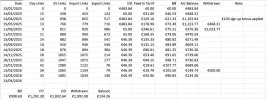
Very little maintenance is required if installed properly in the first place. Ours will be installed 4 years this February, and after some initial issues with the install we have had no issues since or any maintenance required. Our payback was coming in around 42 months, and as they were working so well, I expanded the array and added 20 kWh of batteries last January, and switched to the Pinergy plan.

I'm currently in credit, and our electricity has cost me nothing for 12 months. I did save money by installing the additional array myself, building the battery and creating several automations to maximise export, so not typical, but the payback on the additional panels and battery should be about 24-30 months if the Pinergy plan stays the same. We also purchased a small EV to cover all local trips and are saving about €100 a month in fuel, not included in any payback or the figures below, but it is on track to pay for itself after 42 months, barring nothing serious goes wrong with it.

Pinergy figures below after the grant and the expansion the total cost was about €6500.
The table got mangled. Here's a screenshot
1773477729533.webp
​
 
Last edited:
Can you explain the table a bit? Looks very interesting. For instance the Day and DD columns and what do the last two rows mean?
 
Day - Imported units at Day rate
EV - Imported units at EV rate
Import - Total kWh imported
Export - Total kWh exported
DD - Direct debit, Pinergy have a level pay that's off the charts for the first few months and then will recalculate it.
FIT - Feed in Tarrif
Bill - Total bill including standing charges etc.
Balance - Balance on the account.
Withdrawn - At any time, you can request that the credit be refunded to your current account
*Edit, I spotted a couple of mistakes and corrected them
 
Last edited:
Back
Top