You are using an out of date browser. It may not display this or other websites correctly.
You should upgrade or use an alternative browser.
You should upgrade or use an alternative browser.
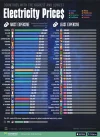
Dublin still has highest electricity prices of all EU capitals despite latest fall - 50% higher than before Ukraine war, gas prices are 72% higher
- Thread starter WizardDr
- Start date
Relatives in Northern Ireland have been complaining about the cost there - I expected them to say it was about 20p a unit, but they are paying 31p and that's after a 22% discount.
Wonder what the sinn fein are doing about this.
They seem to have answers for the Republic, but none in Northern Ireland where they actually have some governmental power.
Wonder what the sinn fein are doing about this.
They seem to have answers for the Republic, but none in Northern Ireland where they actually have some governmental power.
So Ireland has the highest electricity prices in EU and our retail rates are three times higher than our wholesale rates. How do you find out what the wholesale rates are though, where can this information be found.
Why does Ireland have the biggest gap between wholesale and retail rates in Europe?
We have plenty of energy companies now so surely that huge gap should have been competed away?
Is there some structural inbuilt margin guaranteed to these companies by the regulator, there has to be a reason for it?
Why does Ireland have the biggest gap between wholesale and retail rates in Europe?
We have plenty of energy companies now so surely that huge gap should have been competed away?
Is there some structural inbuilt margin guaranteed to these companies by the regulator, there has to be a reason for it?
Have you tried Googling these questions or contacting the Regulator (info@cru.ie) @joe sod? We're 60 replies deep and I don't think there is any more knowledge to be plumbed here.
Sure by that logic there is no point in having any discussion forums whatsoever. The cru website doesn't supply that sort of deep information it was obtained by a European oversite body investigating energy prices throughout the block, that's how it came to light.We're 60 replies deep and I don't think there is any more knowledge to be plumbed here.
You seem fairly knowledgeable yourself on these matters, can you throw some light on it?
I'm Nobody
Registered User
- Messages
- 111
I remember many many years ago the Irish regulator saying we need high electricity prices here to bring in competition from abroad.
I recall a few years ago new competition entering the market having to forward hedge and buy a couple of years ahead. Fair enough.
But, any company buying now should be buying wholesale at the same price as European providers.
You really have to wonder what’s going on here.
Interesting piece by David McWilliams in IT at the weekend saying that wind farms on the Atlantic coast could generate enough electricity for all of Europe, not just Ireland. Imagine even building enough wind farms to give us free electricity.
But, that’s precisely what we lack here - imagination.
D.

Conor Skehan: When will Ireland have a lightbulb moment on the cost of electricity?
As we head into the depths of winter, the annual stress test of our electricity system is back. We hear warnings about storms, tight margins and resilience. All important. But the most damaging questions are rarely asked. Why is Irish electricity so expensive and why is cost treated as a side issue?
 m.independent.ie
Conor skeehan has been writing about this very issue, its behind a paywall but first paragraph gives the gist of his article. Also heard him on newstalk this morning discussing it.
He is saying that our very high electricity prices are structural and down to successive decisions the government and state bodies have been making. They have opted for very high renewable targets which are hugely expensive to deliver. However there has been no public debate on this whatsoever, that these targets would make our electricity very expensive. The government want to deliver offshore wind turbines but these are 6 times more expensive to deliver than other forms of electricity generation. The public has not been informed about any of this. This is making manufacturing anything in Ireland very expensive and contributing to our high inflation rates, oil prices are falling yet food prices in Ireland are rising especially from domestic production .
Perhaps Conor said more on the radio @joe sod, but that is not an accurate summary of the article. He does not single out renewable targets as the cause for high electricity prices and he doesn't suggest the government has been doing anything behind closed doors - sure the very reason we're having to do offshore wind is because the general public have weighed in and said they want wind energy [1] [2] [3], but not in their backyards. Below is (I think) a closer summary of the article, but the short version is that he wants to see affordability as a key pillar of future energy policy and infrastructure decisions.
Conor Skehan argues that Ireland’s electricity prices are not just high, but structurally expensive, and that cost is consistently treated as a secondary concern in energy policy. He says this matters deeply because Ireland is an export-driven manufacturing economy, reliant on competitive input costs to attract and retain industries such as pharmaceuticals, medical devices and food processing. Persistently higher power prices act as a hidden tax on enterprise, quietly undermining competitiveness and discouraging investment that never makes the headlines because it never arrives.
He criticises recent infrastructure and energy planning for focusing on delivery, scale and decarbonisation while assuming affordability will sort itself out. Drawing a parallel with housing policy, Skehan argues that prioritising supply without embedding cost discipline leads to predictable failure. Offshore wind is cited as a clear example: deep-water projects are far more expensive than onshore alternatives, and those higher capital costs ultimately land on consumers and businesses, potentially locking in a long-term competitiveness penalty.
The article warns that Ireland risks repeating mistakes seen elsewhere, pointing to Germany’s industrial decline as the cumulative result of well-intentioned but uncoordinated policies that drove up costs. Irish electricity bills now bundle multiple policy objectives beyond generation alone, yet no single body is responsible for asking how this affects the unit cost faced by households and employers. Skehan concludes that affordability must be a primary test of energy policy, not an afterthought, or Ireland risks building impressive systems while quietly pricing itself out of prosperity.

Ranked: Where Electricity Costs the Most and Least
Europe dominates the world’s highest-cost electricity markets.
 www.visualcapitalist.com