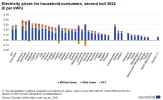
Dublin still has highest electricity prices of all EU capitals despite latest fall - 50% higher than before Ukraine war, gas prices are 72% higher

Absolutely. But it's still a very welcome innovation because at least it serves as a reminder to customers to investigate the alternatives!
Better than nothing but I think you still need to contact them to activate the discount!

And if you don't they charge you standard rates
 

Retail electricity prices in Ireland three times higher than wholesale cost, report finds​

A new report also found EU countries have some of the highest residential electricity prices in the world and that prices are highest in Ireland and Germany.
 
@ClubMan

I'm sure the energy retailers have a very good reason, for those high prices, too (even if it does really look like we're being ripped off :().

Now, correct me if I'm wrong, but aren't Electric Ireland the largest electricity retailer in the state, and ultimately owned by, eh, the state ? So, couldn't they cut prices and effectively force their competitors to follow, if the wanted to ?
 
Last edited:
So, couldn't they cut prices and effectively force their competitors to follow, if the wanted to ?
Unlike many others who have increased their prices they've recently reduced their gas prices and haven't increased their electricity prices.
 
The wind energy companies get guaranteed high prices through feed in tariffs and minimum prices for power that is unusable by the grid. All the balancing of the grid and switching on of gas power, buying gas on the energy markets etc is not paid for by wind companies. This is the fundamental fault of the way the energy markets have been designed. Someone has to pay for all this and we the consumer is doing it through the highest electricity prices in Europe. The government to attract in all these wind farms designed the system so that it was ultra attractive and profitable for them and this is guaranteed for 20 years I think after each wind farm is in operation. One of the biggest beneficiaries of all this is bord na mona, it has never generated as much money since it switched to wind farms. It doesn't have to pay an army of peat harvest workers, expensive machinery and repairs any longer just put all that guaranteed revenue into its back pocket each year
 
The wind energy companies get guaranteed high prices through feed in tariffs and minimum prices for power that is unusable by the grid.
The feed in tariff scheme closed a decade ago. Under the newer schemes the wind generators get a fixed price per MWh they sell in the wholesale market, it's not like they can generate unnecessary electricity during the night and get paid for it. Also it should be noted that the fixed price most of these schemes have been won at is around €90/MWh while the average wholesale price of electricity has been >€100/MWh for the last few years, so it has been working against the wind generators not for them.
 
Last edited:
So is it that we are paying for the buffer energy needed in case the wind stops blowing ? The energy companies also have to contribute to retrofitting costs via the EEOS. So that feeds in somewhere.
 
It's probably fair to say we're paying to a degree for nimbyism related to certain infrastructure, such as the North-South Interconnector. I couldn't sat to what degree though. I would imagine that data-centre demand is also playing a large part, since a good chunk of the cheaper, renewable electricity available has been bought up using power purchase agreements. Pricing is ultimately a result of supply and demand, after all. When we curtail supply through red tape and drive up demand through data centre infrastructure, this is what you get, I guess.
 
Yep - wind and solar has been on the floor for the last week or more...hardly anything being generated. Gas and imports at 82% currently.


And it's not all red tape that is curtailing supply - it's ideology:

 
it's ideology:

Even though the linked article features Eamon Ryan, it was Enda Kenny and Fine Gael in 2019 (supported by independents and Fianna Fáil) who made Ireland the second country in the world to declare a climate emergency.

That same FG/FF/independent ideology also produced the 2019 Climate Action Plan, which set out decades-long decarbonisation targets, including the eventual phasing out of fossil fuels. It was this document that later led the FG/FF/Green coalition to formalise the ban on exploration.

Barryroe is the only viable gas field in Irish waters. It has been under discussion for over 40 years. The Greens have been in government for a totla of only 8 of those years, so it’s hard to argue that Green ideology somehow controlled policy for the other 32+ years. In fact, licences were issued, but every attempt to raise private capital for the development failed. The problem wasn’t political interference; it was market confidence and investment risk.

Even if development had succeeded, production would have taken close to 10 years to come online, and the maximum output would have covered Irish demand for just 3 to 5 years.

In the past decade, both the electorate and politicians have brought about major changes, from marriage equality to abortion reform. Irish people are open to change. If those advocating for continued exploration genuinely believed in their case, they had every opportunity to convince the public and the Oireachtas. But they didn’t. That failure reflects either laziness or poor political strategy on their part, and instead of now complaining about it they should be studying how environmental campaigners out-organised and out-argued them so completely.
 
Barryroe is the only viable gas field in Irish waters. It has been under discussion for over 40 years. The Greens have been in government for a totla of only 8 of those years, so it’s hard to argue that Green ideology somehow controlled policy for the other 32+ years. In fact, licences were issued, but every attempt to raise private capital for the development failed. The problem wasn’t political interference; it was market confidence and investment risk.

Even if development had succeeded, production would have taken close to 10 years to come online, and the maximum output would have covered Irish demand for just 3 to 5 years.
I daresay the experience of Statoil/Shell & others on the Corrib might have ended the proposition of Ireland ever being taken seriously as an investment region for fossil drilling/exploration for years to come. All of the wells in the Porcupine basin that were subjects for test rigs a few years ago have been plugged last I heard.
 
I daresay the experience of Statoil/Shell & others on the Corrib
The influence and reach of a few dozen cranks most of whom didn’t even live near the Sruwaddaconn Bay was extraordinary leading to excess costs of well into the hundreds of millions. RTÉ and the Irish Times ran constant stories on it and very little about the economic benefits to the region never mind the national economy.

I drove around the area years ago and there is no visible sign of the infrastructure apart from the terminal which has a dense forest around it.
 
Last edited:
The rush to Green technology meets (the expensive) reality...


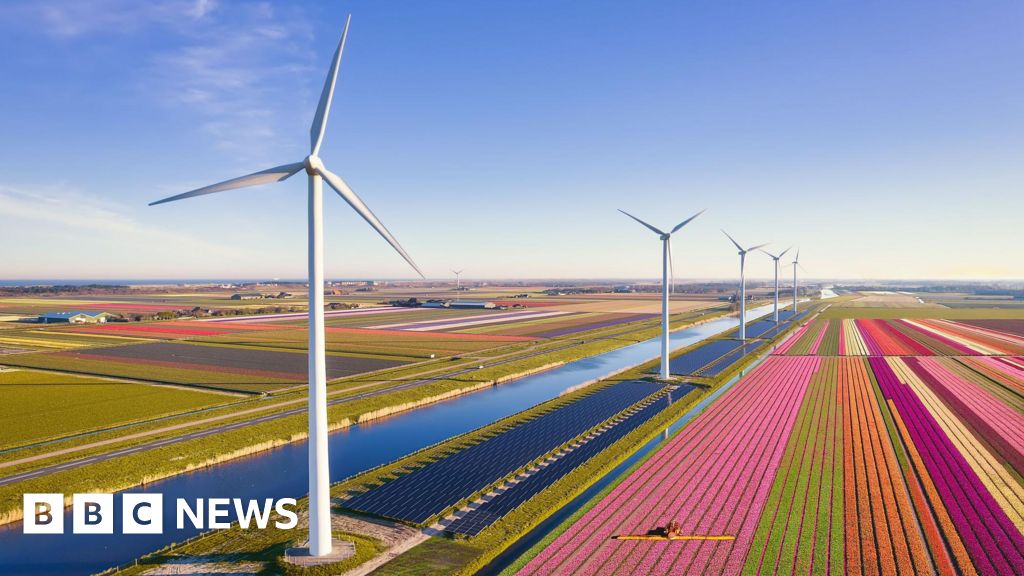
As for electricity production, the Netherlands has replaced gas from its large North Sea reserves with wind and solar.This is all good in environmental terms, but it's putting the Dutch national electricity grid under enormous stress, and in recent years there have been a number of power cuts

So, was all this avoidable? "In hindsight I think almost every problem is avoidable," says Mr Kees-Jan Rameau.

He adds that following the 2015 Paris Agreement on trying to tackle climate change, "we were very much focusing on increasing the renewable power generation side. But we kind of underestimated the impact it would have on the power grid."

"Often consumers want to install a heat pump, or charge their electric vehicle at home, but that requires a much bigger power connection, and increasingly they just cannot get it," says Mr Kees-Jan Rameau.

He adds that it is worse for businesses. "Often they want to expand their operations, and they just cannot get extra capacity from the grid operators.

Tennet is now planning to spend €200bn ($235bn; £174bn) on reinforcing the grid, including laying some 100,000km (62,000 miles) of new cables between now and 2050. That's a huge amount of money, but there is also a big cost to not spending it. Grid congestion is costing the Dutch economy up to €35bn a year Eugene Baijings, who is in charge of grid congestion with Tennet, says that patience is sadly required. "To strengthen and reinforce the grid, we need to double, triple, sometimes increase tenfold the capacity of the existing grid.

And it has got to the point where even new housing construction in the Netherlands is becoming increasingly difficult, because there's just no capacity to connect those new neighbourhoods to the grid."

And the financial incentive for people who feed their surplus solar electricity into the grid is being reduced to almost nothing. In some cases, people will even have to pay to feed solar power into the grid.


Of course it's a clown show here in Ireland - and Eamon Ryan's fingerprints are all over every daft/expensive decision. Great photo-op and feel-good press release all the same...


One Dublin Bus driver said the electric buses are "plagued with issues", calling the heating system "not fit for purpose".

He said: "The battery is not capable of powering the bus to do what it's supposed to do. If you're trying to power and heat up a saloon, with lights and WiFi charging ports and whatever else, it's just a constant drain on the battery."

The buses also use Camera Monitoring Systems (CMS) for visibility, rather than wing mirrors, which some drivers do not like.

The driver acknowledged there was 'mixed opinion' on the buses.

He said: "The NTA had this great idea to replace the fleet with electric buses, but we weren't ready for it and still aren't ready for it.

"I'm there a lot of years now and I've never heard [of] drivers not bringing buses out because of a mirror. Now I'm hearing it regularly that the bus is defective, and it can't be brought out because the camera or the screen isn't working.'"
 
The only reason we put up with high prices in this country is because wages are also higher, Martin said as much in the Dail. The problem arises when the economy crashes and these prices become unaffordable.
 
One Dublin Bus driver said the electric buses are "plagued with issues", calling the heating system "not fit for purpose".
My local route is regularly served by electric buses - from an objective perspective, they are far better for the local air quality, and from a subjective perspective they are a far, far superior product for Dublin Bus customers and fellow road users, such as cyclists. And I’d be a little sceptical about the motives of unionised drivers, it’ll always be the loud complainers that are heard most, regardless of their proportion.
 
Of course it's a clown show here in Ireland - and Eamon Ryan's fingerprints are all over every daft/expensive decision.
It’s not a clown show. There are problems, yes. As your article points out, it seems that Ireland is not the only place struggling with this. But it’s disingenuous to discuss this as if the alternative is much better… it’s only 3 years since the invasion of Ukraine caused gas prices to skyrocket, something which diversity of energy source mitigates against. Similarly, the oil crisis of the 70’s.

Let’s face it, inertia (pardon the pun) is the easy option but that does not make it the best long-term option, not by a long shot!
 
If you look at the chart on this and set it for 5 year view you can see that the current price for Natural Gas in lower than just before the Ukraine War started . The so called regulator allowed the suppliers increase prices based on the NG price as thats the fallback option when renewables do not meet the demand . We as a country are being ripped off full stop on this one .

 
The so called regulator allowed the suppliers increase prices based on the NG price as thats the fallback option when renewables do not meet the demand
It's not the fall-back price - the market is designed so that the most expensive option needed at any given time sets the price for every type of energy supplier. Naturally enough, unless renewables can meet 100% of demand then the price gets set by NG. But it's not just the price of the NG input that's the driver, it's the price of electricity generated by NG. And when renewables are prevalent, the fixed costs of NG power have to get amortised across less units of electricity provided.

But this would be the same problem regardless of the fuel/energy source mix. Coal was super expensive when we only fired it up a few times of year for dunkelflaute conditions, even before renewables.
 
Conor , when you look at our costs to the consumer and factor in how much we are supposed to be getting from renewables we are being shafted big time , this image from the EU is 12 months ago but ours is the highest cost in the EU to produce before taxes despite our location being amongst the best for renewables .
1760714937114.webp
 
Back
Top