"Almost one in 10 young Irish adults believe Holocaust is a myth"

Status
Not open for further replies.
This is not the horse trading of morality. One thing that was wrong does not become right because of a later thing that is wrong.

I agree, but in reality that is exactly what is occurring. In my opinion their is a clear link between the actions of the fascist apartheid regime in Israel and the decline of knowledge and empathy towards the victims and survivors of the Nazi holocaust up to, and including a rise in anti-semitic sentiment.

Or how else would you explain the topic and associated reports from the Jewish Conference?
 
Or how else would you explain the topic and associated reports from the Jewish Conference?
The enabling of racism, xenophobia, and antisemitism and general bigotry that has been enabled by social media, the rise of identity politics, and the general decline in critical thinking and rationality which is also a result of social media.
 
The enabling of racism, xenophobia, and antisemitism and general bigotry that has been enabled by social media, the rise of identity politics, and the general decline in critical thinking and rationality which is also a result of social media.

Thats a fair point, certainly playing its part as there is nothing to stop gross generalisations of peoples no matter where they are from, Mexicans, Somalians, Nigerians, Arabs, Israel, Russians, Irish, British etc....it is certainly a cesspit. It would be interesting to see similar type reports across the board, it may give us an indicator as to where societies are heading, if we don't know already.
 
Maybe we are too harsh on social media?

This is the President of the United States talking about Congresswoman IIhan Omar (before the attack) and Somolia.

https://www.youtube.com/shorts/hNMbSsU39EE

Maybe it was always this way? But because we only had 6 TV channels and 2 newspapers it was always filtered out?

Off topic, apologies, but first time around I treated this guy as a big buffoon of comic status. I never anticipated how dangerous he would become.
 
Yep, we also get a proper critique of New York's new Communist Mayor from that hard line Trump Supporter Bill Maher https://www.youtube.com/watch?v=diGuJ1rvtzI

You posed a direct quote.
I posted a monologue from an individual employed by a media company. Both the individual and his employer are liable for what he says.

Both of our links are a world away from the social media (Twitter etc) that constitutes the cesspool in which "gross generalisations of peoples no matter where they are from, Mexicans, Somalians, Nigerians, Arabs, Israel, Russians, Irish, British etc" are made with impunity.
 
@mathepac a very good summary of holocaust
No it's not. It's a few bullet pointsI jotted down from the film I saw about the filmmakers who accompanied the first Allied troops into the horror camps. Some of the filmmakers were so traumatised by what they saw that were incapable of talking about it decades later.

The films themselves, thousands of hours of them, became political footballs. Although German civilians living in proximity to the camps were conducted on tours of the camps in their neighbourhoods, apart from the odd hanky raised to the nose from time-to-time, I can't remember seeing too many emotional displays from them. The Grand Plans to show the films about the camps to the great and good German population were shelved. The Allies decided they didn't want to alienate the Germans as they were the buffer between the West and the perceived menace of the evil Communists to the East. This was probably the first and one of the more cowardly acts of the burgeoning Cold War.

Putting the SS and civilian guards to work helping to bury corpses in mass graves seemed fitting, although even here the dead were not awarded any modicum of dignity; bull-dozed in graves, dragged along the ground, heaped in trailers, it was at times just a continuum of what the Nazis started, such was the scale of death and human destruction left in the camps in Germany, Poland, Czechoslovakia, etc.

It has never been clear to me what happened to any films made by the Soviets liberating camps as they drove West. There are the issues of the Nazis not taking prisoners in their initial drive East, with captured Soviet troops being slaughtered and buried in mass graves. Maybe they were motivated by revenge to get West ASAP to dole out retribution, or maybe they were made of sterner stuff than the other Allies or saw no need to make historical records of their findings.

Summarising The Holocaust would be a huge undertaking, beyond the scope of this forum or my very modest skills.
 
Last edited:
It has never been clear to me what happened to any films made by the Soviets liberating camps as they drove West. There are the issues of the Nzis not taking prisoners in their initial drive East, with captured Soviet troops being slaughtered and buried in mass graves. Maybe they were motivated by revenge to get West ASAP dole out retribution, or maybe they were made of sterner stuff than the other Allies or saw no need to make historical records of their findings.
The Russians stopped outside Warsaw (on the banks of the Vistula River) to allow the Germans to put down the Warsaw uprising and deport the Jews from the Ghetto. They also stopped within reach of Auschwitz-Birkenau in the summer of 1944 but didn't liberate it until January 1945. Given the long history of pogroms and murder against Jewish people in Russia and the broader Russian empire it is fair to say that the Russians weren't exactly sympathetic towards the Jews.
 
it is fair to say that the Russians weren't exactly sympathetic towards the Jews.
I think it would be a fair to say that the whole of Europe "weren't exactly sympathetic towards the Jews"
I mentioned earlier that I watched a lot of documentaries about this but there are two in my opinion that show this thinking probably more, at least in my opinion and are well worth a watch if you can find them and stomach the content

Inheritance and Shoah I believe show the true lack of empathy towards the "Jews" during the Nazi regime and in the decades that followed
 
The Russians stopped outside Warsaw (on the banks of the Vistula River) to allow the Germans to put down the Warsaw uprising and deport the Jews from the Ghetto. They also stopped within reach of Auschwitz-Birkenau in the summer of 1944 but didn't liberate it until January 1945. Given the long history of pogroms and murder against Jewish people in Russia and the broader Russian empire it is fair to say that the Russians weren't exactly sympathetic towards the Jews.
This is incorrect.
The Warsaw Ghetto uprising by the Jews occurred in the previous year and ended with the deporting of the remaining Jews and the flattening of the Ghetto.
The 1944 uprising was by Polish resistance loyal to the Polish Government-in-exile (in London). They rose up as the Russians approached in the hopes of being able to reestablish control of Poland with Soviet help
It was because of that, that Stalin was content to see the Germans crush the uprising.
My mistake. You are correct.
The Russians did stop within rage of Auschwitz-Birkenau for months, fully aware of what was happening there, allowing the Germans to continue their genocide.
 
The Russians did stop within rage of Auschwitz-Birkenau for months, fully aware of what was happening there, allowing the Germans to continue their genocide.
That's not true either.
Operation Bagration had inflicted enormous casualties on the Germans but also on the Russians.
The offensive had moved the line west by hundreds of miles of scorched earth.
As they approached the Vistula the Soviets started encountering more Germans because the Germans
had set up strong defensive positions there.
You can't just keep advancing indefinitely. Modern armies need a lot of resupply, they can't just live off the land.
Von Manstein demonstrated this in the third battle of Kharkov in 1943 where he lured a rapidly advancing
Red Army into a trap when he saw that they were outrunning their supply lines.
The Soviets needed to sort out logistics, rest their exhausted troops and bring in and integrate fresh troops
to replace their casualties as well as replacing all the equipment they had lost.
The Vistula was a natural point to do that.
The goal of the next and final offensive would primarily be Berlin (Auschwitz wasn't even in that direction).
There is no evidence at all that Auschwitz formed any part of considerations the Soviets made one way or another,
it simply wasn't relevant to planning what they would do next.
The Soviets paused primarily for military reasons (they did (cynically possibly) pause very close to Warsaw but there were well over a hundred miles from Auschwitz).
In fact I don't know if there is evidence that the Soviets knew what Auschwitz was until they got there.
 
That's not true either.
Yea, it is. All of the Allies knew about Auschwitz-Birkenau at least a year before the Russians liberated it. Russia wasn’t a liberating force in Poland, it was an invading force. That became obvious after 1945 but Churchill knew what Russia intended long before then.
There was no strategic military reason for Russia to liberate Auschwitz 6 months earlier but there was nothing stopping them either. It was relatively unguarded and easy terrain.
They wanted a weak and compliant Poland so that they could occupy it more easily after they defeated Germany and have no real resistance when they put their puppet government in place.
Remember that without Russia support in the form of natural resources to help build up the German army in the 30’s and a non aggression pact to free up their eastern flank it is unlikely that Germany could have conquered Poland and France in the manner they did.
 
There was no strategic military reason for Russia to liberate Auschwitz 6 months earlier but there was nothing stopping them either. It was relatively unguarded and easy terrain.

Nothing to stop them? The Germans, maybe?

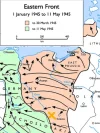
With regard to liberating Auschwitz in 1944, the relevant Soviet operations belonged to the Lvov–Sandomierz Offensive (July-august 1944).
Lvov–Sandomierz overlapped with Operation Bagration but was geographically further south.
From the wikipedia article on Lvov–Sandomierz (note in particular the text in bold):

Large-scale German counterattacks were launched in an attempt to throw the Soviets back across the Vistula. Using the towns of Mielec and Tarnobrzeg on the eastern bank of the river as bases, these attacks caused heavy casualties to the Soviet forces. By mid-August, Konev's spearhead, the 6th Guards Tank Corps had only 67 tanks remaining. The Germans launched a fierce counterattack with the 501st Heavy Tank Battalion and the 16th Panzer Division, totaling around 140 tanks including 20 Tiger IIs. Despite being heavily outnumbered, the 6th Guards held the bridgehead, knocking out 10 Tiger IIs. By 16 August, the German counterattacks were beginning to lose steam, and Rybalko, the commander of the bridgehead, was able to expand the Soviet controlled area by a depth of 120 kilometers, capturing the city of Sandomierz. With both sides exhausted, the fighting died down and the Lvov–Sandomierz offensive was deemed complete.

The next offensive that the Soviets launched was Vistula-Oder which was launched in January 1945 roughly along the entire line that existed in the wake of Bagration and Lvov-Sandomierz. After one week that had liberated Cracow and one week later Auschwitz was liberated.

BTW The Soviets were aware of the existence of Auschwitz as a prison camp for slave labour, located in a major industrial area.
There were many of those, but there is no evidence that they knew it was an extermination camp until they liberated it.

tl, dr there is no evidence for any of your unpleasant claims about the Soviets/Russians with regard to the Jews. One of the first Soviet officers to enter Auschwitz was a Jewish colonel.

vistula-oder.webp
'X' marks the location of Auschwitz
 
Last edited:
BTW The Soviets were aware of the existence of Auschwitz as a prison camp for slave labour, located in a major industrial area.
There were many of those, but there is no evidence that they knew it was an extermination camp until they liberated it.
I'm aware of the details around the Russian liberation and then subjugation of Eastern Europe but kudos on the research.
While the Soviet units that liberated the camp almost certainly didn't know what they were walking into it is likely that Stalin and the Russian command knew.


there is no evidence for any of your unpleasant claims about the Soviets/Russians with regard to the Jews.
Stalin was strongly antisemitic. There's absolutely no disputing that. Here's a brief Wikipedia article. The pogroms against the Jews within the Pale of Settlement continued under the Soviets (and during the Civil War by both Soviet and White Russian forces). Lenin made some great speeches about how wrong it was to persecute the Jews but did absolutely nothing to stop it.


One of the first Soviet officers to enter Auschwitz was a Jewish colonel.
The first commandant of the Camp after it was liberated was also a Jewish officer in the Red Army and the Russian medics did heroic work in what were literally unimaginable circumstances to save nearly 3000 inmates, including Primo Levi (I strongly recommend his books if you haven't read them already).

That doesn't change the facts and they are that it is likely that Stalin and the rest of the Russian high command knew about Auschwitz and knew what it was and chose to do nothing about it. It's quite possible that the Americans and British would have done the same thing.
 
I'm aware of the details around the Russian liberation and then subjugation of Eastern Europe but kudos on the research.
LOL, thanks for the backhanded compliment.
Sure I carried out research, I like to verify my assertions before I make them.
It's a good approach, It's something that I would recommend.

I read Primo Levi's "The Periodic Table" a long time ago.
Anne Frank's diary also, a lot of the usual canon.
I also read Elie Wiesel's "Night" which I have since learned was almost definitely a crock of the proverbial.
I stayed up very late watching a "Shoah" marathon for several nights on a tiny B&W portable tv in my bedsit in 1991.
So yeah, I've watched and read a lot on WW2 generally.
Currently I am re-reading "A Soldier's Duty" by Konstantin Rokossovsky, which I'd also recommend.
 
LOL, thanks for the backhanded compliment.
Not intended at such but you did post maps etc which I'm sure you didn't have to hand.
Sure I carried out research, I like to verify my assertions before I make them.
As do I.

It's a good approach, It's something that I would recommend.
Yet you post some very extreme views which many people regard as conspiracy theories.

I read Primo Levi's "The Periodic Table" a long time ago.
Anne Frank's diary also, a lot of the usual canon.
Ditto.
I also read Elie Wiesel's "Night" which I have since learned was almost definitely a crock of the proverbial.
I stayed up very late watching a "Shoah" marathon for several nights on a tiny B&W portable tv in my bedsit in 1991.
So yeah, I've watched and read a lot on WW2 generally.
Well done.
Currently I am re-reading "A Soldier's Duty" by Konstantin Rokossovsky, which I'd also recommend.
I know very little about him other than him being imprisoned by Stalin and then rehabilitated after Germany invaded.
If the book was written during the Soviet era then it had to pass their censors.
 
Status
Not open for further replies.
Back
Top