Should the government support a business damaged by fire?

Status
Not open for further replies.

Brendan Burgess

Founder
Messages
58,472
I heard this guy on Morning Ireland today whose business has been devastated by a fire saying that he wants the government to step in and help all the businesses impacted by the fire.


"It’s devastating", he said, "within minutes it was gone".

Mr Hepburn said he cannot yet but a value on the loss, but he hopes that the Government will give financial support to businesses.

Don't get me wrong. I am very sorry for this guy and the other business people. But I don't want to pay for his misfortune. He should have insurance in place and, ideally, a disaster recovery plan.
 
It seems local and national politicians are already on the job about supports. I take your point about insurance, but given the devastation on the site, what businesses were operating from it, and why does it appear that no sprinkler system was able to contain the fire to a single unit?

The drone footage in this RTE News online report is horrifying; it looks like the place was a target in something like a WWII fire-bombing. The same report also says, in part:

"Humanitarian assistance to be set up

Meanwhile, Minister of State Mary Butler said she hopes humanitarian assistance will be available quickly for those impacted by the fire.

Ms Butler said she spoke with the Taoiseach yesterday and said Micheál Martin confirmed that a humanitarian scheme will be set up, similar to those implemented when areas are impacted by flooding.

She said she also spoke with Minister for Enterprise Peter Burke and Minister for Social Protection Dara Calleary.

Ms Butler said it will take some businesses a few days to assess the extent of damage to their properties.

"We're dependent on drone footage, but the smoke damage will be massive, even if there wasn't damage from the fire impact," the Fianna Fáil TD for Waterford said.
""
 
Last edited:
I don't think there is any mention of there not being insurance?
It's quite possible that the insurance cover will simply not cover the cost of restoring the business.

One business is a costume hire with some some costumes dating back to 1921.

The question I would have is, are the businesses affected financially viable, and there is no indication that they were not.
Up to 200 employees worked in the business centre.

Its a no-brainer to me for the Govt to step-in and assist financially to restore these businesses as I'd imagine the cost of not doing so would be far greater to the taxpayer.
 
It's not the government's money. It's your money and my money.

What is the cost of not doing so? Some borderline businesses or businesses without insurance will fold. Some other companies will get that business.

But that is business. Weak companies cease to trade and well managed companies survive.

200 people will lose these specific jobs. But there are plenty of vacancies. They won't be unemployed long.

We should not be calling on the taxpayer to bail everyone out whenever there is a problem.
 
Glad to see a thread on this major conflagration started already.

I have some strong views on this event myself.

1. Folks, ain't it funny that after decades of fires suddenly occurring at weekends at major businesses, no one from the government, insurers, employers or unions has ever made much noise about fire standards or fire-detection systems in workplaces ?

Surely it's time we all began to discuss it now. BB said a government bailout isn't lucky-bag money - it's your money and mine. As I see it, insurance payouts will also impact not just on other business fire, theft, loss of trade, etc policyholders - it will be spread across the whole insurable public just like the enormous specific risk with airport insurance is spread across society in general so as to make airports commercially viable. Likewise with government hardship payouts, uncollected income/corp taxes, union dues, etc during the recovery period - all these impacts are "lain off" to our society as a whole. It would clearly be cheaper to upgrade fire protection standards for businesses rather than trundle along with the current ones, making big payouts every now and again to the affected businesses - some of which being marginal at the time of the fire, if not loss-making.

Of greater importance still would be the risk to human life were some business owners/employees actually working when this fire took hold. A widow running an office cleaning business might have a unit to store equipment and could be doing the weekly books on Saturday evening. Her kids would be orphaned as a result of inadequate fire protections.

2. The L.F. Goodbody Jute works (1937-1974) is a very large piece of real estate in an urban setting. It would be amiss of us to avoid consideration of the likely fate of this site after last weekend's fire. It is unlikely that a suggestion of reconstructing a new enclosed collection of small business units on the old site will get much of a hearing. It's far more likely that the business owners will be offered new commercial units on the verge of Waterford and that the old site will be used for residential accommodation, i.e. apartments.

Yes, developers can ultimately obtain possession of old factory sites now subdivided into smaller units so they can redevelop them. Yet they would often have to pay significant compensation, buy out the lease or wait for the break clause. Of course we can't say that such motives applied in this case as the fire-protection infrastructure is likely to have been old and the building itself might have lent itself to more rapid spreading of a fire. But any 'prosperous outcome' for an owner of a fire-struck building is bound to increase the attractiveness of such an event in the eyes of the unscrupulous.
 
One business is a costume hire with some some costumes dating back to 1921.

I was wondering about that when seeing her on the TV news.

Theatrical costumier is a challenging profession unless you have an in-house job with a major TV channel or else a par excellence collection to hire out for operas, films and TV dramas set in a bygone era.

I got the impression that all her patterns were lost along with the costumes and that getting such grades of fabric today as was used in some of the old clobber would be impossible.

I only hope that she insured well for value of her stock as well as for loss of earnings - which in her case will be indefinitely long.
 
I only hope that she insured well for value of her stock as well as for loss of earnings - which in her case will be indefinitely long.
Fingers crossed, will be hard to come back from such a setback.

In the case of the costumier, that could have knock on impact for productions that were relying on the costumes, but it is not as if the government can resolve that with money. The items lost are more like antiques and not easily replaced.
 
It would clearly be cheaper to upgrade fire protection standards for businesses rather than trundle along with the current ones, making big payouts every now and again to the affected businesses - some of which being marginal at the time of the fire, if not loss-making.

It's hard to know. Do we just let these buildings lie empty awaiting development or do we allow small businesses to use them?

It's far more likely that the business owners will be offered new commercial units on the verge of Waterford and that the old site will be used for residential accommodation, i.e. apartments.

I don't know the site. But we do need spaces for small businesses and residential accommodation. I would think that both should be distributed throughout a city. But maybe keep the manufacturing businesses away from the centre. This could require a role for the state or at least the council. To zone parts for development of light industry only. Or on a large site like this, any redevelopment should have a mx of residential and small business.
 
Fire standards always high in ongoing industrial settings for as long as I can remember,
 
It's not the government's money. It's your money and my money.

Well, its the State's money with the Government in charge that we are all legally obliged to pay.

We should not be calling on the taxpayer to bail everyone out whenever there is a problem.

I agree. I don't think that this is the case in this instance.

If the businesses are financially viable and insured its possible they will back operating on their own terms in due course.
Its possible that the insurance may not cover the cost of re-establishing, which is sad. And its possible that a govt intervention financially will not assist in restoring the business as, in the case of the costume business, it is hard to see how they would replace costumes that @odyssey06 rightly points out are more antiques than commercial merchandise.

However, some businesses could be start-up's of budding entrepreneurs working on a shoe-string budget provide a product or service to the local community. Others could be long standing established local retailors with great reputations in the community and keeping the main st alive with their endeavours.

They may be weak small businesses in the grand scheme of things but they may also be valued businesses by the local community.

I think these things and more should be considered before we go down the blunt road of 'business-is-business' type of thinking and be prepared to lend a helping hand where is it warranted.
 
Fire standards always high in ongoing industrial settings for as long as I can remember,

This cannot really be so.

A lot of improvements have been made in the last 20 years as regards fire-detection sensors, monitoring cameras, etc. But I wonder if anti-fire systems inspections are as frequent as they ought to be. If most of the weekend fires are non-malicious (something I often doubt) then we have a scenario in which the same susceptibilities that gave rise to the fires had existed but weren't noticed in the months and years prior to that weekend. It's hard to reconcile that with a business that would be vigilant to fire risk or to a fire regulation regime that was high standard.
 
Go check even before the Stardust fire safety was taken very serious, just look at the reports after stardust to see fire safety was up and running long before then,

This is at best relatively true. Relative to the times and the then knowledge of fire protection.

Stardust changed the whole appreciation of how fires spread. Before Stardust the conventional wisdom - and that presented in fire-safety ads on the BBC and RTÉ - was to shut off air supply to the area of the fire so as to choke the fire of oxygen. So if a chip frier went on fire after a woman put a smoking basket under a tap, the man of the house would get all occupants out, close all windows and doors and go across the road to ring the fire brigade from the neighbours' house.

The Stardust fire investigation (as distinct from the later Stardust Inquiry) was done at the Fulmer Research Institute in UK as we had no such facility in Ireland then. They built a room of the same materials as used in the disco, installing sensors for various gases, temperature, pressure, humidity, etc and then starting a small fire with a semi-smoked cigarette lain on a couch. The found that the flashover observed by patrons that night was caused by flammable gas release from organic materials in the lounge area, e.g. couch coverings, foam, seating, etc. This caused no black smoke to be observed though a slow fire was continually burning away. But with limited fresh air being allowed into the disco (due to windows and doors being shut against gatecrashers) the concentration ratio of flammable gas to oxygen steadily increased towards the ceiling (due to hot gas diffusing upward) until a concentration ratio and temperature was reached that caused ignition of the flammable gases. The intensity of the flashover caused all organic materials in its compass to immediately burn severely.

After the Stardust fire investigation all fire UK and global protection procedures were changed. People were henceforth advised to leave windows and doors open so that flammable gases released during early stage combustion would not accumulate and give rise to a dangerous flashover.

Sure, before 1981 fires were "taken very seriously". But the thing is they didn't have the knowledge then or the sensors, controls and IT systems that we have today. Buildings of that period were different too. Electrical fire prevention wasn't as sophisticated as today.
 
i do not know but i would be shocked if l f goodbody jute works did not have a very modern fire protection system for its time in place when it was a working factory before it closed,
I would be interesting if someone from the area could let us know one way or another,
 
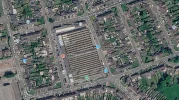
Screenshot from 2026-05-11 19-02-52.webp

The Jute Works is the block in the middle. The block to the left of it has over 60 houses with lots of garden space.

That's a clear profit of €3 million if another 60 houses were built.

And God only knows how much if it was turned into an apartments complex. Certainly more than enough to build a new unit for every one of the 40 burned-out businesses - and lease the units to them at rents higher than what they were paying at Goodbody's . . .

Unlike planning applications to build on greenfield sites, it's no great problem today to get planning for apartments on a derelict industrial site in an urban area. But these sites are not so common and there is a lot of competing developers going after them.
 
I do not know but I would be shocked if if Goodbody Jute works did not have a very modern fire protection system for its time in place when it was a working factory before it closed.
I would be interesting if someone from the area could let us know one way or another.

Well, it ceased production in 1974, I understand. Jute bags for things like barley went out in the mid-70s as regards production although merchants gathering for Guinness still had loads of old ones that they kept going after patching for some years afterwards. But by then even Guinness was starting to use woven polypropylene bags. Of course most combine harvesters were of the drum variety then - only the old ones had chutes and bags. The work was hard but the living was so much simpler then.

No point in going ahead of the official report by the HSE. The place would have been rewired twice since then - fire protections would be part of that, surely. Somehow I doubt if much blame will be attributed to the owner of the works or the 40 odd business owners in this case. À quoi ça sert?
 
  • Like
Reactions: Leo
i am happy to see taxpayers money spent in the instance Brendan linked I can think of a thousand reasons why and very few reasons why not,
Labour is taxed very high in Ireland, why would anyone not support getting good business back up and running again in this area,
 
But shouldn't insurance be covering business continuity? I'm not clear on what government is supposed to do exactly that shouldn't be fully covered by insurance. And there's a risk then of encouraging businesses not to have proper full insurance on the expectation of government support.
If there is some special case for a particular business or they need non-monetary state assistance with paperwork \ getting alternative premises that is different. But this seems to be some sort of government should provide money for reasons which are not fully explained.
 
Status
Not open for further replies.
Back
Top