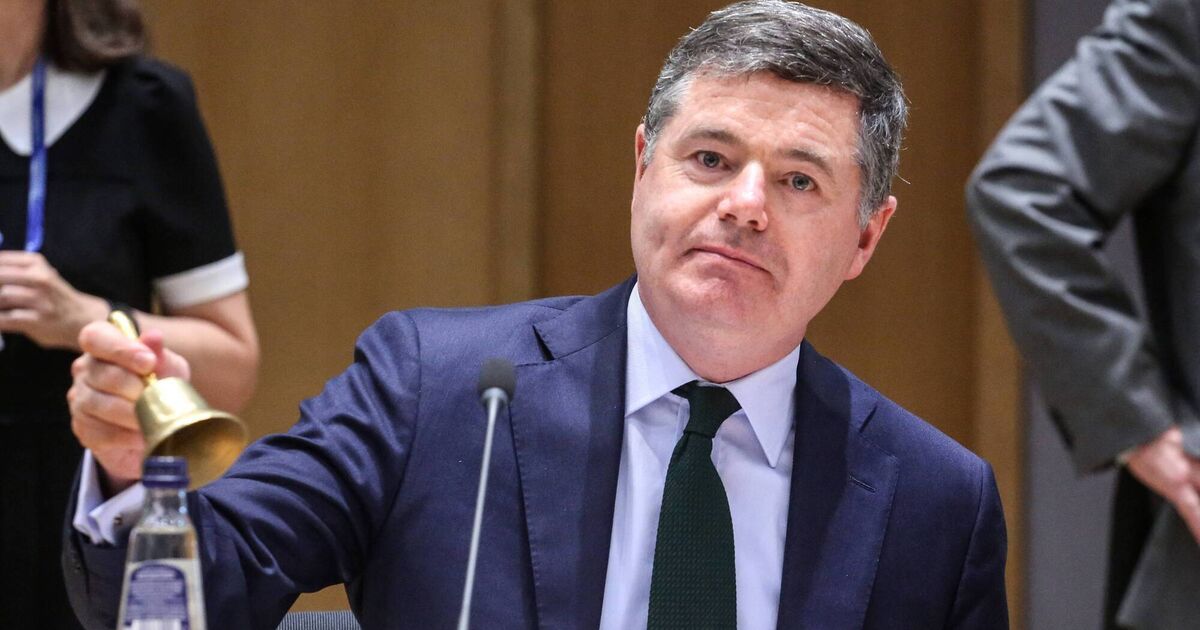
Pascal Donohue, the finance minister who presided over huge increases in state expenditure

joe sod

Registered User
Messages
3,241

Good article in the examiner profiling pascal donohue period as finance minister, he presided over a doubling of the state from 60 billion in 2018 to 117 billion in the last budget facilitated by and large by precarious corporation tax receipts
 
I would have relieved the tax burden on the productive sector of the economy, moved the 40% tax threshold to at least 50K, cut taxes on fuel and abolished carbon taxes. There wouldn't have been 117 billion to throw at state spending but there still would have been plenty and the inflationary pressures caused by big state spending would have been less. Pascal Donohue chose not to relieve the tax pressure on middle income workers but to continue with a very large state sector with a big state spending
 
I would have relieved the tax burden on the productive sector of the economy, moved the 40% tax threshold to at least 50K, cut taxes on fuel and abolished carbon taxes. There wouldn't have been 117 billion to throw at state spending but there still would have been plenty and the inflationary pressures caused by big state spending would have been less. Pascal Donohue chose not to relieve the tax pressure on middle income workers but to continue with a very large state sector with a big state spending
Other than the highlighted bit I agree with you. I'd have gone further with cuts to taxes on work but have corresponding increases in taxes in other areas. I would not have increased any welfare payment by more than inflation and I would have spent the money on infrastructure rather than on increasing the size of the State sector.


That said I think that he was the least worst option and given the political circumstances he worked in he did a very good job. Any of the alternatives were worse.
 
I would have relieved the tax burden on the productive sector of the economy

Specifics?

cut taxes on fuel and abolished carbon taxes.

Couldn't have been done due to EU commitments and the agreed Programmes for Government with FF and the Greens.

Pascal Donohue chose ... to continue with a very large state sector with a big state spending

So which parts of the "very large state sector" would you have downsized/abolished?
 
Does a poster really have to go into granular detail in order to make a point?

It's pretty clear (I would have thought) that a sweeping generalisation like that requires more details to have any credibility!

Does he want to tackle the education sector, the health sector, the security sector, the housing sector, etc etc.

Why not have a look at the graphics at this link, and select your own cherry/cherries to pluck!
I'm of the view that it would be possible to reduce spending on healthcare significantly without reducing services or outcomes through standardisation and streamlining and removing layers of management. It is a grossly inefficient industry.

In no particular order I'd also:
  • Reduce welfare payments to what they were 10 years ago plus inflation,
  • change the criteria to qualify for disability allowances/payment/welfare so that the same proportion of people qualify for it as they did 20 years ago,
  • Merge or abolish at least half of the State bodies we've created over the last 20 years and move decision making and accountability back to the politicians and Departments,
  • reduce and means test the carers allowance,
  • not increase the State pension,
  • apply full PRSI on OAP's,
  • shelve the ridiculous and completely unnecessary policy of reducing pupil teacher ratios,
  • increase the retirement age to 68, going to 70 over the next 10 years,
  • cut HAP significantly since it's HAP that's driving up rent costs and the bottom end of the market,
  • legislate to make it illegal for the State to buy any private house to turn it into social housing,
  • decriminalise possession of small amounts of drugs to reduce the legal aid merry-go-round,
  • limit the number of adjournments that minor offence can have,
  • legislate to drastically reduce the number of Judicial reviews and make it so that the loser pays the costs,
  • Generally curtail the parasitic nature of so much of the legal industry
  • cut all payments to the Greyhound industry,
  • significantly increase property tax,
  • have unemployment benefits which are linked to PRSI payments and previous income but taper which down to nothing after 3 years (after which time your stuff is sold, including your clothes, furniture, jewellery, house, etc, then it's food stamps and a hostel),
  • prioritise working people for social housing and change it so that the number of children you have isn't taken into account when prioritising it.
 
Good article in the examiner profiling pascal donohue period as finance minister, he presided over a doubling of the state from 60 billion in 2018 to 117 billion in the last budget facilitated by and large by precarious corporation tax receipts

And yet Irelands debt ratio to GDP, GNP, GNI (take your pick) has fallen significantly over the same period.

And this assertion of a 'larger State', what does that mean exactly?

Around 16% of Irish workforce are employed by the State. This is one the lowest % rates across Europe.
 
The doubling of state expenditure to 117 billion is staggering when you consider that the IMF ran the show not long before.

What I find troublesome is that there has been no noticeable improvement in any of the main spending areas (infrastructure etc).

Perhaps the fault has been in a disregard for value for money. Somebody benefitted from this massive increase in expenditure but it doesn’t seem to have been the general public.
 
No idea, lets say another 10%
In 2021 there were over 63,000 people employed in Section 38 organisations. They are quasi public servants as they are paid by the State and have the same pay scales and T's & C's as State employees.
There were also nearly 50,000 in the Charity industry where the State was the main or sole source of income.
That's around 110,000 to add to the total.

The figure for State employees is for whole time equivalents. For example the HSE employees over 160,000 people but their whole time equivalent workforce is under 150,000.
The figure for total workforce participation counts every part time worker as an individual. In other words the percentage employed by the State is significantly larger than presented.
 
Last edited:
So which parts of the "very large state sector" would you have downsized/abolished?
Mainly the bureaucratic and regulatory overload in all government departments. But also the funding to outside organisations, quangos etc that we constantly hear pontificating on the media, these are by and large dependent on government funding. The legal system is also a huge beneficiary of the states largesse. Thats where alot of this doubling of government spending is going. Its not going into increasing the productive capacity of the economy . Of course there is a large cohort benefiting from this spending but they are not contributing much overall productivity. Its bureaucracy feeding more bureaucracy essentially
 
Presumably also facilitated by and large by precarious corporation tax receipts

For sure, and the rest.

What good all this precarious corporation tax receipts if it is not spent?

The question is it being spent well? That is always going to be political notwithstanding that there could always be more efficiencies.
 
Back
Top