High fees not a barrier to investing in equities

GSheehy

Registered User
Messages
1,832
I was just thinking in general terms of what are the the main barriers or reluctance to the majority of Irish with surplus funds towards investing or changing fiscal behaviour in general.

Was watching a webinar yesterday and this (Central Bank research) came up.

Not sure how you'd overcome most of these without having someone sit down and explain it to them.

AAM will be shocked that high fees scored so low or that people might not have the funds to invest with.
Screenshot (101).webp
 
Last edited:
Perhaps to be aware of the fees, one already has to have looked into the options, overcome their fear of loosing money and developed some knowledge on the products.
Of course. So we ask everyone to go online and figure it out?
 
The thread title is misleading as far as I can see.

High fees not a barrier to investing in equities​

The heading on what is presumably the Central Bank table is "Obstacles for non investors". That's a, possibly small, subset of the general population.

Anyway, we're lacking a lot of background/context information for the snippet presented.
 
The thread title is misleading as far as I can see.

It clearly passed the rigouous, high level, moderator threshold because I didn't choose that title. The post was lifted from another thread and a new thread was created here.

But, yes, it's fiercly misleading in the contex of what I was getting at.

A more appropriate title would be 'What can the consumer fourm AAM do about the first 5 investment obstacles for investors?' Taking to the keyboard to incessantly rant about charges or that it's too risky to go to an advisor for investment advice isn't going to help these people invest.

non investors". That's a, possibly small, subset of the general population.

Put your own estimated figure on it.

How many active users are there on this forum that are genuinely interested in (just) investments - not any of the other sub forum like mortgages etc? There are (allegedly) 122K visitors to the Irish personal finance sub on Reddit, per week. Again, they're not all there to ask questins or get information on investments. It just means they're interested in money. It's akin to the AAM bubble life that some lead.

Anyway, from the link below ' Our consumer research identifies that 36% of the Irish population report that they hold or own at least one investment product while 53% of the population report that they do not currently invest. '

I've seen no mention of Regulation of any new savings scheme. I presume that everyone wants a regulated product? If so, they're going to have to be purchased via regulated entities. So, if Government want it to be a success they're going to want as large a distribution network as possible.

Anyway, we're lacking a lot of background/context information for the snippet presented.

Surprised that the King of the Searches couldn't do one for this ;-)
 
Last edited:
At a personal level I break all the rules - my investible assets are in govies. So which on the list is talking about me? As I tell a friend who is the absolute opposite of me and also frequents this parish "I am always afraid that I have missed the boat". I suppose it comes under the first heading. I did dabble a bit in DIY a few years back and the tax compliance hassle was really off-putting though admittedly govies aren't completely immune. I look forward to an ISK style option.
 
That's a, possibly small, subset of the general population.
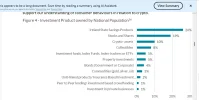
They provide the below graphic. They don't actually say what the investor proportion is and this graphic will double count investors with more than one such asset. They do say that they excluded folk who own only State Savings from being considered investors. Note the high figure for crypto but the average crypto investment is about €2k and held primarily by young folk out of curiosity. There is also probably a positive correlation between young folk who dabble in crypto and participation in online surveys.
1773496332725.webp
 

Attachments

  • 1773492470589.webp
    1773492470589.webp
    58.2 KB · Views: 53
Last edited:
Central Bank research on retail participation in investments said:
Retail Investor Participation in Ireland Consumer Research and Analysis - December 2025
Gender and level of education had the most significant influence on investment participation with being male and having a higher level of educational attainment, influencing higher levels of investment participation.
The classic difficulty in drawing conclusions on causality from statistical correlations. It is not or maybe it is that educated people know better or maybe it is because they have more to invest.
It is or maybe it is not that females are biologically not wired with that gene. Or maybe that even in these woke times there are many females in joint households who leave that to the boss.
Our research shows that a person’s attitude to risk is the most predictive behavioural characteristic. People with a greater willingness to accept risk are more likely to engage in investments with uncertain outcomes, seeking potential higher returns.
Wow! What a shock finding!
 
Not sure how you'd overcome most of these without having someone sit down and explain it to them.

Screenshot (101).webp

Obviously people were able to select multiple but to me it could be presented better as a series of barriers and that you need to pass to each of them to get to the point of investing.

For example, there is objectively a percentage of people who have insufficient funds to invest. If you don't have the funds you should have a fear of losing money but probable have not considered the fees. It's like me saying high running costs or lack of knowledge are a barrier for me in having a private plane.

High fees are probable only an issue for those who have money, accept the risk and have some knowledge that fees can be high.
 
Taking to the keyboard to incessantly rant about charges or that it's too risky to go to an advisor for investment advice isn't going to help these people invest.
Couldn’t agree with you more on the first point, similar applies to the effects of hysteria around Deemed Disposal.

On your second point though, rightly or wrongly most of the stories that make the news and cause the top reason (fear of losing money) are people who have attended financial advisors and been given inappropriate advice. The industry could be a fix to these fears and lack of financial education, but in its current form where it is such a roll-of-the-dice it is actually part of the problem.
 
Last edited:
"Fear of losing money" and "insufficient funds" are arguably linked... in that the people answering the survey are at the point on the curve where the marginal utility loss of -1 euro hugely exceeds the gain from +1 euro.

I think there are deep cultural blockers not captured here, in that the societal expectation is that one can exchange Labour for currency on reasonable terms to age 66 and then throw the switch on a magical day called "retirement", with the state picking up the tab if something goes wrong for a few months on that journey. Sadly, with things changing faster every day, neither of those are assured. But we still live in an environment where someone who chooses to make big sacrifices for tomorrow (as opposed to buying the latest must have on social media) seems an outlier regarded with suspicion and puzzlement, and possibly a target if/when hard times arrive.
 
Last edited:
@Zenith63

I'm no spokesperson for the industry. I'm not a member of the representative body and I'm selective in who I do business with these days as body and (some) providers interests aren't aligned with mine.

The CB regulate the industry. They grant (and renew) the approval to be a regulated entity. I'm not sure what they can do, in advance, to counteract a small cohort that are, in the eyes of the media, breaking bad. Product providers grant (and renew) agencies to intermediaries. Could the latter legally cancel an agency because an intermediary that places regulated business with them who sold an unregulated product for someone else? Seriously doubt it. Does 'the industry' want this negative publicity? Absolutely not. But I'm not sure what any profession ( like law or accountancy, actuarial) can do about the selling of a product into a market where even the FAs/Accountantants/Lawyers/Acturies believe that the product is not going to fail. So much so that they have their own money in the unregulated product. There's a long line of involvement from other professions in the background that get no mention in the media. If it's obvious to accountants/lawyers/actuaries, in hindsight, that the product is/was a dog, why are they not speaking up in advance instead of signing off on it?

When's the last time you read a laudatory tale of a positive outcome, here or in the media, on an unregulated financial product? Public perception is that there must be none. When's the last time you read a newspaper article having a rant about high charges that included a workaround for the consumers in that space?

This site is what, 21 years old. Is the incidence of folk losing money the eaxct same as 21 years ago? I'd hazard a guess that it is because consumer awareness or education can only go so far. The issues at play here are mainly psychological, I'd say. Everyone of us has a role to play in trying to reduce the incidences but I don't think that the issue is going away.

I'd be of the opinion, in the context of the replies to the survey, that fear of losing money, to some (a lot?), is the fear that their €1,000 will be worth €999 next year because they will never understand inflation
 
Last edited:
People could move away from IL, Zurich, Standard Life, etc.. avoid 1.00 or even 1.50% AMC, and move into ETFs on the platforms at 0.20% AMC?

Brokers would also lose out?

I lifted this from a thread on the potential on a new ISA and though it might be more appropriate to put it here and address it under the title of this thread and not have it deleted under the original for being off topic.

I presume by 'brokers' you mean those that sell/distribute unit-linked investment products? If so, I think that the future is bright for a lot of them with these products. But, thanks for your concern :-)

Average age for an investor in one of these products is circa 55. There's a substantial wealth transfer on the horizon over the next 20 years. Age that you're most likely to receive that transfer would be 55 - 64. There's circa €9bn pa in intergenerational transfers.

If the Government are set on improving the tax implications (and cost via the repeal of the 1% Levy), outside of set limits of an ISA type product, then I don't see how brokers are going to lose out because the vast majority of the recipients will need advice. And, when you peel away all the perceived negativity and bias against the product #24, they're a good fit for that demographic as they can set up a regular income facility to supplement other sources of income and taxation is managed for them, there's a good choice of assets and they can switch between assets (or rebalance) without having a CGT event.
 
Last edited:
Back
Top