Deemed Disposal at 38% vs CGT at 33% - a stochastic analysis

Can somebody explain the reference to the 10th and 90th percentile?
There were 1,000 simulations. If they are ordered in terms of the object under consideration (CGT or DD8 Exit Tax) from lowest at 1 to highest at 1,000 then the 10th percentile would rank at 100 and the 90th percentile would rank at 900.
It is meant to test whether the average result conceals big differences at the poor and good outcomes respectively.
Broadly in bad outcomes the income dominates capital gains and vice versa in good outcomes. CGT is friendly to capital gains whilst Exit Tax is friendly to income.
This is the case for an investor subject to high taxes on income. A standard rate taxpayer would usually prefer the CGT plus tax on Income option.
 
Last edited:
But this particular post is very artificial
It's artificial but it's relevant to the real-life decision an investor will make.

I don't have the choice between an index fund taxed CGT @ 33% or taxed DD @ 38%.

I do have the choice between Berkshire Hathaway @ 33% or a FTSE All-World ETF @ 38%.
 
Last edited:
I don't have the choice between an index fund taxed CGT @ 33% or taxed DD @ 38%.
A basket of large cap shares has tended to be the conventional wisdom on AAM to get equity exposure. It stood me very well over the years.

I do have the choice between Berkshire Hathaway @ 33% or a FTSE All-World ETF @ 38%.
Has the performance of BH over the last 12 months not revealed that it was always a bit of an illusion to think it was equivalent to the S&P500 or a World Index? The JP Morgan American trust at least claims to aim for S&P500 replication, but again looking at its performance for the last 12 months the tracking is not good and it makes you wonder how it would look in a down market (given it uses leverage).

I guess the value of the spreadsheet is that a more sophisticated investor can get a sense of what the tax situation will look like with their strategy, while the average punter gets confidence that they are not at a tax disadvantage using an ETF to take the age old wisdom of buying a bunch of global equities and forgetting about them.
 

Attachments

  • Berkshire Hathaway Inc. Cl. B vs. iShares MSCI World ETF - Stock  ETF Comparison  Aiolux.webp
    Berkshire Hathaway Inc. Cl. B vs. iShares MSCI World ETF - Stock ETF Comparison Aiolux.webp
    33.3 KB · Views: 93
Last edited:
I'm under no illusion that Berkshire is any kind of pseudo-index tracker. The convention (perhaps more on Reddit with the younger audience) is that BRK.B or JAM are "good enough" in the long term for people who don't have the appetite to manage a basket of shares.
 
@Corola @Zenith63 This BH share seems fascinating. I know we are not meant to discuss individual shares on AAM. Nonetheless it does seem to be only subject to CGT. I had a conversation with my financial advisor (who dare not speak her name in these parts) and she gave me a fascinating take on BH. I don't do shares myself as my aristocratic upbringing has made me very risk averse.
 
It's discussed here as well:
 
I see that discussion of BH has a Papal dispensation. Actually something I have nursed ever since I retired from a leading bank is capital losses from dealings in the shares that I really couldn't avoid as they came with the territory. BH shares would seem to be my answer. But my financial advisor reminds me "According to MacroTrends, BRK.B’s P/B ratio as of Oct 24, 2025 is around 1.58×.". I think B here means NAV and not Book.
I baulk at paying over the odds for anything.
 
Last edited:
Could I summarize the analysis by saying it shows that an accumulating ETF taxed at 38% with DD has similar outcomes to an accumulating ETF taxed at 33% without DD and annual dividend tax charged at 52%? If so what about a distributing ETF?

The change to 38% is unlikely to be the final step, there's been talk of a phased series of changes. The minister in the budget implied for example the tax framework will be adapted beyond this change.
From the minister "I intend to publish a roadmap early next year, setting out my intended approach to simplify and adapt the tax framework to encourage retail investment. It will take into account the European Commission’s recommendation on Savings and Investment Accounts."

I'd doubt anyone in Revenue did a similar analysis to end up with the 41% -> 38% change, it more likely was a simpler analysis of how much they were prepared to lose from this tax heading next year.

"It is not immediately obvious that increased investment by Irish folk is good for the Irish economy as it would be mostly into foreign assets"

They want it for the similar reasons they want Irish people to save in pensions - and pensions are mainly foreign assets. Many people who invest reasonable amounts into ETFs over a long time will self-exclude themselves from some state benefits (e.g. job seekers allowance), and at least some of the money invested ends spent and taxed here eventually some could be spent setting up new businesses and employing people.
 
Could I summarize the analysis by saying it shows that an accumulating ETF taxed at 38% with DD has similar outcomes to an accumulating ETF taxed at 33% without DD and annual dividend tax charged at 52%? If so what about a distributing ETF?
Yes to the first clarification. If we assume that the distributing ETF divies are reinvested in the ETF we are talking about the same thing.
The change to 38% is unlikely to be the final step, there's been talk of a phased series of changes. The minister in the budget implied for example the tax framework will be adapted beyond this change.
Probably close to the final step in terms of its comparison with CGT+Income Tax on divies or in terms of its comparison with DIRT. But we may be due a paradigm shift downwards as others have also suggested. Compared with the UK (which used to be our starting point) we apply high taxation to savings.
I'd doubt anyone in Revenue did a similar analysis to end up with the 41% -> 38% change, it more likely was a simpler analysis of how much they were prepared to lose from this tax heading next year.
I think I agree with you there.
 
Last edited:
They want it for the similar reasons they want Irish people to save in pensions - and pensions are mainly foreign assets.
Despite the considerably less favourable taxation of savings Ireland's saving rate is actually quite a lot higher than in the UK. I guess the extra savings find their way to the banks rather than foreign assets.
  • Ireland’s saving rate has been consistently in the ~12-15% range lately, showing modest variation.
  • The UK, by contrast, has a lower “normal” baseline (often single‐digit percent) but large swings: a very high peak during the pandemic, then a drop, now ~10-11%.
 
Despite the considerably less favourable taxation of savings Ireland's saving rate is actually quite a lot higher than in the UK. I guess the extra savings find their way to the banks rather than foreign assets.
The UK has a lower savings rate because they have a good investment taxes regime, so all the money that is sitting in irish deposit accounts losing value due to inflation and DIRT tax is invested in stock market in the UK . When you add up savings and investments the average UK net wealth is alot higher than Ireland's net wealth per capita . Of course the establishment here try to use the relative high savings rate here as an excuse to levy even more taxes.
 
The UK has a lower savings rate because they have a good investment taxes regime,
I was using savings in the macroeconomic sense i.e. the amount of disposable income that is not spent on goods and services. It is by definition "invested" , as I say, in the macroeconomic sense.
so all the money that is sitting in irish deposit accounts losing value due to inflation and DIRT tax is invested in stock market in the UK
Irish households have about 0.25 trillion in each of deposits and pensions/insurance. For sure the Brits have a greater proportion of their financial net worth in shares, mostly FTSE 100. Therein lies a good reason for the UK to promote investing in the stockmarket through ISAs etc. We face the opposite situation - money directed into shares would be mainly a drag on the Irish economy.
Of course the establishment here try to use the relative high savings rate here as an excuse to levy even more taxes.
I hope that just because I am a duke you are not conflating me with the wicked "establishment":confused:
 
Irish households have about 0.25 trillion in each of deposits and pensions/insurance. For sure the Brits have a greater proportion of their financial net worth in shares, mostly FTSE 100. Therein lies a good reason for the UK to promote investing in the stockmarket through ISAs etc. We face the opposite situation - money directed into shares would be mainly a drag on the Irish economy.
what about Denmark, they have a population the same as Ireland yet they have one of the most valuable pharma companies in the world, aswell as a thriving stock market, they don't adopt that very small minded mentality that in the short term yes money may flow to big international stocks but in the long term it will benefit irish companies and the indigenous economy. If everyone adopted that attitude where would we be, back in the middle ages with banks and monarchs controling the economic activity and virtually nobody owning stocks and shares in the wealth generating things. That is really a backward and silly mentality adopted by the irish establishment.
 
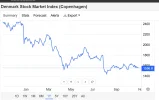
One year performance of the Danish stockmarket. Going a tad off topic.
That means nothing frankly, many stock markets have bad years, it's mainly because of the fall in stock price of novo nordisk over last year. Our stock market is a minnow compared to the Danish one, we don't have any novo nordisks or no irish company that could even approach that. We actually used to have them 25 years ago. The Irish stock market cap is 88 billion, the Danish one is 622 billion that's the difference.

Posting a one year return of Danish stock market doesn't answer the fact that irish people are heavily restricted from taking part in the stock markets. Blackrock today made that point. It was wondering why Ireland is the domicile of trillions of dollars in ETF funds but the Irish population has virtually no exposure. It was critical of the over regulation of the funds sector with contradictory regulations. Also critical of the banks for their over conservative approach in not providing an adequate investment platform and funds for Irish people Outside of pensions
 
The Irish stock market cap is 88 billion, the Danish one is 622 billion that's the difference.
I think that proves the point - not my point but the point of a mandarin with an ESRI type hat on. Ireland Inc. has much less to gain from promoting stockmarket investment than other jurisdictions.
 
I think that proves the point - not my point but the point of a mandarin with an ESRI type hat on. Ireland Inc. has much less to gain from promoting stockmarket investment than other jurisdictions.
I wonder how much of that is a result of determinism from our punative taxation regime? Danish households and pension funds can hold equities without punitive friction, and tax wrappers reduce behavioural barriers. I feel that tax design is a major reason Ireland’s equity market is tiny compared to Denmark’s. Deemed Disposal, high CGT, and dividend taxation make direct equity investing unattractive outside pensions. Denmark’s system, with low-tax pension wrappers and retail accounts, plus global corporate champions, creates a virtuous cycle of equity participation. Ireland’s incentives push capital toward property and pension schemes, not listed shares.

Broadly in bad outcomes the income dominates capital gains and vice versa in good outcomes. CGT is friendly to capital gains whilst Exit Tax is friendly to income.
This is the case for an investor subject to high taxes on income. A standard rate taxpayer would usually prefer the CGT plus tax on Income option.
Returning to your original thesis, I ran my own numbers and indeed the overall result matched yours... With mainstream assumptions (~7% total return, ~2.5% yield, 14% volatility, exit tax at 38% with 8‑year deemed disposal vs 33% CGT plus annual dividend taxation), outcomes are very close on average; in my crude model, DD8 is a hair better up to ~20 years, CGT a hair better at 30-40 years. As you lower the dividend yield, the advantage shifts to CGT, and if you go all the way to zero‑dividend holdings (which is a personal preference), CGT is clearly superior.

To simplify my life, in modelling I left out some smaller details (i.e.: no immediate 33% relief for capital losses in the CGT case, only carry-forward; CGT annual exemption harvesting vs loss offset in DD8 remains unavailable - a real qualitative downside of DD8)...

I do note that CGT wins in strong markets (benefit of long deferral), but the real surprise to me was the poor 10th percentile: despite assuming immediate 33% loss relief for CGT (quite optimistic), the DD8 regime holds up because capital gains effectively shelter dividends within each 8‑year block.

 
the DD8 regime holds up because capital gains effectively shelter dividends within each 8‑year block
It’s more that DD8 taxes divies at 38% rather than 52%. A different picture for a standard rate taxpayer.
Great to have corroboration of my findings.
I am not really in a position to judge whether Ireland’s small stock exchange is a consequence of the tax regime.
 
As you lower the dividend yield, the advantage shifts to CGT, and if you go all the way to zero‑dividend holdings (which is a personal preference), CGT is clearly superior.
Does accumulating vs distributing ETFs make any difference in your analysis?

How are dividends from distributing ETFs taxed? Each year or once every 8 years and when units are sold?
 
Does accumulating vs distributing ETFs make any difference in your analysis?

I didn't directly model it as the taxation is complex, and I'm not confident I understand it.

Hypothetically, if accumulating ETFs weren't taxed but allowed to gross roll-up, they outperform distributing ETFs (by an amount depending on the amount of the dividend -- more for larger dividends) per year over all horizons. Distributing ETFs suffer annual income tax on dividends (52%), which kills compounding. Accumulating ETFs that were allowed to gross roll-up shelter dividends inside the fund until deemed disposal. The gap would persist even after applying the 38% exit tax every 8 years.

How are dividends from distributing ETFs taxed? Each year or once every 8 years and when units are sold?

My understanding (and please correct me if wrong) is that for foreign ETFs, any cash distributions (dividends) are treated as income and taxed immediately at the investor’s marginal income tax rate. The remaining fund value is still subject to exit tax (38%) at a chargeable event. Whereas for Irish ETFs, the dividend is considered part of the fund’s growth and taxed at the next chargeable event under Exit Tax. Irish ETFs (both accumulating and distributing) enjoy gross roll-up: no annual tax on dividends.

So, from a tax perspective, my understanding is that there’s no deferral advantage for foreign accumulating ETFs versus distributing ones. Both lose the gross roll-up benefit that Irish UCITS ETFs enjoy.

But I am very much open to correction here!!!
 
Back
Top