Duke of Marmalade
Registered User
- Messages
- 5,664
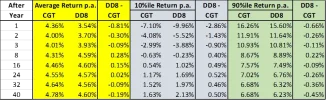
Below is a summary of some doodles I have been doing following the drop in Exit Tax to 38%.
I have assumed the alternative "CGT" approach would be along the Swiss lines as alluded to by @nest egg, viz. dividend income taxed annually.
It is based on 1,000 stochastic simulations. Stochastic is preferable because of the asymmetric approach to capital losses.
Assumed an overall return of 7% p.a. including 2.5% dividends and annual volatility of 14%.
The investor is assumed to be subject to a charge of 52% on dividends as they arise annually.

Observations
On average there is not much to chose between the two approaches, with Exit Tax slightly better in the mid durations. There are two influences. First the longer the period the more deferral of CGT has a benefit. OTOH the Exit Tax regime is more beneficial on the treatment of dividends.
The surprise to me came from the poor performing 10 percentile. I have made the fairly optimistic assumption that losses in the CGT case get immediate 33% relief and expected this to dominate. It does so in the early years but in later years even the 10 %ile shows some gains and so the allowance for capital losses is irrelevant. In contrast the Exit Tax regime benefits from capital gains effectively sheltering dividends.
At the upper end the CGT regime comes out more clearly as the winner as the prolonged gross roll-up has most beneficial effect in these scenarios.
Conclusion
Contrary to my earlier intuition, I don't see much scope for further reduction in the Exit Tax rate. Indeed (especially if a left wing government emerges) increases in the CGT rate seem more likely than increases in the Exit Tax rate.
The non allowance of capital losses in the Exit Tax regime is not such a deficit as some seem to think - to lobby for their allowance would be a Pyrrhic victory.
I have attached a copy of the spreadsheet.
I have assumed the alternative "CGT" approach would be along the Swiss lines as alluded to by @nest egg, viz. dividend income taxed annually.
It is based on 1,000 stochastic simulations. Stochastic is preferable because of the asymmetric approach to capital losses.
Assumed an overall return of 7% p.a. including 2.5% dividends and annual volatility of 14%.
The investor is assumed to be subject to a charge of 52% on dividends as they arise annually.
Observations
On average there is not much to chose between the two approaches, with Exit Tax slightly better in the mid durations. There are two influences. First the longer the period the more deferral of CGT has a benefit. OTOH the Exit Tax regime is more beneficial on the treatment of dividends.
The surprise to me came from the poor performing 10 percentile. I have made the fairly optimistic assumption that losses in the CGT case get immediate 33% relief and expected this to dominate. It does so in the early years but in later years even the 10 %ile shows some gains and so the allowance for capital losses is irrelevant. In contrast the Exit Tax regime benefits from capital gains effectively sheltering dividends.
At the upper end the CGT regime comes out more clearly as the winner as the prolonged gross roll-up has most beneficial effect in these scenarios.
Conclusion
Contrary to my earlier intuition, I don't see much scope for further reduction in the Exit Tax rate. Indeed (especially if a left wing government emerges) increases in the CGT rate seem more likely than increases in the Exit Tax rate.
The non allowance of capital losses in the Exit Tax regime is not such a deficit as some seem to think - to lobby for their allowance would be a Pyrrhic victory.
I have attached a copy of the spreadsheet.
Attachments
Last edited: