Update on cost of bailout

What can be done now to reduce that 35bn+ net cost?
There is nothing to stop the Government moving a surplus from the Exchequer (i.e. central treasury) a/c to the NTMA and instruct it to pay off national debt. This is achieved through redeeming government bonds or buying back other debt.

I don’t know if the government can instruct the NTMA to buy back specific debts like the EFSF / EFSM loans. Also, it may not be wise to do so as greater savings might be achieved by redeeming other debt, and the NTMA is the competent authority for decision making in this area. However, this being Ireland, the Government may decide that, rather than redeem the EFSF loans, funds can be better used through e.g. ‘investing’ in vanity projects or buying votes by increased public expenditure on vocal interest groups.

The other issue is that the EFSF / EFSM debts are back-loaded. This means that most of the capital repayments on these loans are scheduled for a late repayment period, i.e. from 2029 to 2042, so unless capable of renegotiation they probably cannot be paid off until maturity. When will Ireland have to repay the EFSF loans? | European Stability Mechanism
 
Surely the cost of the bailout is different from the cost of financing the bailout?

Or are they related?

If I buy as asset for 70, and it subsequently depreciates to 40, I have made a capital loss of 30.

How I financed the 70 initial cost, by cash or borrowing, is a separate issue to the capital loss of 30?

Isn't it?

We have lost 35bn approx due to the banking crisis. We can't go back in time and change that.

We financed that cost by borrowing from various sources, and we have already repaid the most expensive sources of finance.
 
With the sale of the government stake in ptsb (formerly irish permanent) the government will also have got back its money on that. Irish permanent was one of the "bad banks" but even on that and even by under selling its stake now to the austrian bank it is still getting its money back. If nama were half competent the government could have made back much more.

Just aswell we didn't have danny and michael healy rae backing the government then, jackie was a man of his word though.
 
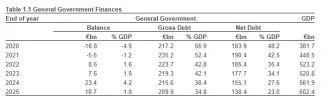
The national debt is down to €209.9 Billion... so we should definitely spend our windfall surplus of €9 billion on inflationary cost of living measures, especially as there are no major wars, oil crisis, impending private credit market collapses or other financial shocks on the horizon. :rolleyes:
 
I would have expected more from the sale of PTSB in comparison though
I think the question it raises is would a similar size bank be worth more in a different country of comparable size and if so what it wrong with the Irish banking sector that makes PTSB worth less than expected.
 
But those are decisions the government took after the banking crash and bailout. It can't be exclusively blamed on the banks because other countries kept infrastructure spending going but cut welfare and public sector rates, we maintained all those rates effectively, there were relatively small cuts in absolute rates.

The government’s failure in my option was nationalising the banks in the manor they did. Ultimate Ireland took the hit to save the knock on impact to other European banks. The cost should have been shared or we should have had far more favourable loan conditions.

Yes the decisions happened after but they were directly foreseeable so it’s difficult to separate. The government was never going to slash the public sector or pensions and invest in infrastructure.

I don’t think anything has changed in that regard if money began to dry up today similar decisions would be made because that’s the result of the political system, voters and who has influence in Ireland
 
Folks

Read the thread title? Is it about the Children's Hospital? No, it's not. Therefore don't include comments about the Hospital in your posts and don't respond to posts which do.
 
€8bn in bailout loans to be repaid early under Govt plans

Some good news with potential savings on interest.

The interesting comment is "Speaking on Today with Claire Brock, Mr Harris said it would be up to the NTMA to decide if the €8 billion repayment would be used to reduce the national debt."

I get that we have no sovereignty over our monetary policy but we retain control of our fiscal policy. Surely what the NTMA decides to do as a matter of monetary policy will impact decisions made at fiscal level?

"He [Harris] said the Government had sought approval for this yesterday and that "it may well make financial sense".

Mr Harris stressed that "we may actually be able to reduce the interest rate payments that this country would have to pay" -
seems like a no-brainer but it seems like its out of the hands of Government, and they get all the flak in the media!

So who is in actual charge here? The government are open target for criticism but what if the NTMA decide against Ireland paying down its debt early?
 
But they have already got back loads of money from selling down their stakes in the banks and through asset disposals by nama yet they are only now deciding to pay down the european loans they used in the bailout. Their logic was ah sure they were got at such low interest rates no point in paying off early. Therefore most of the debt they accrued from the bailout is still outstanding even though they got back alot of that money through asset and bank stake sells through the years. What did they do with that money?
 
I'd have thought the national dept is all one big loan with payable interest rates. Does it matter if its the bailout or COVID, its the national dept being repaid? Are they referring to bailout as it sounds politically more acceptable to repay?
 
In fairness, I think the NTMA has been the one govt body that has really excelled over the last few years. They were constantly retiring old higher-interest borrowings and refinancing them with longer term low interest loans. Sure, it was like shooting into an empty net but at least they scored!

Maybe they will now repay some of the more expensive bonds with the €8b?
 
According to the National Treasury Management Agency (NTMA), as of end Sept 2026, Ireland's gross national debt is €220bn. If the exchequer used all its available assets to pay off debt it would be €184bn.

I actually remember when it was IRL£30bn which at the time I never thought it could be possible to repay that much.

I don't think countries have any real intention or ability to pay back their national debts, just try to keep up with the interest payments.
 
So who is in actual charge here? The government are open target for criticism but what if the NTMA decide against Ireland paying down its debt early?
The NTMA is mandated to ensure our country is funded properly. It's sensible to let them decide how to do it. These bonds from memory carried a 5.5% or 5.7% interest rate. The NTMA these days is borrowing 10 year bonds at 3.1%. Replacing these European bonds with new borrowing would halve the interest payments without eating into the cash available to the country.
But they have already got back loads of money from selling down their stakes in the banks and through asset disposals by nama. What did they do with that money?
Used it. You can't really say which euro went where, but in theory the money was used to help fund infrastructure projects and go into sovereign wealth funds, which you assume will deliver a return > the interest rate Ireland has to pay on its bonds. Given that the economy is growing at > our interest rates for debt, and seems to be capacity constrained, using money to pay to build new infrastructure, for example, seems a better bet than just paying down debt.
I'd have thought the national dept is all one big loan with payable interest rates. Does it matter if its the bailout or COVID, its the national dept being repaid? Are they referring to bailout as it sounds politically more acceptable to repay?
It's not one big loan, it's lots and lots of loans with different maturities and interest rates. This is specifically a loan that carried a relatively high interest rate (5.5% or more) compared to what we currently pay to borrow (closer to 3%).

You can read about the breakdown of Irish debt in the very detailed investor presentation the NTMA produces regularly. The latest one from October. Page 38 onward.
Maybe they will now repay some of the more expensive bonds with the €8b?
I would bet so.
as of end Sept 2026, Ireland's gross national debt is €220bn. If the exchequer used all its available assets to pay off debt it would be €184bn.
It's considerably more favourable than that. There are numerous ways to calculate net debt, but page 35 of the NTMA document I link above gives a good breakdown. We hold about €122bn in financial assets. Now there's always a question about how marketable these are. But net debt from things you could lay your hand to and sell is probably <€140bn. Of course, asset prices move in a crunch. But generally, Ireland is very well positioned on debt.
I don't think countries have any real intention or ability to pay back their national debts, just try to keep up with the interest payments.
The difference between you or I and a country is, the country will never (presumably) die. €10bn borrowed in 2000 is worth €5.57bn today. By 2100 if inflation ran at a straight 2% a year from here, it would be worth €1.29bn in today's money. The interest bill in real terms will also erode, assuming there isn't a major interest rate shock upwards.

The interest rate is how debt markets tell governments if their borrowing level is sustainable. But generally speaking the idea is you borrow less than the growth rate of your economy / inflation and you can do it forever. The issue lately has been governments borrowing such that their debt to GDP keeps rising and rising.

That isn't a problem Ireland has (even using debt to GNI*) at present. Our net debt to GNI* is close to 40%. Gross government debt to GNI* is about 58%, vs debt to GDP of 104% for the UK, for example. Even Germany is higher than us, at 66%.
 
The NTMA is mandated to ensure our country is funded properly. It's sensible to let them decide how to do it. These bonds from memory carried a 5.5% or 5.7% interest rate. The NTMA these days is borrowing 10 year bonds at 3.1%. Replacing these European bonds with new borrowing would halve the interest payments without eating into the cash available to the country.

Absolutely, no disputing any of that and I'm guessing that SH wouldn't be saying it publicly if there even a remote chance it wouldn't happen.

I was just a bit irked at the language of the Minister of Finance of the Government seeking approval from NTMA....good to have independent bodies outside of government.
 
Back
Top