Tracking capital gains on shares

presidenttttt

Registered User
Messages
465
Surprised I can't see a thread on this, please redirect me if it exists. May be worth a stickie if not.

What is the most efficient way to track stocks/share gains and losses for ones tax return?

I am thinking of the context where someone may have multiple platforms like degiro, revolut investments, eToro, 212 etc etc, and may purchase via multiple buys over time (DCA), and also multiple sells. I know there is a first in first our principle or rule, but practically how are people managing this efficiently?
 
Anything useful here?
 
I know there is a first in first our principle or rule, but practically how are people managing this efficiently?
You really just have to keep your own records in a spreadsheet.

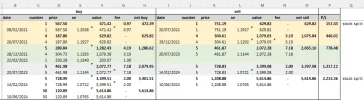
Everytime you buy a stock add it on the left side. Everytime you sell add it on the right side and net them off against each other.

You can make FIFO easier for yourself by selling in the same number of units that you bought in.
 
I have found it very difficult as well.

I have shares in CRH and got new shares instead of dividends. So I have lots of acquisitions at different prices.
There was also a rights issue if I remember correctly.

When I sold some, it took me a while to figure it out and my notes were not great.
Then a couple of years later I sold some more and I tried to figure out what I had done the last time.

But I think that Excel is the only way to go.
 
T212 is also a nightmare when you rebalance pies etc, there are just so many buys and sells throughout the year.

I use Excel but I do wonder if I am under or over paying the various taxes(its not just CGT!) sometimes due to human error in my spreadsheet and I am probably not the only one.
 
You probably shouldn't rebalance pies if you have a lot of stocks. It will basically sell or buy every stock even if it's only marginally away from your target weighting. You have to pay the spread/FX every time you do that, and the admin quickly gets out of control.

If you have a stock that is way higher than the rest just sell part of it manually.
 
Has anybody had a Revenue audit of their share dealings ?

I have a lot of my dealings on paper. I have changed brokers several times. It would be a nightmare to try and show all the previous history of various shares I have transferred from broker to broker. This would be necessary to prove the losses and gains on these shares.

Also a lot of the companies have done share splits and set up new companies to move some products away from the main company. All the pharmaceutical shares I own have split up.
It's difficult enough to check where these new named shares origionated from, never mind the value they were set up at.

How much time could revenue spend on an audit in order to possibly find a mistake in my records ?

If they did manage to find a mistake it would be for a small amount and it could be in my favour.
 
I'm probably underthinking it. I get a report from Degiro in Dec & Jan showing my profits / losses based on sales of shares.
e.g.
Jan - Nov - Gains / Losses from sale of shares €1400
Dec - Gains / Losses from sale of shares €-300

So is it not sufficient to just submit those two numbers to Revenue in Dec & Jan and track the total in a spreadsheet?
As the number above adds up to €1100 it's below the €1270 TFA for the year.
That's fine if you're with one broker and the broker is likely calculating things more or less accurately. But others are talking about using different brokers and maybe more complex shareholding scenarios.

I like the idea of underthinking things though. I might make that my new year resolution... :)
 
It is more complex than that, there may be different currencies involved, some taxes may already be deducted in some cases and in some cases not, time of buying vs selling (30 day rule) and fist in, first out, dividends are not CGT and will be taxed based on your other income and so on.
 
Just trying to remember my history of brokers is difficult.

As far as I remember, I started with
BCP, Fexco and Computershare.

Fexco changed into Goodbody.

I transferred Goodbody to TD Waterhouse.
I think TD Waterhouse changed into Interactive Investor

I transferred from Interactive Investor to Saxo.

I transferred Saxo to IBKR and Degiro.

I also transferred from Computershare into most of the above.
 
The transfers themselves don't necessarily need to be recorded accurately, since transferring isn't a taxable event. But if you've also been buying and selling at each broker then it will be complicated.

So keeping one central record of all buys and sells is needed, eg Excel.
 
Some enterprising individual should run courses on this, I know this stuff reasonably well, but it can get overwhelming, I would pay for it.
Maybe an AAM thread on its own is needed that provides instructions on how to calculate all this, one for each broker.
 
For each share I record the number, price and value in €, including fees and currency exchange if necessary.

Every sale on the right is matched up to corresponding buy(s) on the left. The profit or loss is then the difference for each tranche.

Stock splits I have treated as a sell and re-buy to make it easier to follow, but the split itself isn't taxable, only a subsequent sale of that tranche. Them sum them up by year of sale for your tax return.
 

Attachments

  • 1767795064557.webp
    1767795064557.webp
    44.7 KB · Views: 109
Last edited:
The transfers themselves don't necessarily need to be recorded accurately, since transferring isn't a taxable event
This is true for any shares that have not been split or reconfigured over time.

Where any changes have been made, I have a record of a certain number of shares purchased. In a lot of cases this is on paper.

I now have a different number of these shares in an online account. There are paper and multiple computer files with the history of all the reconfigurations. Over time it is very difficult to keep track of all this.

If I sell some of these shares, I presume that IBKR for instance might notify Revenue of the value of the shares at transfer in time and selling value. This will not correspond to my actual profit or loss.

If Revenue audit this situation it will be very time consuming and difficult to gather up the evidence trail. I don't have access to many of these closed broker accounts. So it would be impossible to provide evidence of whether I actually bought or sold shares in the account, or was the change of share quantity due to a corporate event.

How much time and effort would Revenue spend on this for a relatively small sum of money.
 
Some enterprising individual should run courses on this, I know this stuff reasonably well, but it can get overwhelming, I would pay for it.
@flyingfolly tried to create an app but nobody gave them feedback or was willing to pay for it.
 
If I sell some of these shares, I presume that IBKR for instance might notify Revenue of the value of the shares at transfer in time and selling value. This will not correspond to my actual profit or loss.
I wouldn't be unduly worried about it. You wouldn't be routinely audited for no reason, only if there was some suspicion, for example if IBKR reported large sales but your CG1 form didn't reflect that.

If Revenue audit this situation it will be very time consuming and difficult to gather up the evidence trail.
The onus is on the shareholder to maintain adequate records, but if the evidence is lost to time then you would just have to make a reasonable best estimate.
 
Last edited:
Back
Top