
The cost of unity

patfert1

Frequent Poster
Messages
722

At the Fine Gael ardfheis a study by economist Stephen Kinsella was presented on the economics of potential Irish unity.

Over the course of 50-odd pages, Kinsella sets out in some detail the potential costs of various models and scenarios for Irish unity. Obviously, there are certain variables that hugely influence the total bill. These include the vexed questions of who pays for future pensions, and what Northern Ireland’s share of the UK national debt would be.
The potential costs, he says, range from €3 billion to €25 billion in year one
Kinsella also describes how the costs of integrating the Northern economy (such as it is) by equalising pay, welfare and other elements across the unified country can be understood as costing southern taxpayers while benefiting households in the North. The biggest beneficiaries, he says, will be public service workers, pensioners and those on welfare in the North.

Even in the most optimistic scenario, households in the South would be paying significant amounts to improve the position for people in the North. In one scenario, the first year costs range from €1,500 for each taxpayer in the South to almost €5,000. And remember, the costs are recurring. Again, it is hard to see southern voters signing up for this.

This alongside another IT article yesterday about how our multinational tax take is able to pay for such large public sector expenditure.

My personal view is that unification would be cause massive societal and financial - and potentially worse - problems for the country, and if it coincided with a reduction in the multinational tax take (and multinationational employment levels) would set the country back decades if not effectively bankrupt it.

BUT I expect that financial arguments will lose out to emotional arguments in the debate around any referendum, and the country as a whole would vote with its heart not its head for reunification, and a generation will suffer as a result.
 
Last edited:
I think the unification through a referendum any time soon would invariably lead to a civil war.

On a purely financial cost arguments (assuming a peaceful, agreed transition) there will be some cost but not the crippling costs as bandied about the economists.

NI is one of the poorer regions of the UK and much is made of the subvention of €10-€20bn a year

The North West region of the 26 counties is the poorest region in the Republic and in a UI, the 6 counties would be the poorest region.

That said, in a 32 county Ireland there would be no '6 county' region - the essence of a UI. So places like Mid Ulster and Antrim and Newtownards would be excluded and instead the regions with highest social benefits per person would be Ards & North Down, Carlow and Louth. Donegal, Longford, Causeway Coast & Glens have similar levels of income and also high had state transfers.

In 2023, social benefits per person were 12% higher in Northern Ireland than in Ireland.

CSO - Gross Disposable Household Income per Household

Some rough maths:


GDP of NI is €81bn in 2024 - social welfare bill in NI is €13.3bn - 16.4% of the value of the entire NI economy
GNI (to take account of impact windfall FDI distorstions) in RoI is €321 bn in 2024 - €29bn social welfare bill - 9% of the value of the entire RoI economy.

Taking those figures at face value in a UI the entire economy will be €402bn with a welfare bill of €42.30bn - 10.5% of the value of the entire 32 county economy. Hardly a public expenditure earthquake?

NI has 12% higher social benefits per person not because the monetary rates are higher but because there are more people reliant on benefits than in RoI to the best of my knowledge.

There would be additional costs in duplication of services etc but that happens anyway and can be weeded out over time.
Economists appear to me to be fixated with costs, and rarely if ever focus on the benefits.

Again, assuming peaceful, agreed transition, benefits would be the beginning of the demise the Catholic/Protestant divide that has plagued this country for centuries, more roundly seen as a Irish/British divide. The beginning of the demise of paramilitary culture. The beginning of the demise of Sinn Fein, DUP, UUP, Fianna Fail, Fine Gael in their current manisfestations - their core raison d'etre will be gone and new political alignments will emerge with issues of social economic justice coming to the fore and determining political allegiences.

A new United Ireland (peacefully and agreed) would from a foreign affairs prospective would be in diplomatic terms carry a heavy-punch reputationally globally. Leading perhaps to greater inward investments and opportunities.


All that said, it is unlikely to me that a peaceful transition would occur. The events of Garvaghy Rd lay bare the fundamental positions of the two communities, or at least a significant amount of those communities.
While DUP can rightly point to the breaking of the law by the Garvaghy protestors they themselves stand on a fundamental principle of breaking the law. Having never signed up to the GFA their core raison d'etre is that it is the British Monarch that is sovereign and not the people - ergo, the people have no right to determine NI's constitutional future outside of the United Kingdom.

In the main, the prospect of a political UI is at a minimum another generation away unless some catalystic occurrence should bring about demise of the British monarch, perhaps another European war.
 
In the main, the prospect of a political UI is at a minimum another generation away
A well-reasoned post, thanks.

To the prospect of a political UI, quoting from Gemini:

The NI Secretary of State must call a poll if “it appears likely that a majority of those voting would express a wish that Northern Ireland should cease to be part of the United Kingdom and form part of a united Ireland”.

The most recent opinion poll on Irish unity voting intentions in Northern Ireland was conducted by LucidTalk for the Belfast Telegraph between 29 October and 31 October 2026, with results published on 8 November 2026. The survey gathered 3,989 responses (weighted to a representative sample with a margin of error of ±2.3%):
  • Maintain the Union (Remain in the UK): 46%
  • United Ireland: 42%
  • Undecided / Unsure: 12%
A survey by The Institute of Irish Studies for The Sunday Times conducted between 8 May and 22 May 2026 (sample size 1,534) found
  • 49.7% opposed to a united Ireland
  • 35.8% in favour
  • 4.7% who did not know, and
  • 9.8% who neither agreed nor disagreed.
On these numbers it would most likely take a decade or two - if ever - for the UI option to consistently top 50% in NI polls.
But if and when it does, the Secretary of State will be obliged to call a referendum.
And surely the Irish government could not avoid holding the same referendum in the Republic.

One other thought. What are the chances of a UK government proactively calling a referendum with the goal of getting rid of the North once and forever?

----
As an aside, I think it's madness that any referendum to change the status quo - one with such lasting consequences - whether it be Brexit, Scottiish independence, or a United Ireland - should be decided by a simple majority of those franchised adults who turn out to vote. IMO the bar should be at least 66-70% for such decisions.

In the case of Brexit in 2016, of those who voted, 52% chose leave and 48% preferred to remain in the EU. Actually 37% of the total electorate voted to leave, and this was equivalent to just 26.5% of the total UK population at the time.

In the case of the Scottish independence vote, 30.3% of Scotland's entire population voted for independence, 37.5% of the entire population voted against. The percentage of actual votes cast was 44.7% for independence with 55.3% against. Note that 16 year olds could vote in this referendum.
 
Last edited:
The NI Secretary of State must call a poll if “it appears likely that a majority of those voting would express a wish that Northern Ireland should cease to be part of the United Kingdom and form part of a united

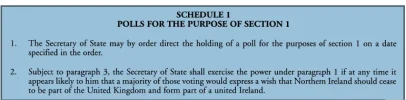
Just on that, this is the text of GFA

1794764866142.webp

It's 'may' and 'shall exercise....if at any time it appears likely to him...". Very loose and open to wide interpretation.

surely the Irish government could not avoid holding the same referendum in the Republic.

Well, that's a hidden road bump that is not addressed in the GFA.

IMO the bar should be at least 66-70% for such decisions.

While I agree with your sentiment that a 50%+1 referendum is a blunt instrument to decide anything I would be opposed to anything but a simple majority. You could end up with a situation where there is consistently 60%-40% in favour of a particular constitutional change and yet no change occurs because a minority is protected by a weighted rule is recipe for more conflict imo.

I'd suggest holding the border poll now, see what the result is - but on an agreed condition that the result is in principle and not legally binding.

If NI or the South votes NO, back to the drawing board for United Irelanders to come back another time 7yrs+, if at all.

If in the event there is a majority North/South vote for Yes, it should trigger a legally binding consultative period established under the British-Irish council of how this would occur, say over 7 yrs - identity, culture, constitution, flags, state departments and institutions, policing, defence, etc....and then, a second referendum put to people of All-Ireland if what is proposed by the British-Irish council is acceptable or not.

I know people who support a UI but would oppose it if our flag or national anthem is changed. :rolleyes:

Sacrifices would have to be made and emblems, flags, institutions will need to carry a British element in recognition of the large indigenous population that identify as British. However if not acceptable to a majority, the status quo to remain.
 
Last edited:
Taking those figures at face value in a UI the entire economy will be €402bn with a welfare bill of €42.30bn - 10.5% of the value of the entire 32 county economy. Hardly a public expenditure earthquake?

NI has 12% higher social benefits per person not because the monetary rates are higher but because there are more people reliant on benefits than in RoI to the best of my knowledge.
Another factor to consider is that NI has 50% more State employees per capita as we have in Ireland. That is an additional burden.

More problematic would be the fact that they also have significantly worse educational outcomes, particularly at the lower end of the scale. Those in Northern Ireland are more than twice as likely to leave school early, more than twice as likely to not be in employment, education or training and three times less likely to have a third level qualification. In short a large proportion of the workforce of Northern Ireland would not be able to participate in the economy of a united Ireland. That would cause significant social problems, particularly amongst the Loyalist community where those low educational outcomes are most significant.
 
Another factor to consider is that NI has 50% more State employees per capita as we have in Ireland. That is an additional burden.

To what extent? Again rough figures

https://www.irishexaminer.com/business/economy/arid-41403125.html

400,000 f/t positions in the public service in Ireland with a population of 5.6m ? of 14%

Population of NI is 1.9m. Take 14% of that = 266,000 multiply by 1.5 is 399000.

Thats 400,000 plus 399000 = 799000 in a total population of 7.5m or 10.65%.
More problematic would be the fact that they also have significantly worse educational outcomes, particularly at the lower end of the scale. Those in Northern Ireland are more than twice as likely to leave school early, more than twice as likely to not be in employment, education or training and three times less likely to have a third level qualification. In short a large proportion of the workforce of Northern Ireland would not be able to participate in the economy of a united Ireland. That would cause significant social problems, particularly amongst the Loyalist community where those low educational outcomes are most significant.

These are just good arguments for ending partition and improving the lives of those in NI.
 
To what extent? Again rough figures
Apologies, I was looking at figures from 10 years ago. The massive increase in the size of the State Sector in this country over that period has meant that we have almost caught up with Northern Ireland. We are now at 27.41% of the workforce whereas they are at 34.87% of their workforce. Source
These are just good arguments for ending partition and improving the lives of those in NI.
Those are two different things and may not be symbiotic.
I agree with Charlie Haughey that Northern Ireland is a "failed political entity" and therefore a failed economic entity but it doesn't follow that unification with this country would fix that. 35 years after reunification there are still employment, GDP and wealth gaps between the former East and West Germanies and they wanted unification and they had previously been one country. Different kettle of fish here.
 
These are just good arguments for ending partition and improving the lives of those in NI.
What are the reasons you feel a UI would - or could - improve the lives of those in NI?

One answer I can suggest is that there would be a better chance of a functional all-Ireland Dublin-based government than the current going-nowhere governance stalemate in NI.

Against that, the chances of a SF forming a majority government would increase, with resultant risk of loyalists experiencing real or perceived discrimination to add to the grievances they would start out with having been forced into a UI. (Can we imagine a FF-FG-DUP-and-misc-others coalition to keep SF out of government?)

All that said, it is unlikely to me that a peaceful transition would occur.
Indeed.
 
Those in Northern Ireland are more than twice as likely to leave school early, more than twice as likely to not be in employment, education or training and three times less likely to have a third level qualification. In short a large proportion of the workforce of Northern Ireland would not be able to participate in the economy of a united Ireland. That would cause significant social problems, particularly amongst the Loyalist community where those low educational outcomes are most significant.

In this respect the north-eastern part of NI has more in common with the declined post-industrial-era North of England than it does with the rest of the island of Ireland. Low educational achievement, high cross-generational unemployment. On top of this the corruption resulting from decades of dominance of certain areas by paramilitary organisations. I shudder to think of the ROI trying to integrate this, even if the political divisions were not present.
 
On top of this the corruption resulting from decades of dominance of certain areas by paramilitary organisations.
And the fact that until recently if your father was an upstanding member of the local Lodge you could walk in to a job in the Public Sector or Short's / Harland & Wolff etc. so an education was unnecessary.
 
Last edited:
Back
Top