You are using an out of date browser. It may not display this or other websites correctly.
You should upgrade or use an alternative browser.
You should upgrade or use an alternative browser.
The 9 Funds Available on MFF Platform
- Thread starter GSheehy
- Start date
Surely this means that some of them already exist?do these nine funds exisit already, or are they being specifically created for MFF?
These KIDs are absolutely useless. For example this is the indication of how the Amundi funds will perform:

EU law requires that this information is given based on an analysis of daily movements in the fund or its index if it is a tracker over the last 5 years.
Duke of Marmalade
Registered User
- Messages
- 5,660
Yep They can be very, very misleading. The EU text is dripping with hubris - talking about things like the kurtosis of daily changes in the last 5 years. The argument is that the statistics of around 1,500 observations should be significant and credible. On the evidence of these KIDs maybe we do get a sense of what @Dave Vanian correctly calls the volatility and therefore the width of the range of possible outcomes. But clearly the position of the range is very reflective of how markets moved in general over the previous 5 years.If I recall correctly, these are all based on past performance and will always therefore be almost completely useless.
These 5 years were when QE unwound with negative implications for Low Risk and we also saw the continuation of the long bull market in equities.
I would add about 1% onto the Low Risk figures and subtract 6% from the High Risk figures.
Last edited:
Duke of Marmalade
Registered User
- Messages
- 5,660
A good question. ILIM funds are new and therefore unable to provide past performance figures.Quick question: do these nine funds exist already, or are they being specifically created for MFF?
The Amundi funds seem to be versions of existing funds but with the tag of AE suggesting that they are to that extent "new". But there is sufficient data on the indexes they track to provide the performance figures.
I didn't check the Blackrock ones.
Duke of Marmalade
Registered User
- Messages
- 5,660
Here?

 myfuturefund.ie
MyFutureFund
MyFutureFund is designed to help people increase their financial security in their retirement years. It is separate from the Irish State Pension, which remains the foundation of pensions in Ireland.
How can I learn more?
Each Investment Manager has provided a simple overview of their investment principles for each investment strategy. These overviews are called Key Investor Information Documents (KIIDs).
You can find the KIIDs for each of the investment strategies below. You should read these documents if you are considering switching investment strategies.
The busiest Dublin Bus route in 2025.

Dublin Bus unveils busiest route of 2025 and exact time of day buses are slowest
Reflecting on 2025, Dublin Bus revealed their busiest stop, busiest route and their slowest time of day when buses travel at just 13.5km/h

They don't claim to be projections, indeed they say What you get from this product depends on future market performance. Market developments in the future are uncertain and cannot be accurately predicted.A fuller picture on the "projections"
So it's not only not helpful, but actively misleading in this case if you were to base a decision on them.If I recall correctly, these are all based on past performance and will always therefore be almost completely useless.
Duke of Marmalade
Registered User
- Messages
- 5,660
These are ritual disclaimers, which would be present where the word "projections" is actually used.. Clearly they are not implying that these are as useless for predicting the future as showing recent Lotto winning numbers or that their only merit is for students preparing a thesis on historical performance.They don't claim to be projections, indeed they say What you get from this product depends on future market performance. Market developments in the future are uncertain and cannot be accurately predicted.
I note that Amundi actually use 10 year past performance. I think the rules state that there must be a minimum of 5 years past performance before providing these figures.
Duke of Marmalade
Registered User
- Messages
- 5,660
You are of course dead right. These KIDs are an embarrassment to their parentsAren't these criticisms better directed at the KIIDs themselves and the regulatory framework that mandates what they must contain rather than at MFF/AE?

I compared MFF to the glidepath of my occupational pension provider's lifestyling fund: Passive IRIS.Standard PRSAs are required to have a default strategy which most if not all interpret as a glidepath towards a "safer" balance at retirement.
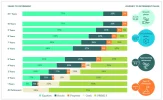
PRIME 3 is itself a multi-asset fund so I split it out into its components to see the full picture.

Apart from the obvious precipice adjustments, there are other differences:
No cash: IRIS moves to 25% cash (plus cash held in PRIME 3) to cover the tax-free lump sum. MFF stays in bonds.
Equity allocation: MFF has more equities than IRIS in the high-risk phase, but less in the medium-risk phase, and none in the low-risk phase.
De-risks earlier: MFF starts de-risking 15 years from retirement, IRIS starts at 9 years.
No property or alternative assets.
Last edited:
Duke of Marmalade
Registered User
- Messages
- 5,660
Nice graphics. The approach of MFF won't survive IMHO. It's no big deal as they have lots of time to wise up. Do you mind sharing the charges on your New Ireland company plan?
I don't really understand why people are still fixated on lifestyling when it's arguably been debunked.
The fallacy of "lifestyling"
I was recently made aware of a situation which highlights the total fallacy of "lifestyling". The basic premise behind lifestyling is that one should invest in growth assets up to, say, 10 years before retirement and then ease into bonds/cash or "safer" investments as you approach retirement...
www.askaboutmoney.com
A critique of the lifestyling approach to pensions
I came across a paper which may help the PA answer some of those questions: "Beyond the Status Quo: A Critical Assessment of Lifecycle Investment Advice" https://www.netspar.nl/assets/uploads/19.-Cederburg-ACO_Manuscript.pdf "Our findings suggest that financial advice and pension regulations...
www.askaboutmoney.com
Duke of Marmalade
Registered User
- Messages
- 5,660
It certainly has its critics. You have highlighted me as one of that group in your link. (Heck I thought Trump was obsessed with people's past social media history.)I don't really understand why people are still fixated on lifestyling when it's arguably been debunked.
I was a bit OTT in that post, mainly informed by the madness of investing in long bonds at 0%.
There are two "facts" which many agree upon, even the debunkers.
1. Someone aged 20 should have their pension savings 100% (at least) in equities or other "growth" assets..
2. Most people who are not comfortably off, in the target market for MFF for example, should not have their pension pot 100% in equities at retirement.
So "lifestyling" is the term given to reconciling these two positions, especially for default strategies.
It is an extremely broad church and MFF have introduced a mad monk all of their own.
99% allocation, 0.65% AMC and €2.86 monthly fee.Do you mind sharing the charges on your New Ireland company plan?
I linked to two existing threads on the issue. If you feature there then that's your own doing and not a result of any forensic investigation on my part.You have highlighted me as one of that group in your link. (Heck I thought Trump was obsessed with people's past social media history.)
