RTB Case studies

stormy

Frequent Poster
Messages
603
New RTB prescribed forms: signed Friday, mandatory Sunday, typos included

Rent review and rent-reset exemption notices aren't RTB house style — they're statutory forms prescribed by ministerial regulation. Every word is law, and tribunals hold landlords to every word. In TR0001393 a warning letter demanded €913 in arrears when the ledger showed €903. The tenants didn't even attend the hearing; the Tribunal found the €10 discrepancy itself, held that "no act of default arises if the amount demanded to be paid is not in-fact due," and invalidated the termination — a year after the notice was served, back to the start. All because a single character was wrong.

Now the forms the RTB has just prescribed for the rest of us (S.I. 470/2026, mandatory from 14 September):

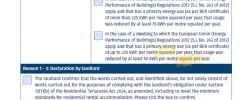
1. A non-existent Act. The landlord's declaration, the box you tick under pain of false-information penalties, cites "section 12(1)(b) of the Residential Tenancies Act 2024." The Act is from 2004. One wrong digit, in the operative declaration, in all three forms that carry it. A landlord's single character slip invalidates a notice; the RTB's slip creates a statutory reference to an Act that doesn't exist.

2. The energy table can't hold its own units. Adjacent rows: "kWh per metre squared per year," then "kWh per metre square per year." Harmless — but copied unread into all three forms.

3. One form, two names. The rent review form gives its serving instructions as "Serving a Notice of Rent Setting" on page 1 and "Serving a Notice of Rent Review" on the last page. These aren't synonyms: setting a rent is what happens at the start of a tenancy (s.19), reviewing it is changing it during a tenancy (ss.20–22) — different statutory events, different notices, different timelines, and this form is the review one. The prescribed forms exist precisely to keep that distinction straight, and this one uses both names for itself.

4. The housekeeping. Signed 11 September, mandatory from the 14th, gazetted in Iris Oifigiúil on the 15th — the day after every landlord in the State was required to use it.


A single character slip costs a landlord a year and a restart. A non-existent Act in the statutory declaration costs the RTB nothing.


Link to new forms, complete with typos:
 

Attachments

  • markup_1000078860.webp
    markup_1000078860.webp
    73.1 KB · Views: 4
  • Screenshot_20260916-075246.webp
    Screenshot_20260916-075246.webp
    85 KB · Views: 5
When you use the online form to end a tenancy, it tells you that the NoT must be sent to the RTB within 28 days of service on the tenant.

That 28 day rule was abolished during the summer of 2022, over 4 years ago, and it is still there on the website!
 
That 28 day rule was abolished during the summer of 2022, over 4 years ago, and it is still there on the website!
Indeed. And the trap has teeth: following the RTB's own guidance is no defence. The tribunals apply the Act, not the website — so the RTB's error becomes the landlord's invalid notice, at the landlord's cost, every time. If anyone has a determination where 'I relied on RTB guidance' actually saved a defective notice, I'd be glad to see it.
 
TR0001281, published today. A HAP tenant, a PRS fund, and a deposit. How hard can it be?

The Landlord Can't Count
The landlord — a professional PRS operator with a management company and an accounts assistant in attendance — retains part of the deposit for arrears. Asked how much, it produces three spreadsheets with three different figures. Asked where the arrears arose, its representative can't say. Its own email says every payment is "accounted for", which it later explains means the payments were received, not that they were enough. Its charges come to "€37,244,50" — comma included — and the payments received are €36,472.58 in one sentence and €36,474.58 in the next.

Meanwhile a €508.84 overpayment sat in the landlord's "deposit account" for the entire tenancy. Nobody told the tenant. She was, at the time, finding the rent hard.

The RTB Can't Find the File
Day one of the hearing is adjourned because the landlord's representative was given the wrong case files. This is the second time this month the RTB has stood down a three-member panel because the box had the wrong papers in it (TR0001510 was the other).

The Tribunal Can't Tell What Year It Is
The report records the hearing opening on 27 March 2020 — five years before anyone applied. The attendees list says 27 March 2025 — before the application and before the adjudication it was appealing from. The resumed hearing is headed 15 May 2025 at 14.30; the header says 15 May 2026 at 10:30. Three years for one hearing. The tenant "vacated in August 2025" — she left in August 2024. Her payment schedule runs from 30 February. One HAP payment covers the period "from 24.02 to 23.02", which ends the day before it starts.

And then, in a deposit case, the Tribunal computes the refund from a deposit of €1,980. The agreed facts say the deposit was €1,215. €1,980 is the rent. Every figure in the order flows from that number. On the agreed deposit, the tenant had already been overpaid. On the Tribunal's, she's owed another €448.45. Take your pick. The determination did.

Epilogue
The Tribunal awarded the tenant €300 in damages because the landlord "was unable to identify the extent or amount of arrears". Fair enough. It then miscopied the deposit, misdated the hearing three times and invented a thirtieth of February in the same document. Nobody awards the Tribunal damages for that. Nobody reads it, either — and this one was signed by a chairperson whose last two reports also managed an adjudication seven months before its own application and a notification a year before its own hearing.

This is the body that will fine you €5,000 and prosecute you if your paperwork is wrong.
 
This is astonishingly poor from a body which has legal powers. It suggests incompetence and/or pressure to get through many cases.
It can't be pressure to get through cases, the delays in getting a hearing seem to be huge.

Who staffs these tribunals and what qualifications do they have?
From what I hear, there is alot of movement of staff back and forth between Threshold, the Dublin Region Homelessness Executive etc. and the RTB.
 
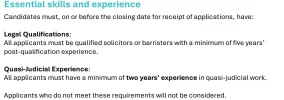
"Decision Maker – Member of anIndependent Panel of DecisionMakersInvestigations and Sanctions Unit"
Astonishing that despite being a qualified solicitor or barrister with five years experience and two years quasi-judicial experience, these are the rubbishy biased rulings that they come out with - including all of them missing the Argutinski issue for years.
 
If one assumes legal training includes the concept of impartiality, and yet the RTB rulings tend to favour the tenant over the landlord, then it becomes a question of the job-specific training and instruction the decision makers receive from the RTB. It would indeed be interesting to see such materials. Since the RTB is a govenment body, wouldn't it be possible to request these under a FOI request?
 
Somewhat related, I only noticed recently they post the FOI disclosure logs here:
Great sleuthing @stormy

I think I can fully see why this one was refused outright - it would be difficult to hide the reduction in tenancies over the period

Could you provide records detailing the number of approved housing bodytenancies registered in in the Killarney Local Electoral Area since 2017 up to 2025.Ideally an annual average number of tenancies that were active during the year.Could you also provide the same records for the Tralee Local Electoral Area?
 
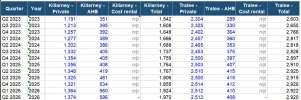
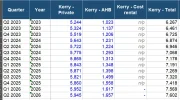
2017 to Q1 2023 would have to come from the RTB directly. The data series only starts in Q2 2023. The RTB says the earlier register data isn't comparable, because it held duplicate and inactive tenancies that were only cleared out between Q4 2021 and Q2 2023. Below are the published numbers from Q2 '23. Looks like no cost rentals in Kerry.

Killarney & Tralee
1790772291543.webp


Kerry County Below - Private tenancies declined in latest quarter.
1790772280187.webp
 
TR0001427, published yesterday.

Tenants find carpet moths days after moving in. The landlord reimburses their pest products, then has the carpets and underlay ripped out and new flooring laid. Done in under two weeks. They stay three more years, sign a new lease every June, and send one email in all that time — about a heater.

Three years later, after a row over a lease-break fee, they go to the RTB. Mould claim dismissed. Belongings claim dismissed. Medical claim dismissed — one prescription pre-dated the tenancy. "Dirty on arrival" dismissed; his photographs beat theirs.

Then €1,000 against him. Not for failing to fix the moths — the Tribunal found he acted promptly. For fixing them: "the extent of the works required resulted in a material loss of peaceful occupation during the period of remediation."

So: s.12(1)(b) obliges you to do the repair. s.12(1)(a) makes you liable for doing it.

Ignore the infestation and you're in breach. Fix it and you're in breach. There is no course of action that isn't a breach.
He has 14 days to pay. The tenant in TR0001417 who paid rent once in eleven months has until 2033.

This is what "just follow the rules" looks like in practice. A landlord who did everything the Act requires, at once, at his own cost, has been found in breach of the Act for doing it — three years later, on a claim the Tribunal says didn't need to be raised at the time. You cannot run a property on these terms. You can only be caught by them.
 
Last edited:
He has 14 days to pay. The tenant in TR0001417 who paid rent once in eleven months has until 2033.
So he has to pay them money. It's not even deducted from their tab they will probably never pay?
For fixing them: "the extent of the works required resulted in a material loss of peaceful occupation during the period of remediation."
Do we have any information about how long the actual remedial took?
 
So he has to pay them money. It's not even deducted from their tab they will probably never pay?
They're different cases. The €16,000 tenant is TR0001417 in Galway. There the tenant paid first month's rent only then got over six years to pay the 16k arrears (I put in to show the bias). The moth tenants in TR0001427 owed nothing — in fact the landlord had already waived the lease-break penalty and refunded their deposit in full before the hearing. So there was no tab to set it against. He refunded everything, then paid them another €1,000 on top.

Do we have any information about how long the actual remedial took?

On timing: the moths appeared within days of them moving in, in June 2022. He reimbursed their pest products first, and when that didn't work he had the carpets and underlay ripped out and new flooring laid. The Tribunal accepted the works were done in under two weeks. It didn't dispute the speed — it found he "did take steps to address the infestation once notified." The award was expressly for the disruption of those two weeks: "the extent of the works required resulted in a material loss of peaceful occupation during the period of remediation."

So €1,000 for a fortnight of floor replacement, three years after the event, on a claim only raised once the tenants fell out with the agency over a lease-break fee.
 
Then €1,000 against him. Not for failing to fix the moths — the Tribunal found he acted promptly. For fixing them: "the extent of the works required resulted in a material loss of peaceful occupation during the period of remediation."
How is the landlord at fault here. The moths were undoubtedly caused by the previous tenants who didn't deal with or report the infestation. This is also not something you are likely to pick up on an inspection.

The landlord acted on the problem immediately and fixed it as quickly as was feasible.

I've been reading the Tribunal Reports as well. I think the rule is no matter how minor the incident or how badly behaved the tenant, he must walk out with a lump of cash in his hand.

What I'm also noticing on the FB groups is retaliatory claims by tenants. A landlord asks for something to be rectified on an inspection, refuses an excessive request, warns about late rent and the tenant comes up with something (there is no property or landlord who is perfect) and takes a case to the RTB. The tenant is practically guaranteed to get compensation.

With the 6 year/permanent tenancies, this will only get worse.

The RTB will continue to encourage it - look what we are doing for tenants and we need more 'resources' (money) so that we can keep doing this.
 
Back
Top