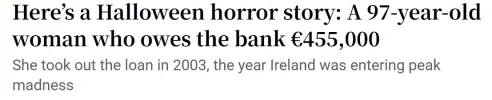
Moneymakeover Irish Times: "Life loan proves a millstone for 97 year old"

The summary is interest on interest is scary over long timeframes.
Yes.
Interest on interest transforms a horizontal straight line plot into an exponential curve.
The higher the interest rate charged, the steeper the curve.
Which is what concerns me about people saying it's OK for them to charge more than mortgage rates.
They have fixed cost tasks to do at two times only, the beginning and the end, and these costs are largely independent of the amount
loaned or the interest rate.
In our example, if they charge 5.6% the interest on interest comes out at €157,771.76.
With just a half a percent extra, it brings the company in another €37k of interest on interest
With just a full one percent extra, that rises to over €80k

The compounding effect of interest on interest should mean that people are hyper vigilant about interest rates and not saying a shur an extra 1%
sounds about right
.

I know nothing about Spry but I'd be very surprised if their rates are good value.
I mean, how often does that occur in a market with one player?
 
With Spry, the borrower can pay the interest every year without penalty.
In fact, they can pay 10% of the amount borrowed without penalty.

So it does not need to compound.

I agree that their rates are high but we have discussed already why they are high.

And if Dominic Coyle, Joe Duffy and Leper stopped their irrational demonising of these loans, mainstream lenders might well enter the market and bring the rates down and produce more flexible products.

In the UK they are offered directly by insurance companies e.g.
Aviva
Canada Life
Legal and General
 
The finance sector is still recovering from its “carry-on” leading to the recession starting 2007/8. I can’t see how the Central Bank hasn’t investigated the whole issue of so-called Life loans. From where I stand the Central Bank is falling down on the job.
 
The issue of the family is that it is none of their business frankly.
The nickname for the product was the Rathfarnham Mortgage
4 bed semis, professional children
none of whom could see that John couldn't buy a dress for his wife.
To the families I say have a whip around before Mum does it again.
 
This woman needed a Drawdown loan, which are widely avaiable in the UK. She would have got 130k, used the 30k ( on which she would have paid interest) and left the 100k in an accessible account. She would not have paid interest, on any money she didnt draw.
 
This woman needed a Drawdown loan, which are widely avaiable in the UK. She would have got 130k, used the 30k ( on which she would have paid interest) and left the 100k in an accessible account. She would not have paid interest, on any money she didnt draw.
I'm not so sure. From the Irish Times question/report it seems like she only needed €30K but she borrowed €130K for some, so far unknown, reason.
 
The issue of the family is that it is none of their business frankly.
The nickname for the product was the Rathfarnham Mortgage
4 bed semis, professional children
none of whom could see that John couldn't buy a dress for his wife.
To the families I say have a whip around before Mum does it again.

AI is a bit of help with this

In plain English, the passage means:

"The family's involvement is not appropriate. Quite frankly, it is none of their business.

The product was nicknamed the 'Rathfarnham Mortgage'.

The people involved were well-off, professional families living in four-bedroom semi-detached houses, with children. Yet none of them seemed to realise that John could not even afford to buy a dress for his wife.

My message to the families is this: they should all contribute some money to help out, rather than leaving Mum to have to do it again."

In essence: The speaker is criticising the family for failing to recognise or address John's financial difficulties. They are saying that the family should contribute financially instead of allowing the mother to bear the burden again.

The reference to a "whip around" means collecting money from a group of people, with everyone contributing what they can.
 
Whether this lady needed €130k or €30k, if she qualified she was entitled to apply. Putting €100k on deposit isn’t a red flag - some might say it’s none of the banks business.

Imagine the bank writing to regular mortgage holders to lodge their deposits against their home loans because they “don’t need the cash” and are “accruing interest on interest”.

Maybe this lady just wanted to know she could afford a private nursing home, if she needed it.

Others would say if she was turned down that the bank was being cynical and considered her “too healthy”.

The alternative to these products is forcing older people to sell their homes and move to release equity, is that preferable?

If I was cash poor but had an expensive house when I’m older, I love the idea I can release equity easily, if I wanted to.

Would this lady’s family have given her the cash she wanted? Without interest, without security?

Talk of banning the product because some find it distasteful is short sighted. Should we just ban credit cards too? Or PCP?
 
If she borrowed 25%(130k) of the house value in 2003 the house was worth 520k if I’m doing my maths right. It must be worth a hell of a lot now. It’s the nieces and nephews on the warpath now that they’re set to inherit a lot less than they thought.
My mother in laws house in Churchtown sold for 580k in 2015 and about 800k recently. It wouldn’t have been worth anything like 520k in 2003.
I worked for B of I up until 2002 and I can tell you those Life Loans weren’t pushed at all. There was no hard sell.
 
If she borrowed 25%(130k) of the house value in 2003 the house was worth 520k if I’m doing my maths right. It must be worth a hell of a lot now.
€130,000 @6% for 25 years amounts to €557k
€100,000 @1% for 25 years amounts to €128k

So the net debt could well be €455k

The limit on borrowing was 25% , so let's assume she borrowed the maximum so her home was worth 500k in 2003
Prices have risen by about 80% so her home is now worth about €900k
 
Jennifer O'Connell in the Irish Times today mentions this story.
That woman is now 97 and the lifetime loan of €130,000 has become a life-sapping debt of €455,000.
If only she hadn't lived so long..

Currently the inheritance is dropping by about €70 a day. That's simply not sustainable Jennifer!
 
The headline again demonises the product

1793438893060.webp

And 2003 was also the year a single woman aged 72 got a letter from her bank, Bank of Ireland, offering her a “lifetime loan”. These products, which had been launched to great fanfare just two years earlier, promised large sums of money offset against the value of your house which would literally only be repaid over your dead body, or after you permanently left the home. “A lifeline for cash-strapped elderly people,” one commentator wrote approvingly in another newspaper. “The borrower gets up to a third of the money in cash and the bank could get over half of the original value in interest. Of course, the property value should rise in the meantime.”

That “should”, as we now know, was doing an awful lot of heavy lifting. The woman in question only needed €30,000, but for unknown reasons she took out a loan of €130,000 anyway – back then, borrowing more than four times what you needed may have seemed practically prudent.


Here’s a Halloween horror story whose ending you already know: property prices collapsed but the interest went on accumulating. That woman is now 97 and the lifetime loan of €130,000 has become a life-sapping debt of €455,000. Someone representing her family wrote to Dominic Coyle in The Irish Times this week to describe how they have been trying to get mediation on this loan with Bank of Ireland since 2022 and have complained to the Financial Services and Pensions Ombudsman.

It really is disgraceful of the Irish Times. The property price has risen by about 80% since 2003.

"For some unknown reason" - The borrower and her nieces and nephews know the reason, but it just does suit the story to tell it.

a single woman aged 72 got a letter from her bank, Bank of Ireland, offering her a “lifetime loan”. She got a letter offering her a loan because, of her own initiative, she applied for it. It was not like the proactive marketing of credit card limits being automatically increased.
 
Last edited:
They were not proactively sold or marketed.

They were made available on application by customers.

And how did customers apply for a product they knew nothing about? How does that happen?

(BTW as you know I don't have an issue with these loans. I think they can be a good product for those that need them. I don't think the interest rate is very high, but I do think they are a last resort and I do think in some cases customers did not understand them and that they should be highly regulated, which they nowadays seem to be, I do think the 130K to the widowed elderly woman was an example of a bad case)
 
Last edited by a moderator:
Back
Top