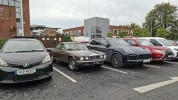
Cars for simpler times.

Of course alot of this might be to do with cars being less inspiring these days, they all look the same, complex hunks of metal, and of course the ould keeping up with jonses mentality!
I remember reading once that the reason cars all car brands started to look the same was because of the rise of consumer 'focus groups' being employed to decide on the design.
 
I'm well aware of the more exotic 80s cars, like the Opel Manta that I see driven to work every day, but @Colin4444 seems to be implying that there's plenty of Corollas, Kadetts, R5s, Uno's and 205s running about daily.
To be fair I said you see them on the roads, I nowhere implied that every second car was a 1980's car :)
 
That was on my mind recently when reviewing the market for cheap EVs (I'm but actually in the market right now, just curious). With petrol/diesel cars the rule of thumb for best value seems to have been don't buy new, buy c. 2-4 years old. But maybe it's the case with EVs that one should consider buying new?
You looking to me for advice clubman !!
Im no expert in cars by the way, the thing is that second hand reliable diesels and petrol are holding their value much more than they used to. We actually experienced second hand cars going up in value after covid, that never happened before due to supply constraints with new cars.
We saw that electric cars depreciate much faster but on the plus side you then can pick up a cheaper second hand electric car, although with expensive diesel and petrol now maybe the demand for used electrics has gone up.
Maybe when the ev industry produces better cars that are easier to fix and as the knowledge base of mechanics gets better the issue of repairing used electrics might not be as big an issue. Look how long it took the car industry to produce truly reliable diesel and petrol cars. The sweet spot for reliability was probably from 1995 to 2015 .
 
well aware of the more exotic 80s cars, like the Opel Manta that I see driven to work every day, but @Colin4444 seems to be implying that there's plenty of Corollas, Kadetts, R5s, Uno's and 205s running about daily.
The scrappage shemes from the early 2000s got rid of alot of those cars , it was reasonably generous and second hand cars were so cheap then ,alot of perfectly good cars were scrapped back then. If you are in spain or portugal or eastern europe you will still see plenty of those cars still on the road.
 
The fact that you wont see cars built in 2020, on the roads in 2050+ is a sure sign that cars are way way way less reliable.
In what sense is that a "fact"?
but these differ greater, what is the expected life of an EV v expected life of car built in 1980? You not comparing like with like..
The expected life of a car built in 1980 was 10-15 years. (Obviously, some lasted longer than that, and few may even be still on the road. We're talking averages here.) This is based on average age at scrappage, a figure which can't be calculated reliably until about 95% of the cars in question have been scrapped.

This was an improvement on the expected life of a car built in 1960, which was 10-12 years.

By 2000, expected life had pushed out to 15-20 years.

(These figures are from the US. We might have driven our cars a little longer in Ireland, because of the cost of replacing them.)

For the reason just pointed out, we can't calculate the expected life of cars built within the last 20 years or so in the same way — not enough of them have been scrapped yet. For these cars we rely on statistical projects based on scrappage rates to date, which is a technique that gives less certain results. But useful life expectancy is very unlikely to be shorter than 15-20 years; most estimates are around 20 years.

Modern EVs have a simlar expectancy to modern ICEVs. This is a dramatic improvement by comparison with earlier generations of EVs — the estimated risk of an EV leaving service declines by approximately 12% for each successive year of manufacture. This data comes from a UK study, based on an analysis of MOT test records.
 
Back
Top