Installed ours 2 years ago, very simple and not messy to get done. Have a battery and we've exported (according to the app) about half of what we generated back to the grid. Bills over the summer are €0 and have built up a credit of around €250 for the winter. We had the cash so as other posters have suggested, it can make sense when you have it as opposed to putting it into a savings account.
You are using an out of date browser. It may not display this or other websites correctly.
You should upgrade or use an alternative browser.
You should upgrade or use an alternative browser.
Are domestic solar panels financially beneficial - or just ideological?
- Thread starter Windsor23
- Start date
- Status
- Not open for further replies.
Wow. The EAB is based on usage of 4,200 kWh.we use over 20k kwh per annum
Are you running a farm or a grow house or something?
|
|
|
|
| |||||
| 7,236 | 67% |
|
| |||||
| 3,514 | 33% |
|
| |||||
| Totals | 10,750 |
|
Debating about installing a 8kw unit. Looking on line it states for my location I should generate 6,000 to 9,000
So my thinking is that if it generated 6,000 and that covered 66% of my day time usage (Allowing for days with very little generation) = 2320 Units That would save me €598. Then I could sell back the balance of the 6,000 Generated = 3,680 to the grid at 20c = €736. So total savings = €1,334
55% Of my saving is dependent on the Utility Company / Government paying me 20c a unit - What are peoples thought on this continuing at this rate?
CharlieMac
Registered User
- Messages
- 514
In time the feedback tariff will be greatly reduced and possibly abolished entirely.
Longer term the ideal approach will be to have as many panels as possible and a decent sized battery and configure your life around using all your own generated energy... directly fom the panels and off your battery storage.
Longer term the ideal approach will be to have as many panels as possible and a decent sized battery and configure your life around using all your own generated energy... directly fom the panels and off your battery storage.
Funny you should mention that, a few years ago the guards appeared for some unknown reason during a power cut and went out of their way to have a good look around the place.Wow. The EAB is based on usage of 4,200 kWh.
Are you running a farm or a grow house or something?
House design means there is a lot of air to heat and despite an A2 BER, air tightness is not the best so heating not as efficient as it could be.
Volume of house would be probably 3 or 4 times the average a semi d, house is in a very exposed area, 3 teenagers having showers a lot and charging an EV doing decent mileage means it all adds up, definitely some vampire electronic stuff around the place too
Hey @CharlieMac
Why do you understand the Clean Export Guarantee (you referred to it as feedback tariff) will be “greatly reduced and possibly abolished entirely”. I’ve seen nothing out there to support that contention.
We’ve had solar panels for over three years now. Initially a 4kWp set up but we increased it to 5.75kWp in February. Very, very happy with it all financially and environmentally.
g
It's happened in so many other countries once they achieved a certain saturation of micro generation. It's highly unlikely Ireland would be an outlier there.Why do you understand the Clean Export Guarantee (you referred to it as feedback tariff) will be “greatly reduced and possibly abolished entirely”. I’ve seen nothing out there to support that contention.
Some countries have gone further now and enforce curtailment when they have surplus local or cheaper supply options. If and when that happens having a battery storage option will become even more compelling.
CharlieMac
Registered User
- Messages
- 514
These export incentives are not sustainable for the energy companies especially as wholesale energy prices fall. As adoption increases there will be less need to incentivise people to get on the solar bandwagon as it can already make sense to have solar without any export payment.
I could see a case for some level of export payment as an electrical grid load balancer. I just think it's foolish to build a case for getting solar on the existence of export rates, certainly at today's rates.
I could see a case for some level of export payment as an electrical grid load balancer. I just think it's foolish to build a case for getting solar on the existence of export rates, certainly at today's rates.
t's happened in so many other countries once they achieved a certain saturation of micro generation. It's highly unlikely Ireland would be an outlier there.
Some countries have gone further now and enforce curtailment when they have surplus local or cheaper supply options. If and when that happens having a battery storage option will become even more compelling.
The government could (and probably will) start by removing the €400 tax exemption on small-scale microgeneraton sales. (It's due to end in December in any case and without the Greens in government it may not be extended.)
Annieindublin
Registered User
- Messages
- 1,104
I wish we could fit them on our apartment block, it might help with the bills for the lights, lifts and gates. And the fountain in the pond. We have a lot of sunny rooftops.
I asked at the AGM and was told it wasn’t permitted. I may look further into why not at some point.
I asked at the AGM and was told it wasn’t permitted. I may look further into why not at some point.
Read a forum post somewhere on this before, apparently management companies are restricted on multi-year investments like this - maybe it’s a borrowing limitation, therefore they’d have to raise capital equitably from the residents… good luck with that unless it’s a very small, tight-knit group of residents, each with the means to invest.I asked at the AGM and was told it wasn’t permitted. I may look further into why not at some point.
Mostly of these have come with dynamic feed-in tariffs too though, so export at peak loads is highly valued. Either way a battery is essential, whether self-consumption or export is the more beneficial.It's happened in so many other countries once they achieved a certain saturation of micro generation. It's highly unlikely Ireland would be an outlier there.
I saw on LinkedIn recently that Energia have been over to visit Octopus about their Kraken system, which is built for precisely this purpose.
This should be at the top of every page on this site.you need to do the maths though to see if it makes sense.for you
My first thought would be to price a system with a battery and to run numbers for that too.What are peoples thought on this continuing at this rate?
the fact that you don't seem to be able to store any excess electricity going forward.
Or an EV in some cases...You can with a battery option.

Vehicle-to-grid - Wikipedia
For anyone approaching retirement age (I’m not saying you are, btw!Debating about installing a 8kw unit.
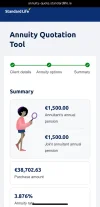
 ), this is one way to think of it….. an inflation-adjusting, 100% dual life, €1500pa annuity would cost nearly €39k. Or you could drop about €12k on solar+battery and it should last the 30 years to age 95. Remember, most of these components are guaranteed to produce 80% of initial output after 20/25 years, they don’t fail at that stage. Even accounting for an inverter replacement at some point (3k or so), it’s still awesome value compared to an annuity.
Attachments
The government could (and probably will) start by removing the €400 tax exemption on small-scale microgeneraton sales. (It's due to end in December in any case and without the Greens in government it may not be extended.)
I missed this, so maybe others did too:
Budget 2026 extended the tax exemption of certain profits of micro-generation of electricity for a further three years to 31 December 2028. The exemption is €400 but ... "where more than one individual is named on the electricity bill each individual can avail of the exemption i.e. the exemption is not split between them."
The relevant part of the Tax and Duty Manual* has yet to be updated.
* https://www.revenue.ie/en/tax-profe...ains-tax-corporation-tax/part-07/07-01-44.pdf
So beautifulextended the tax exemption of certain profits of micro-generation of electricity for a further three years to 31 December 2028
Mothergoose
Registered User
- Messages
- 226
I can say that they are very beneficial with a south facing roof. I have two properties with them. One is south facing and my payment last year from the exporting it was 700 - I know I will have to pay tax on this. I had no electricity bill at all. I have a battery and get night right also, but basically I heated the house through the day with just an Everhot electric stove downstairs - after 9.00 a.m. when it was light. Did all my washing cooking during daylight hours. I only used my gas for one hour a day in the evening. However, one of my children lives in another house I own, and the panels there are east west - it goes 40% or thereabouts towards my electricity during the winter months, but in summer, April to end September covers all the electricity and heats the water all day. Prior to getting solar panels in this house we would have to heat the water with the gas in the summer as this was cheapest.
Is that actually the case? Is this considered income and assessable for income tax etc.?One is south facing and my payment last year from the exporting it was 700 - I know I will have to pay tax on this.
What about standing charges and PSO levy?I had no electricity bill at all.
- Status
- Not open for further replies.